


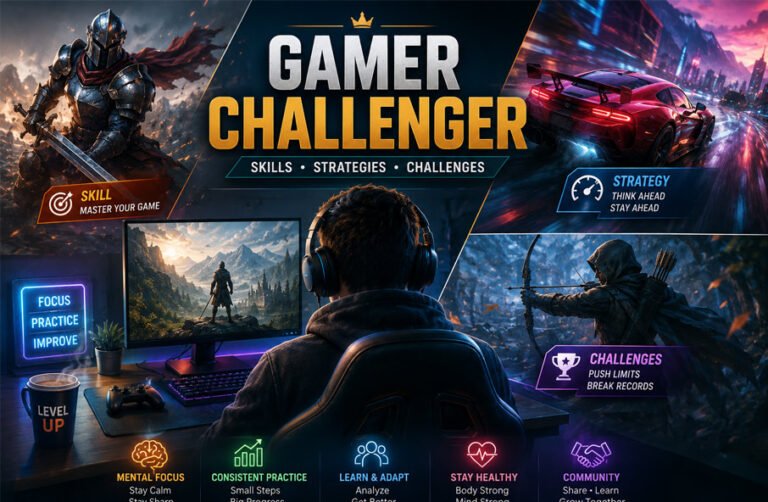
A Gamer Challenger is a player who looks for ways to make gaming more difficult, competitive, or skill-based. Instead of only finishing a game, these players often create extra goals such as speedruns, no-death runs, limited-equipment challenges, or higher competitive ranks.
People search for Gamer Challenger to understand what the term means, what skills are needed, and how this style of gaming is different from normal play or esports. This guide explains the Gamer Challenger mindset, important skills, useful strategies, practice methods, and the most common types of gaming challenges.
What Is a Gamer Challenger?
A Gamer Challenger is generally a player who goes beyond the normal goals of a game. Instead of simply completing the story, winning matches, or reaching the end, the player creates harder rules or objectives.
The term is better understood as a gaming approach or mindset than an official title. A Gamer Challenger may try to improve a personal record, reach a higher competitive level, complete a difficult challenge, or master a specific game mechanic.
For example, someone may try to complete a game without dying, finish a level without taking damage, use only basic weapons, or beat a game as quickly as possible. Some players even use unusual control methods or remove features that normally make the game easier. These kinds of self-imposed goals are an important part of the Gamer Challenger idea.
A Gamer Challenger does not have to be a professional player. Someone can follow this approach in single-player games, multiplayer games, competitive titles, RPGs, shooters, platformers, racing games, and many other genres.
It is also important not to confuse the general term with Challenger rank. Some competitive games use Challenger as the name of a specific high-level rank. That is different from the broader Gamer Challenger concept discussed here.
Gamer Challenger vs Esports Player
A Gamer Challenger and an esports player can share many of the same skills, but they are not exactly the same.
An esports player normally takes part in organized competition. This may include official tournaments, leagues, ranked teams, professional organizations, or prize-based events. Their main goal is usually to perform well against other players under formal competitive rules.
A Gamer Challenger has a wider focus. The player may compete against others, but they may also compete against their own previous performance, a game timer, or a difficult set of self-created rules.
For example, a speedrunner trying to beat a personal record may be a Gamer Challenger without taking part in esports. The same applies to someone attempting a no-damage run or completing an RPG without using healing items.
There can still be overlap. An esports player may use Gamer Challenger methods to improve accuracy, decision-making, map knowledge, or consistency. A Gamer Challenger may also move into tournament play later.
The main difference is that esports normally involves structured competition, while Gamer Challenger can also include personal challenges outside official tournaments.
The Gamer Challenger Mindset
The Gamer Challenger mindset is based on improvement. Winning matters, but it is not always the only goal.
A player following this approach looks at mistakes and tries to understand why they happened. If a challenge fails, the player may review the attempt, change the strategy, and try again.
Confidence is also useful, especially during difficult matches or high-pressure moments. However, confidence should come from preparation and experience rather than careless play.
Another important part of the mindset is setting realistic goals. A player may first try to complete one difficult level without dying before attempting an entire no-death playthrough. Smaller goals make progress easier to measure.
Feedback can also help. Watching replays, listening to experienced players, or asking others to review gameplay can show problems that may be difficult to notice while playing.
The source material describes Gamer Challenger as an attitude built around new rules, limits, goals, learning from setbacks, and continuous improvement.
Patience is important as well. Some challenges can take dozens or even hundreds of attempts. Players should know when to stop, take a break, or reduce the difficulty if gaming becomes frustrating instead of enjoyable.
Important Skills for a Gamer Challenger
Different games require different abilities, but several skills are useful across many types of competitive and challenge-based gaming.
Reaction time matters in fast games where players must respond quickly to opponents, attacks, or environmental changes. Accuracy is especially important in shooters, fighting games, and titles that require precise movement.
Timing is another major skill. A player may need to know exactly when to attack, block, dodge, jump, use an ability, or move to a different position.
Game knowledge is just as important as mechanical skill. A strong player learns how enemies behave, how maps are designed, where resources appear, and which actions give the best results in different situations.
Decision-making also becomes important under pressure. Players often have only a few seconds to choose whether to attack, defend, retreat, save resources, or change position.
Other useful skills include map awareness, movement control, pattern recognition, resource management, communication, teamwork, and the ability to adapt when an opponent changes strategy.
Not every Gamer Challenger needs all of these skills. A speedrunner may focus heavily on movement, routing, and timing, while a competitive team player may need stronger communication and map awareness.
Strategies for Improving Your Gameplay
Improvement is easier when practice has a clear purpose. Playing for many hours does not always lead to better results if the same mistakes are repeated.
One useful strategy is to study opponents. Players can look for patterns such as aggressive pushes, defensive positions, repeated attacks, or common movements. Recognizing these habits can make the next action easier to predict.
Map knowledge is also important. Competitive players should understand useful positions, sightlines, objectives, escape routes, and resource locations. In single-player games, understanding enemy placement and level design can make difficult challenge runs more consistent.
Planning ahead can also improve results. Instead of thinking only about the current fight or objective, a player can consider what may happen after it. This is especially useful in strategy games, MOBAs, shooters, and competitive team games.
Watching skilled players can help as well. Tutorials, match reviews, and professional gameplay can show new techniques. However, players should understand why a strategy works instead of copying it without considering the situation.
Game updates can also change strategies. Weapons, characters, maps, abilities, and game systems may be adjusted over time, so competitive players sometimes need to change their approach.
Visualization and Mental Preparation
Visualization means mentally preparing for a difficult situation before it happens.
A player may think through a route, boss fight, match opening, difficult movement sequence, or expected opponent response. The goal is to become more familiar with possible actions before attempting them.
The source material recommends mental rehearsal as one way to prepare for difficult gaming situations.
Visualization should not be treated as a guaranteed way to improve performance. It works best as a supporting practice alongside real gameplay, review, and repetition.
Purposeful Practice
Purposeful practice means choosing one specific area to improve instead of simply playing without a goal.
For example, a shooter player may practice recoil control or aiming. A MOBA player may work on last-hitting. A speedrunner may repeat one difficult section until the route becomes more consistent.
Players can also review recorded gameplay or built-in replays. This makes it easier to spot missed opportunities, poor positioning, slow reactions, or repeated mistakes.
The source recommends identifying weak areas, analyzing replays, and using consistent focused practice rather than relying only on long and unfocused gaming sessions.
Simple goals can make practice easier to measure. Instead of saying “I want to get better,” a player could aim to improve accuracy, reduce mistakes in a certain section, or finish a route several seconds faster.
Popular Types of Gaming Challenges
Gaming challenges can take many forms. Some focus on speed, while others make the game harder by removing weapons, upgrades, healing, or other useful mechanics.
Speed Challenges
A speed challenge usually involves completing a game, level, mission, or objective as quickly as possible.
Speedrunning is the best-known example. Players study routes, movement techniques, shortcuts, enemy locations, and game mechanics to reduce completion time.
Improvement often comes from repeating small sections and finding places where time can be saved. Some speedrunners compete against official records, while others simply try to beat their own previous time.
No-Death and No-Damage Challenges
A no-death challenge requires the player to complete a selected part of a game, or sometimes the entire game, without dying.
A no-damage challenge is even stricter because the player tries to avoid taking any damage.
These challenges require strong knowledge of enemies, attack patterns, level design, and safe strategies. They also require consistency because one mistake can end a long attempt.
Minimalist Challenges
Minimalist challenges limit the tools available to the player.
Someone may complete a game using only basic weapons, avoid upgrades, use starter equipment, or limit the amount of resources they can collect.
Removing powerful items forces the player to depend more heavily on timing, movement, knowledge, and strategy.
Restriction-Based Challenges
Restriction-based challenges remove one or more normal game mechanics.
For example, a player may avoid healing items, refuse to use a certain weapon, stop using a powerful ability, or complete a section without jumping when the game allows it.
The rules are normally created by the player or community before the attempt begins.
Creative Challenges
Creative challenges are less focused on traditional difficulty and more focused on unusual ways of playing.
Examples include completing an RPG without attacking enemies where possible, using an unusual character build, creating a specific structure in a sandbox game, or playing with an unconventional controller.
The collected source groups gaming challenges into minimalist, speed, no-death, creative, and restriction-based formats.
There is no single official list of Gamer Challenger activities. Players and communities can create new rules as long as the goal is clear and the challenge can reasonably be completed.
Gaming Equipment: What Do You Really Need?
A Gamer Challenger does not need an expensive setup to improve. Skill, practice, game knowledge, and good decisions usually matter more than buying premium hardware.
Better equipment can still help in some games. A high-refresh-rate monitor, such as a 144Hz display, can make fast movement look smoother. A responsive gaming mouse or keyboard can also reduce input delay and make controls feel more precise.
The best setup depends on the game. A competitive shooter player may care more about mouse accuracy and monitor refresh rate. A racing player may prefer a controller or steering setup. A fighting-game player may use a standard controller or arcade-style device.
Audio can also matter in games where footsteps, direction, or other sound details are important. A reliable headset or headphones can make these sounds easier to notice.
For online multiplayer games, a stable internet connection is also useful. Connection problems can cause lag, delays, or disconnections even when the computer or console is powerful.
Comfort should not be ignored. A suitable chair, desk height, monitor position, and enough space for the keyboard or mouse can reduce discomfort during longer sessions.
The important point is that equipment should support the player. It cannot replace practice or strategy. The collected source also makes this distinction, noting that high-quality equipment can help while mindset and practice remain more important.
Physical and Mental Health for Gamers
Physical condition can affect concentration during gaming. Long sessions without breaks may lead to tiredness, discomfort, or reduced attention.
Regular movement and exercise can help players avoid sitting in one position for too long. The source also connects exercise, balanced food, and enough sleep with better focus and gaming performance.
Sleep is especially important before difficult competitive sessions. Being tired can make it harder to react quickly, stay focused, or make good decisions.
Players should also pay attention to posture. The monitor should be placed at a comfortable viewing height, and the keyboard, mouse, or controller should be easy to reach without unnecessary strain.
Short breaks are useful during long practice sessions. Players can stand up, stretch, drink water, and give their eyes and hands some rest.
Mental health matters as well. Competitive games and difficult challenge runs can become frustrating after repeated failures. Taking a break can be more useful than continuing while angry or tired.
A Gamer Challenger should treat improvement as a goal, not as a reason to ignore sleep, work, study, relationships, or other daily responsibilities.
Learning From the Gaming Community
Gaming communities can help players learn faster because they provide access to guides, discussions, examples, and feedback.
YouTube is useful for tutorials, strategy guides, speedruns, walkthroughs, and match reviews. Watching skilled players can show better routes, positioning, timing, or decision-making.
Twitch gives players a chance to watch gameplay live. This can be useful when trying to understand how experienced players react to changing situations.
Discord communities are often focused on individual games. Players may find teammates, ask questions, discuss strategies, or share challenge ideas there.
Reddit can also be useful for game-specific discussions, challenge-run communities, and feedback. The collected source identifies Twitch, YouTube, Discord, and Reddit as common platforms for learning from other gamers.
Community advice should still be checked carefully. A strategy may be outdated after a game update, or it may work only for a specific skill level, character, map, or game version.
The most useful approach is to compare advice with personal experience and current game information.
Benefits of Taking on Gaming Challenges
Gaming challenges can give players new goals after they understand or complete the normal content of a game.
They can also help reveal weaknesses. A no-death run may show that a player struggles with certain enemies. A speedrun may reveal slow movement or poor route planning. Competitive rank goals may highlight problems with positioning or decision-making.
Challenges can also encourage players to learn game mechanics in more detail. When equipment, healing, upgrades, or other tools are limited, players often need to understand timing and strategy more carefully.
Another benefit is measurable progress. A player may compare completion times, number of mistakes, rank changes, accuracy, or success rates between practice sessions.
Creative challenges can also change the way a familiar game feels. Playing with unusual restrictions or goals may create a different experience without requiring a new game.
For some players, challenge runs also provide a reason to join communities, share results, discuss strategies, or learn from other people attempting the same objective.
These benefits depend on how the challenge is used. A challenge should support learning or enjoyment rather than become an unhealthy source of pressure.
Drawbacks and Challenges
Gamer Challenger activities also have limitations.
Some difficult challenges require many repeated attempts. This can take a lot of time and may become frustrating, especially when one small mistake ends a long run.
Competitive gaming can also create pressure. Players who focus too much on rank, records, or winning may enjoy the game less.
Long practice sessions may cause tiredness or physical discomfort. Poor posture and too little rest can make the problem worse.
Equipment can become another concern. Players sometimes feel that they need expensive monitors, keyboards, mice, controllers, or other accessories. Better equipment may help in some situations, but constantly upgrading hardware is not necessary for most personal gaming challenges.
Online multiplayer games can also expose players to rude or toxic behavior from other users. Muting, reporting, or leaving harmful interactions may be necessary.
Game updates can create another difficulty. A patch may change a character, weapon, map, route, or game mechanic. Strategies that worked before the update may no longer be as effective.
The main drawback is not the challenge itself. Problems usually appear when gaming becomes unbalanced, overly stressful, or too important compared with everyday responsibilities.
How to Become a Gamer Challenger
The easiest way to begin is to choose a game you already know and enjoy.
Start with one clear goal. A beginner might try to move up one competitive rank, complete a level without taking damage, improve a personal completion time, or finish an area without using healing.
The goal should be specific enough to measure. “Get better at the game” is difficult to track. “Complete this level without dying” is much clearer.
Set the rules before starting the challenge. If certain weapons, upgrades, items, or abilities are not allowed, decide that before the attempt begins.
Practice the skills connected to the goal. A player trying to improve a speedrun should work on routing and execution. Someone trying to improve competitive rank may need to focus on positioning, accuracy, communication, or decision-making.
Review failed attempts when possible. Replays or recorded gameplay can show where mistakes happen.
Increase the difficulty slowly. A player does not need to begin with an entire no-death game run. Completing one level or boss without dying can be a better first goal.
The collected source recommends beginning with a game you enjoy and choosing a small target, such as improving one rank division or completing a level without taking damage.
Learning from other players can also help, but progress should remain realistic. Taking breaks and changing goals when necessary are part of a healthy approach.
Gamer Challenger Websites and Name Confusion
The phrase Gamer Challenger can be confusing because websites also use the same or a very similar name.
During our research, gamerchallenger.com and gamerchallenger.pro appeared as separate websites with different content and purposes. There was not enough reliable evidence to confirm that they are operated by the same company.
The .com website mainly presents material related to the Gamer Challenger idea and gaming improvement. It has also displayed details that describe an Android offering, including a version number, file size, developer name, worldwide availability, and Android support.
However, those app details were presented by the site itself. Our research did not find enough independent evidence to confirm a verified Google Play listing, package information, developer identity, or full release history. Readers should therefore treat those details as website claims rather than independently confirmed facts.
gamerchallenger.pro presents itself differently. It operates as a browser-game website where users can choose games and play through a web browser.
According to the information shown on that site during our research, it offers categories such as arcade, racing, puzzle, shooter, survival, endless-runner, tower-defense, and 3D games. It states that registration and software installation are not required for normal gameplay.
The .pro site also describes its service as free and advertising-supported. Its published privacy information says it may still process normal technical and browsing data such as IP address, device information, browser details, visited pages, and interactions.
These website services should not be confused with the broader meaning of Gamer Challenger explained in this guide.
The safest approach is to evaluate each website separately. A similar name does not prove shared ownership, and promotional claims should not be treated as confirmed facts without outside evidence.
Bottom Line
A Gamer Challenger is best understood as a player who uses difficult goals, self-imposed rules, practice, and strategy to improve their gaming skills.
The idea can include speedruns, no-death runs, minimalist play, creative restrictions, competitive rank goals, and many other challenges. A player does not need to become a professional esports competitor or buy expensive equipment to follow this approach.
Good practice habits, realistic goals, game knowledge, feedback, and a balanced routine are more useful than simply playing for long hours.
Readers should also remember that websites using the Gamer Challenger name are separate from the general gaming concept. Their features, ownership, safety, and claims should be checked individually.
Frequently Asked Questions
What does Gamer Challenger mean?
A Gamer Challenger is generally a player who pushes beyond normal game objectives by setting harder goals, improving specific skills, or creating personal gaming challenges.
Examples include speedruns, no-death runs, limited-equipment runs, and competitive improvement goals.
Is Gamer Challenger an official gaming rank?
Not in the general meaning used in this guide.
Some games have a rank called Challenger, but that is a game-specific ranking system. The broader Gamer Challenger term describes a style of gaming and improvement rather than one official rank used across all games.
Is a Gamer Challenger the same as an esports player?
No. An esports player normally competes in organized tournaments, leagues, or other formal competitions.
A Gamer Challenger may compete in esports, but they may also focus only on personal challenges such as speedruns or no-damage runs.
What are some popular Gamer Challenger challenges?
Common examples include speedruns, no-death runs, no-damage runs, minimalist challenges, creative challenges, and restriction-based runs.
Players may also create their own rules based on the game they are playing.
Do you need expensive gaming equipment?
No. Good equipment can improve comfort, responsiveness, or visual smoothness, but it is not required.
Practice, strategy, consistency, and game knowledge are usually more important for developing skill.
How can beginners become Gamer Challengers?
Start with a familiar game and choose one simple challenge.
For example, try completing one level without dying, improving your best time, increasing your rank by one division, or practicing one weak game mechanic.
Once the goal becomes manageable, increase the difficulty gradually.
Where can Gamer Challengers learn new strategies?
YouTube, Twitch, Discord, Reddit, game-specific forums, and official or community guides can all be useful.
Players can watch skilled gamers, study tutorials, discuss strategies, find teammates, and ask for feedback.
Are GamerChallenger.com and GamerChallenger.pro the same?
There is not enough reliable evidence from our research to confirm that the two websites are operated by the same company.
They also present different services. gamerchallenger.com focuses more on Gamer Challenger-related information and makes claims about an Android offering, while gamerchallenger.pro presents itself mainly as a free browser-game platform.
They should therefore be treated as separate websites unless reliable ownership information proves otherwise.
More To Explore:
Hypackel Games Review: How It Works, Features, Safety, and More
