

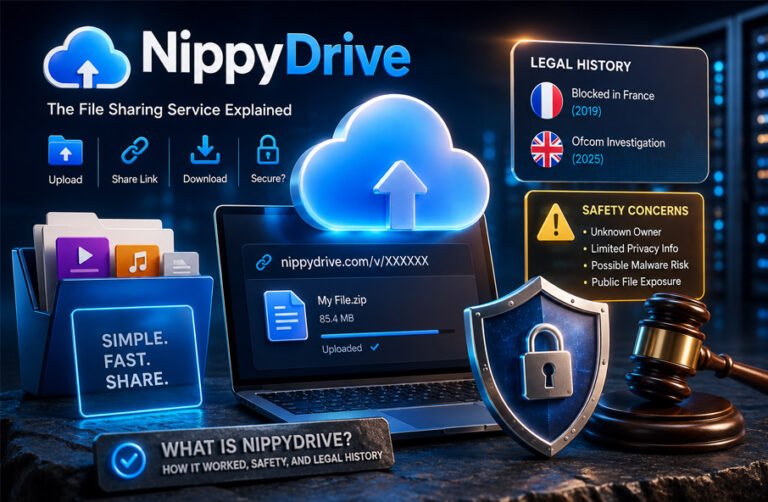
NippyDrive was an online file-hosting and file-sharing service. It allowed people to upload files and share them with others through web links. The service operated mainly through the nippydrive.com domain.
People still search for NippyDrive because they may find old NippyDrive links, want to know whether the website still works, or have questions about its safety and privacy. NippyDrive was not the same type of service as Google Drive or Dropbox. It worked more like a simple file host made for quick uploads and downloads.
This article explains what NippyDrive was, how it worked, its known features, its safety and privacy concerns, its legal history, and what happened to the service.
What Is NippyDrive?
NippyDrive was a simple online service for storing a file on the web and giving other people a link to access it.
Historical versions of the website used descriptions such as “Cloud File Sharing” and later “Cloud Storage.” However, NippyDrive did not appear to work like a full modern cloud workspace.
Services such as Google Drive and Microsoft OneDrive are built around user accounts, folders, document editing, syncing, backups, sharing permissions, and long-term storage. NippyDrive was much simpler. Its main job was to let a person upload a file and give others a way to download or open it.
Because of this, NippyDrive is better understood as a file host or cyberlocker rather than a complete business cloud-storage platform.
People reportedly used it to share different types of digital files, including music, videos, archives, and documents.
How NippyDrive Worked
NippyDrive worked mainly through a web browser. Users did not need special desktop software just to reach the upload page.
A person could choose a file from their device and send it to the NippyDrive server. Historical information reports a maximum combined upload size of 100 MB.
After the upload finished, the website created a web address for the file. Historical links reportedly followed a format similar to:
nippydrive.com/v/xxxxxx
The uploader could then copy that address and send it to other people through email, social media, online forums, or messaging apps.
Anyone who had access to the link could open the file page. Depending on the type of content, users could download the file or sometimes play supported media directly from the page.
There is no strong historical evidence showing that users always needed an account for basic uploads or downloads. The simple upload design suggests that some normal use may have worked without detailed registration. However, this should not be treated as fully confirmed because reliable account documentation is limited.
Public sharing also had an important weakness. If someone posted a file link on a public forum or social network, the uploader could lose control over who received it. The link could then be copied and shared again by other users.
NippyDrive Features
NippyDrive had a small set of features focused mainly on uploading and sharing files.
Browser-Based File Uploads
Users could upload files directly through a web page. This made the service easy to access from a computer with a compatible browser.
There is no reliable evidence showing that users needed to install a special NippyDrive application before uploading normal files.
100 MB Upload Limit
Historical information reports that users could upload files with a maximum combined size of 100 MB.
This limit was small compared with modern cloud-storage services. It also supports the idea that NippyDrive was mainly designed for quick file sharing rather than storing large personal collections or business backups.
Shareable File Links
After uploading a file, NippyDrive created a web address that could be shared with other people.
This was one of the main reasons to use the service. Instead of sending a file directly through email, a person could upload it once and then send the NippyDrive link.
File Names and Sizes
Historical NippyDrive pages could show information such as the uploaded file name and its size.
This helped visitors understand what they were about to open or download. However, showing file information publicly could also create privacy concerns if the file name contained personal or sensitive details.
Recent and Popular Files
Historical versions of NippyDrive reportedly included sections showing recent or popular uploads.
This meant that some uploaded material could become easier for other visitors to discover. NippyDrive therefore was not always limited to private one-to-one sharing.
Users needed to understand that putting a file on a public file host could make it available to a wider audience than expected.
Simple Web Access
NippyDrive focused on simple web access rather than complicated file management.
Its main tools were built around uploading, opening, downloading, and sharing files. There is no strong evidence that the historical service offered the same folder management, teamwork tools, or document editing found in modern cloud platforms.
Features That Cannot Be Confirmed
Many newer websites describe NippyDrive as a powerful cloud-storage platform with advanced business tools. These claims do not match the stronger historical evidence we have.
There is no dependable official information confirming that NippyDrive offered a permanent 15 GB free storage plan, paid plans from 100 GB to 2 TB, unlimited business storage, family plans, or enterprise subscriptions.
There is also no reliable proof of official Windows, macOS, Android, or iOS apps.
Other claims that remain unconfirmed include automatic device syncing, offline file access, real-time document editing, team folders, file version history, advanced recovery tools, password-protected links, expiring links, API access, automatic backups, and connections with business software.
Some articles also claim that NippyDrive used AES-256 encryption, end-to-end encryption, two-factor authentication, private encryption keys, advanced malware detection, and detailed security logs. Reliable historical documents have not confirmed these features.
For this reason, NippyDrive should not be described as an advanced Google Drive or Dropbox competitor without strong evidence.
NippyDrive History and Ownership
The nippydrive.com domain was created on June 2, 2014.
Website records show that the service was active during the years that followed. Some reports also indicate that individual NippyDrive file pages could still be reached during 2024.
The exact date when the full service first became available is less clear. Historical records point to activity by around 2015, but there is no well-documented official launch announcement.
The person who created or operated NippyDrive has never been clearly confirmed.
There is no reliable public record identifying a verified founder, chief executive, management team, company headquarters, or office address connected with the service.
Domain registration information also used privacy protection. This means the public registration record did not clearly show the real person or company controlling the website.
A privacy company listed in a domain record should not be treated as the actual owner of NippyDrive. Privacy services are commonly used to hide personal registration details from public WHOIS records.
Because of the lack of clear company information, it is difficult to know exactly who was responsible for operating the service.
NippyDrive and Other Nippy File Hosts
Several other file-hosting websites used similar names, including NippyShare, NippySpace, NippyBox, and NippyFile.
These websites had similar naming and were connected with the same general type of file-sharing activity. Some of them also appeared together in legal and regulatory records.
Their similarities suggest that they were closely related in some way. However, there is no reliable public company document proving that every Nippy-branded file host had exactly the same owner.
For accuracy, they are best described as related or associated file-hosting services rather than confirmed products of one known company.
Was NippyDrive Safe?
There is not enough reliable information to say that NippyDrive was completely safe.
One important point is the difference between website security and file safety.
Historical versions of NippyDrive used HTTPS. HTTPS helps protect information while it moves between a user’s browser and the website. It makes it harder for someone on the network to read the connection.
However, HTTPS does not prove that a file stored on the website is safe.
NippyDrive hosted files uploaded by users. If an unknown person uploaded harmful software, a misleading file, or another unsafe download, HTTPS would not make that file harmless.
There is no dependable historical evidence showing that every NippyDrive upload went through a strong malware or antivirus check before being made available.
This means users needed to be careful when opening files from unknown uploaders.
A file name could also be misleading. For example, a download could appear to be a normal document, video, or archive while containing something different.
That does not mean every NippyDrive file was harmful. Many users may have used the service for normal file sharing. The problem is that there is not enough information about the platform’s checking and moderation systems to guarantee the safety of every download.
NippyDrive Privacy and Security
NippyDrive also had several unanswered privacy questions.
Reliable historical documents do not clearly explain how uploaded files were protected after reaching the company’s servers.
There is no confirmed information showing whether NippyDrive used encryption at rest. There is also no strong proof that the historical service used true end-to-end encryption.
These are different from HTTPS. HTTPS protects information during transfer. Encryption at rest protects stored information on the server. End-to-end encryption is designed so that only the intended users can read the data.
NippyDrive’s historical security system is not documented well enough to confirm these protections.
It is also unclear how long uploaded files stayed on the service. Reliable information about automatic deletion, permanent deletion, inactive files, and backup copies is limited.
The physical location of NippyDrive’s stored data was also not clearly explained to users. There is no dependable public information showing where all servers were located or which staff members could access stored files.
Other areas that remain unclear include account recovery, user activity logs, data sharing with third parties, and the handling of deleted files.
These missing details matter when someone is storing private information.
Sensitive files such as identity documents, financial records, private photographs, customer information, legal documents, or confidential business files should normally be stored with a provider that clearly explains its ownership, encryption, privacy rules, deletion process, and support options.
NippyDrive did not leave enough reliable public information to confirm those protections.
NippyDrive Copyright Case in France
NippyDrive faced an important copyright case in France in 2019.
A French music producers’ group took legal action because copyrighted songs were being shared through NippyDrive and other file-hosting websites without permission.
The case involved several related domains, including NippyDrive, NippyShare, NippySpace, NippyBox, NippyFile, and other file-sharing services.
A Paris court ordered major French internet providers to block access to these websites for a period reported as 18 months.
The case showed that copyrighted music was available through NippyDrive. However, this did not mean that every file on the service was illegal. Many file-hosting websites can be used for normal and legal file sharing. The problem starts when users upload or share protected content without permission.
The case also showed one of the main problems with open file-sharing websites. When users can upload files easily and share them publicly, copyright control becomes harder. Clear reporting systems, fast removal of illegal material, and active moderation become important.
Ofcom Investigation in the UK
NippyDrive later faced another legal and safety issue in the United Kingdom.
On June 10, 2025, Ofcom opened a formal investigation involving NippyDrive and several other file-sharing and file-storage services.
Ofcom is the UK regulator responsible for communications and online safety rules.
The investigation was part of a wider programme looking at whether file-sharing services were taking proper steps to deal with illegal content.
Ofcom had received complaints about the possible sharing of child sexual abuse material through some file-sharing services. It then examined whether the providers were following their duties under the Online Safety Act 2023.
Ofcom looked at several issues.
One issue was whether NippyDrive had properly answered a legal information request. Ofcom reportedly sent the request on April 1, 2025, with a deadline of May 1, 2025.
The regulator also examined whether the service had completed and kept a suitable illegal-content risk assessment.
Another question was whether NippyDrive had proper safety measures in place to reduce the risk of users finding or sharing illegal content.
It is important to understand that opening an investigation does not automatically prove that a company broke the law. An investigation is used to collect information and decide whether further action is needed.
Why Ofcom Closed the Investigation
NippyDrive became unavailable to UK users after the investigation started.
Reports indicate that access was blocked in the UK around the middle of June 2025.
Ofcom later closed its investigation into NippyDrive on October 13, 2025.
The main reason was that the service was no longer available to UK users, so continuing the investigation was no longer considered a priority at that time.
The closure should not be understood as a full clearance of every concern.
Ofcom did not say that all questions about the service had been solved. There was also no confirmed final financial penalty or complete breach finding against NippyDrive in that closed case.
The regulator kept the option to look at the service again if conditions changed.
Was NippyDrive Legal?
NippyDrive cannot simply be called a legal or illegal website.
File hosting itself is legal. Many people and businesses use online file-sharing services every day for normal purposes.
The legal problem depends mainly on how the service is used and how the operator deals with unlawful content.
For example, sharing your own document, video, photo, or software file can be perfectly legal.
Uploading copyrighted music, movies, books, software, or other protected content without permission may break copyright law.
NippyDrive became involved in copyright action in France because protected music was being shared through the service.
The UK Ofcom case involved different concerns. It focused on online safety rules, illegal-content risk assessments, information requests, and safety measures.
These two cases show that a file-hosting service can face different legal problems in different countries.
The correct way to describe NippyDrive is that it was a file-sharing platform that faced important copyright and online-safety action. Calling the entire website illegal would be too simple and could be misleading.
Is NippyDrive Still Working?
The original NippyDrive file-hosting service does not appear to be working normally in 2026.
The nippydrive.com domain may still exist or remain registered, but a registered domain does not mean that the old service is active.
A domain can remain registered even when the original website has closed. It may be kept for protection, advertising, resale, or future use.
Available information does not show a working return of the old NippyDrive uploader.
There is also no verified relaunch announcement, new support centre, official product page, or company statement confirming that the original service has returned.
For this reason, old NippyDrive links should not be trusted as a way to recover important files.
If someone needs an old file that was once shared through NippyDrive, better places to check include an original computer or phone, an old backup, an email attachment, a private message, or another cloud-storage account.
Is NippyDrive.net the Same Service?
No reliable evidence shows that nippydrive.net is the same service as the old NippyDrive file host.
The historical file-sharing platform was connected with nippydrive.com.
The website using nippydrive.net presents itself as a site about cars, driving, reviews, and related information.
It should therefore not be treated as a confirmed replacement or relaunch of the old NippyDrive service.
Similar domain names can belong to completely different websites. Readers should always check the domain carefully before assuming two services are connected.
NippyDrive Alternatives
Because the original NippyDrive service no longer appears to work normally, users who need online storage or file sharing should use an active service with clear privacy rules, support, and ownership information.
Google Drive
Google Drive is a cloud-storage service connected with Google accounts.
People choose it because it works well with Google Docs, Sheets, Slides, Gmail, and other Google services.
It supports folders, file sharing, permission controls, syncing, and online document editing.
Google Drive is better suited to long-term storage and teamwork than the old NippyDrive service.
It is useful for students, individuals, small teams, and businesses that already use Google products.
Microsoft OneDrive
Microsoft OneDrive is Microsoft’s cloud-storage service.
It works closely with Windows and Microsoft 365 apps such as Word, Excel, and PowerPoint.
Users can store files, organize them into folders, share them with others, and sync them across supported devices.
OneDrive is especially useful for people who already use Windows or Microsoft Office.
Compared with NippyDrive, it offers much stronger account management, file organization, recovery options, and business tools.
Dropbox
Dropbox is a well-known cloud-storage and file-syncing service.
It is mainly used for storing files, syncing them across devices, and sharing folders or documents with other people.
Dropbox is popular because its file-sharing system is simple and works across many devices.
It is a better option for people who need regular syncing and long-term file access rather than basic temporary link sharing.
iCloud Drive
iCloud Drive is Apple’s cloud-storage service.
It is built into iPhones, iPads, and Macs and lets users keep files available across Apple devices.
It is best for people who already use the Apple ecosystem.
Users can store documents and other files, organize folders, and access their content from supported devices.
It offers a much clearer account and storage system than the historical NippyDrive service.
Proton Drive
Proton Drive is a cloud-storage service with a strong focus on privacy.
It offers encrypted storage and is designed for users who want more control over their personal data.
People may choose Proton Drive when privacy is more important than advanced office collaboration.
For sensitive personal files, a service with clearly explained security and privacy policies is a better choice than an old file host with unclear ownership and limited documentation.
WeTransfer
WeTransfer is different from normal long-term cloud storage.
It is mainly designed for sending files to other people through a simple transfer link.
This makes it closer to the basic purpose of NippyDrive.
People choose WeTransfer when they need to send files quickly without building a large folder system.
It is useful for temporary transfers, while services such as Google Drive, Dropbox, and OneDrive are usually better for long-term storage.
When choosing any NippyDrive alternative, users should compare storage limits, sharing controls, file recovery, encryption, privacy policies, pricing, and customer support.
Bottom Line
NippyDrive was a simple online file-hosting and file-sharing service.
Its main purpose was to let users upload files and share them through web links. Historical information points to a 100 MB upload limit and a basic browser-based system.
It should not be confused with a modern cloud workspace. Many newer claims about large storage plans, mobile apps, advanced encryption, business tools, and real-time collaboration have not been properly confirmed.
NippyDrive also faced important legal and safety issues. It was involved in a French copyright case in 2019 and later became part of an Ofcom investigation in the UK in 2025.
The service became unavailable to UK users and the Ofcom case was closed in October 2025.
By 2026, the original NippyDrive file-hosting service does not appear to operate normally.
People looking for cloud storage today have better-known options such as Google Drive, OneDrive, Dropbox, iCloud Drive, and Proton Drive. For simple file transfers, services such as WeTransfer may be more suitable.
Frequently Asked Questions
What was NippyDrive?
NippyDrive was an online file-hosting service. It allowed people to upload digital files and share them with others through web links.
How did NippyDrive work?
Users uploaded a file through a web browser. The service then created a link that could be shared with other people. Anyone with access to the link could open the file page and, depending on the content, download or play the file.
Was NippyDrive free?
Reliable historical pricing information is limited. There is not enough strong evidence to confirm its exact free and paid plans.
Some newer websites claim that NippyDrive offered large free storage accounts and paid plans, but these claims have not been properly verified.
Did NippyDrive have a 100 MB upload limit?
Historical information reports a maximum combined upload size of 100 MB.
This fits with NippyDrive’s main purpose as a simple file-sharing service rather than a large cloud-storage platform.
Was NippyDrive safe to use?
It is not possible to say that every NippyDrive file was safe.
The website used HTTPS at different points, but HTTPS only protects the connection between the website and the browser. It does not guarantee that a user-uploaded file is free from malware or other risks.
Reliable information about NippyDrive’s malware scanning, stored-file encryption, and security controls is limited.
Why was NippyDrive investigated?
NippyDrive was involved in two important types of action.
In France, it was included in copyright proceedings involving protected music shared without permission.
In the UK, Ofcom opened an investigation in 2025 concerning online safety duties, illegal-content risks, and compliance with information requests.
Does NippyDrive still work?
The original NippyDrive file-sharing platform does not appear to operate normally in 2026.
There is no verified announcement showing that the original service has officially returned.
Is NippyDrive.net connected to the old NippyDrive?
There is no reliable evidence confirming a connection.
The old file-hosting service used nippydrive.com, while nippydrive.net currently presents itself as a website about cars and driving. They should not be treated as the same service without proof.
More To Explore:
