

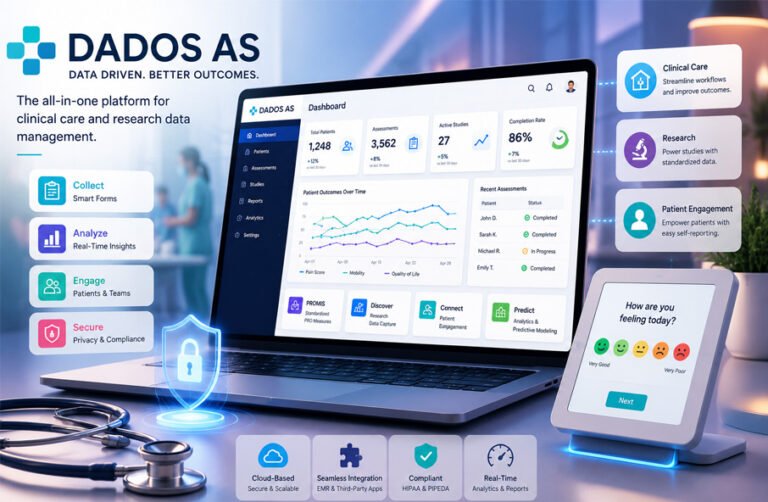
DADOS AS is a web-based platform made for collecting and managing healthcare and research data. It can help clinics, hospitals, and research teams collect patient information, organize it, create reports, and use the data in clinical studies.
People may search for DADOS AS because they want to understand what the platform does, how patients and researchers use it, and what tools it offers. This guide explains how DADOS works, its main features, its different tools, its uses in healthcare and research, and the benefits and limits to consider.
What Is DADOS AS?
DADOS stands for DAta Driven Outcome System. It is an electronic data collection platform made mainly for healthcare and medical research.
Instead of collecting information only through paper forms or separate systems, DADOS allows data to be collected digitally. Patients, healthcare workers, and researchers can enter information using web forms, tablets, kiosks, or other supported devices.
The platform can be used to collect different types of information. This includes patient details, clinical information, survey answers, and patient-reported outcomes. Patient-reported outcomes, often called PROs, are reports given directly by patients about their symptoms, pain, physical ability, quality of life, or other health measures.
DADOS is also used to organize and standardize information. This is important in research because data collected from different patients or locations needs to follow the same format to be useful.
The platform can also produce reports and help healthcare teams review patient outcomes over time. Researchers can use the collected information for studies, registries, and further analysis.
DADOS is mainly designed for professional healthcare and research use. It is not a normal personal database app or a general business data tool.
Who Developed DADOS?
DADOS is connected with University Health Network (UHN) in Canada. Its development has been associated with the Electronic Data Capture Program at the Techna Institute.
The system has a long history. An earlier version called DADOS-Prospective was described in academic research published in 2006. It was created as a web-based system for collecting and managing data in prospective clinical research.
The older DADOS-Prospective system included tools for clinical research forms, study management, electronic records, audit trails, data exports, and multi-centre research.
That earlier version was also described as open-source software. However, readers should not assume that every detail about the 2006 version applies to the DADOS services available today. The platform has changed and developed over time.
The current DADOS system includes several tools for clinical care, patient surveys, research management, reporting, and predictive modelling.
How Does DADOS AS Work?
DADOS works by moving healthcare and research data collection into a central digital system.
A healthcare team or research group first decides what information it needs to collect. They may use existing questionnaires or create forms for a specific study or clinical program.
Patients or staff can then enter the required information using digital forms. Depending on the setup, these forms may be completed on a computer, tablet, patient kiosk, or compatible device at home.
For example, a patient may receive a questionnaire asking about pain, physical function, or general health. The patient completes the form, and the information is stored in the DADOS system.
The platform can also use standardized forms and validation rules. These can help keep information consistent and identify missing or incorrect entries.
Authorized healthcare workers and researchers can then review the collected information. They may use reports, dashboards, or data exports to understand patient progress or study results.
DADOS can also connect with some clinical information systems. This can reduce the need for staff to enter the same patient information more than once.
For research projects, the platform can help manage information from one location or several research centres. This makes it useful for both single-site and multi-centre studies.
Main DADOS Tools and Features
DADOS includes several parts made for different healthcare and research needs. The main tools include DADOS Care, DADOS Connect, DADOS Discover, PROMIS support, and DADOS Predict.
DADOS Care
DADOS Care is focused on everyday clinical work.
It can be used to register patients, collect intake information, record patient outcomes, and follow changes in a patient’s condition over time.
Clinics can use tablets or kiosks to collect information before or during an appointment. This can reduce the amount of information that staff need to enter manually.
DADOS Care can also work with existing clinical systems in supported setups. For example, patient information or laboratory data may be brought into the platform from another healthcare system.
Healthcare teams can then use the collected information to review patient progress and create reports.
DADOS Connect
DADOS Connect is designed to make it easier for patients to provide information directly.
Patients can complete questionnaires on tablets or kiosks while visiting a clinic. In some cases, they can also complete surveys from home using their own compatible device.
This is especially useful for collecting patient-reported outcomes. A patient may report information about symptoms, pain, physical ability, emotional health, or quality of life.
DADOS Connect can also support scheduled questionnaires. Patients may be asked to complete surveys at certain times during treatment or after a procedure.
This can help healthcare teams follow changes between appointments instead of collecting information only when the patient visits the clinic.
The platform can also help research teams manage follow-up questionnaires and keep track of whether patients have completed required forms.
DADOS Discover
DADOS Discover is mainly focused on research.
It allows researchers to build and manage forms used for clinical studies. Forms can be designed for the needs of a particular research project instead of requiring completely separate software for every study.
Researchers can use DADOS Discover to collect standardized information from study participants and manage study data in one system.
The platform also supports reports and data visualization. Researchers can review information while a study is still running rather than waiting until all data has been collected.
They may also examine information for individual patients or look at results across a larger study group.
Collected data can be exported when researchers need to perform further analysis using other tools.
DADOS PROMIS
DADOS supports PROMIS, which stands for Patient-Reported Outcomes Measurement Information System.
PROMIS includes standardized questionnaires used to measure different areas of a person’s health. These may include physical function, pain interference, depression, and other patient-reported measures.
Some PROMIS assessments use computer-adaptive testing, also called CAT.
A computer-adaptive questionnaire changes the next question based on the answers a patient gives. This can help collect useful information without asking every patient the same long list of questions.
For example, if a patient’s answers already give enough information about one area of health, the system may not need to ask many additional questions about that area.
This can make patient questionnaires shorter while still collecting useful and standardized information.
DADOS Predict
DADOS Predict focuses on predictive modelling.
Predictive modelling uses existing data to look for patterns that may help estimate future outcomes. In healthcare, this may include studying information from earlier patients to understand possible risks or results for future patients.
DADOS can help collect structured information that may later be used to develop these models.
For example, researchers may study clinical information and patient-reported outcomes to look for factors connected with recovery, complications, or other results.
A predictive model may then be added to a clinical or research workflow where appropriate.
However, DADOS Predict should not be understood as a tool that automatically diagnoses patients. Predictive models are designed to support research and decision-making. Their usefulness depends on the quality of the data, the way the model was created, and how it is used in clinical practice.
EMR Integration and Data Sharing
DADOS AS can connect with electronic medical record systems, often called EMRs. This can help clinics and hospitals avoid entering the same patient information again and again.
When the connection is set up, selected patient details can move between DADOS and the clinical system. This may include basic patient information, laboratory results, or other clinical data, depending on the organization and its setup.
This type of integration can make data collection faster and reduce manual work. It can also help researchers and healthcare teams keep information in a more organized form.
Some third-party sources also describe DADOS AS as supporting APIs for connections with other healthcare applications and research tools. However, the exact integrations available may depend on the system being used. Organizations should confirm compatibility before setting up the platform.
Reporting and Analytics
DADOS AS includes reporting tools that help users understand the information they collect.
Healthcare teams can create reports to track patient outcomes over time. Researchers can also review study data while a project is still running.
The platform can show information through dashboards and other visual reports. This may help users look at results for one patient or study larger groups of patients.
For example, a clinical team may track changes in pain or physical function. A research team may monitor study progress, patient responses, or outcome measures across different locations.
Data can also be exported when researchers need to use other statistical or analysis tools.
Real-time access to organized data can make it easier to find trends and review results without waiting for manual reports to be prepared.
How DADOS AS Is Used in Healthcare and Research
DADOS AS can be used in both routine healthcare and medical research.
In clinics, it may be used for patient registration, intake forms, questionnaires, and patient-reported outcomes. Healthcare teams can use this information to follow changes in a patient’s condition during treatment or recovery.
The platform can also support clinical registries. A registry collects similar information from many patients over time. This can help researchers study outcomes and understand patterns across larger groups.
For research projects, DADOS AS can support prospective studies, observational research, and other forms of clinical data collection. It can also be used in projects involving more than one research centre.
Multi-centre studies often need a common way to collect the same information at different locations. A centralized platform can make it easier to keep these records consistent.
DADOS has also been used for patient outcome research in different medical areas. Sources discussing the platform mention fields such as orthopedics, oncology, and cardiology. These are examples rather than a complete list of supported medical specialties.
Healthcare organizations may also use collected data for quality improvement. For example, they may study patient outcomes to understand whether certain care methods are working as expected.
Security and Patient Privacy
Healthcare platforms may handle sensitive patient information, so privacy and security are important parts of any DADOS AS setup.
DADOS uses controlled access so that patient and research information is available only to authorized users. Authentication and user permissions can help limit who is able to view or change information.
The platform has also been described as supporting audit trails. An audit trail keeps a record of changes made to data. This can be useful in clinical research because researchers may need to know when information was changed and who made the change.
Third-party sources state that patient information is protected with encryption and mention Advanced Encryption Standard, or AES. They also describe the platform as meeting privacy requirements such as HIPAA and PIPEDA.
These compliance claims should be treated carefully. Privacy requirements can depend on the country, organization, hosting setup, and way the system is configured. Healthcare organizations should check current official DADOS documentation and their own legal requirements before using the platform for sensitive information.
No healthcare data system should be considered completely risk-free. Strong passwords, access controls, staff training, secure networks, and proper data policies are still important.
Supported Devices and Accessibility
DADOS AS is mainly a web-based platform. This means users generally access it through a compatible browser rather than relying only on a traditional desktop program.
Depending on the setup, DADOS can be used on desktop and laptop computers, tablets, and patient kiosks.
DADOS Connect also allows patients to complete supported questionnaires remotely. This may allow a patient to report information from home using a compatible personal device.
This can be useful for follow-up surveys because patients do not always need to return to a clinic just to complete a questionnaire.
A suitable device and internet connection may still be required. Availability can also depend on the healthcare organization and how it has configured DADOS.
There is no strong public evidence that DADOS currently provides a dedicated consumer Android or iPhone app. Its main approach appears to be web-based access across supported devices.
Benefits of DADOS AS
One of the main benefits of DADOS AS is that it can reduce reliance on paper forms. Patients and staff can enter information directly into a digital system.
Digital collection can also reduce repeated data entry when DADOS is connected with existing healthcare systems.
Standardized forms can make research data more consistent. Validation rules may also help identify missing or incorrect information before it becomes part of a larger dataset.
Another benefit is faster access to information. Healthcare teams and researchers can review reports without waiting for someone to manually prepare them.
DADOS Connect can make patient-reported outcomes easier to collect. Patients may be able to complete questionnaires at home or on a tablet instead of filling out paper forms during every clinic visit.
The platform can also help research teams working at several locations. Central data collection makes it easier for different sites to follow the same study process.
DADOS AS may also help connect research and clinical care. Information collected through research can be studied in a structured way, while clinical teams can use suitable outcome data to understand how patients are progressing.
These benefits depend on how well the platform is set up and used. They should not be treated as guaranteed improvements for every organization.
Limitations to Consider
DADOS AS is a specialized platform. It is mainly designed for healthcare and clinical research, so it may not be useful for ordinary business data management.
Setting up the platform may also require technical work. A healthcare organization may need to connect DADOS with existing systems, create forms, manage user access, and train staff.
Integration can also differ between organizations. An EMR system used by one hospital may not work in exactly the same way as a system used somewhere else.
Remote questionnaires depend on internet access and a suitable device. Some patients may need help using digital forms.
Predictive modelling also has limits. A model can only be as useful as the data and methods used to create it. Poor-quality or incomplete data can lead to weak results.
Another limitation is the lack of clear public pricing information. Organizations cannot easily compare costs without contacting the DADOS team.
Some public information about DADOS also comes from older academic material. Readers should not assume that every feature described in older versions is still available in exactly the same form today.
DADOS AS Pricing and Availability
A clear public price list for the current DADOS platform was not found during our research.
The official information available about the platform focuses more on its tools, research uses, and clinical functions than on fixed subscription plans.
Organizations interested in using DADOS may need to contact the responsible team to discuss their needs, request more information, or arrange a demonstration.
The older DADOS-Prospective system was described as open-source software. However, this does not mean that every current DADOS service is free.
Open-source software and hosted healthcare services can have different costs. Hosting, support, integration, training, maintenance, and customization may all affect the final cost.
Readers should therefore avoid websites that claim specific free, premium, or enterprise plans unless those prices can be confirmed through current official information.
DADOS AS vs. Traditional Data Collection
Traditional healthcare data collection often uses paper forms, manual entry, spreadsheets, or separate systems. DADOS AS moves more of this work into one digital workflow.
With paper forms, staff may need to transfer answers into another system later. Digital forms can send the information directly into the platform.
Traditional collection methods may also use different formats across departments. DADOS can use standardized forms so that the same type of information is collected in a consistent way.
Manual reports may take more time to prepare. DADOS can provide reports and dashboards from information already stored in the system.
Patients may also have more options for completing questionnaires. Instead of filling out forms only during a clinic visit, DADOS Connect can support remote reporting in suitable programs.
This does not mean that paper or traditional systems are always inaccurate or unsafe. Their quality depends on how they are managed. The main difference is that DADOS is designed to automate and centralize more parts of the process.
Who Should Use DADOS AS?
DADOS AS is mainly suited to organizations and professionals working with clinical or medical research data.
Hospitals and clinics may use it to collect patient outcomes, intake information, and follow-up questionnaires.
Researchers and universities may use it to manage clinical studies, registries, and multi-centre research projects.
It can also be useful for research coordinators and clinician-scientists who need a structured way to collect and review information from patients.
Healthcare teams that regularly collect patient-reported outcomes may find tools such as DADOS Connect and PROMIS support useful.
However, DADOS AS is not designed as a normal personal database, general office tool, or simple business analytics platform. Its main purpose is healthcare and research data management.
Is DADOS AS the Same as Data as a Service?
No. The healthcare DADOS platform should not automatically be confused with Data as a Service, commonly shortened to DaaS.
In the healthcare context, DADOS stands for DAta Driven Outcome System. It is a platform designed for clinical and research data collection.
Data as a Service is a broader technology model. It usually refers to providing data to users or businesses through cloud services, APIs, or other online systems.
Some third-party websites use the phrase “Dados AS” when discussing Data as a Service. This can make search results confusing, but there is no strong evidence that “Dados AS” is a standard technical name for DaaS.
There is also a separate Norwegian company legally named Dados AS. That business provides IT and database services and is not the same organization as the healthcare DADOS platform.
Readers should therefore check the context when they see the term online.
Bottom Line
DADOS AS is a web-based platform designed to collect, organize, and use clinical and research data.
Its main tools include DADOS Care for clinical workflows, DADOS Connect for patient questionnaires, DADOS Discover for research data, PROMIS support for standardized patient-reported outcomes, and DADOS Predict for predictive modelling.
The platform can also support reporting, clinical-system integration, remote questionnaires, and single-site or multi-centre research.
Its main advantages include digital data collection, standardized information, faster reporting, and easier collection of patient-reported outcomes.
There are also limits to consider. Integration requires proper setup, predictive tools depend on good data, public pricing is limited, and security or compliance requirements should always be checked for the specific organization and location.
For hospitals, clinics, and research teams that need structured healthcare data collection, DADOS can provide several useful tools in one system.
Frequently Asked Questions
What does DADOS stand for?
DADOS stands for DAta Driven Outcome System. It is designed to support electronic data collection in healthcare and clinical research.
What is DADOS AS used for?
DADOS AS is used to collect, manage, analyze, and report clinical and research information. Common uses include patient questionnaires, patient-reported outcomes, clinical studies, registries, and outcome tracking.
How does DADOS Connect work?
DADOS Connect allows patients to complete questionnaires digitally. Depending on the healthcare program, forms may be completed on tablets, kiosks, or compatible devices at home.
Can DADOS integrate with electronic medical records?
DADOS can connect with clinical and electronic medical record systems in supported setups. This may allow selected patient information to move between systems and reduce duplicate data entry. Exact compatibility depends on the organization’s technology.
Is DADOS AS secure?
DADOS includes access controls, authentication, audit trails, and reported encryption features. Third-party sources also mention HIPAA and PIPEDA compliance, but organizations should confirm current security and legal requirements for their specific deployment.
Can DADOS support multi-centre research?
Yes. DADOS has been designed to support research involving multiple locations. A centralized system can help different research sites collect and manage information using the same study process.
Does DADOS AS have a mobile app?
There is no strong public evidence of a dedicated consumer Android or iOS DADOS app. The platform is mainly web-based and can be accessed through supported computers, tablets, kiosks, and compatible personal devices.
How much does DADOS AS cost?
A clear current public pricing table was not found. Organizations interested in using DADOS may need to contact the platform team for information about access, setup, support, and possible costs.
More To Explore:
Corporate Software Inspector: What It Is, How It Works, and Key Features
