


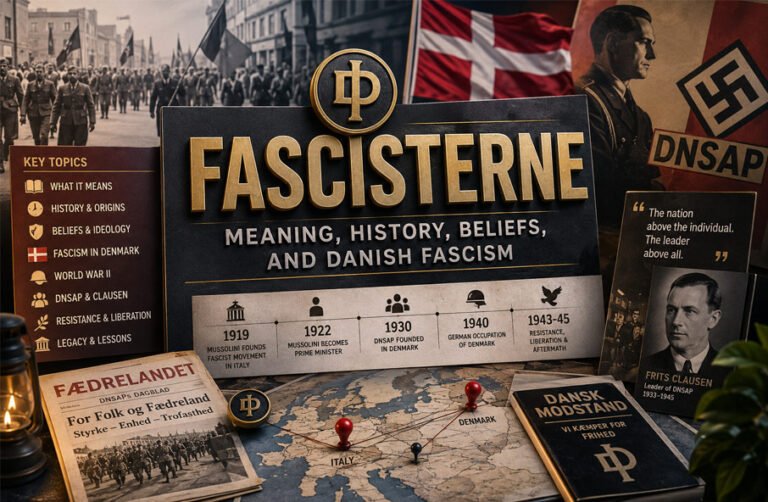
Fascisterne is a Danish word that means “the fascists.” It refers to people who support fascism, not to fascism itself. English-speaking readers often search for the term because it can look like the name of a political group, ideology, or organization.
The word is closely connected with the history of fascism in Europe, especially the rise of Benito Mussolini in Italy and later fascist and Nazi movements in other countries. This article explains what Fascisterne means, where fascism came from, what fascists believed, how fascist governments used propaganda and political control, and how the movement later affected Denmark.
What Does Fascisterne Mean?
Fascisterne is the definite plural form of the Danish word fascist. The most direct English translation is “the fascists.”
Danish often adds an ending to a noun to show that it refers to a specific person or group. This is why fascisterne has a more specific meaning than simply fascister.
The main forms are:
| Danish word | English meaning |
|---|---|
| Fascist | A fascist |
| Fascisten | The fascist |
| Fascister | Fascists |
| Fascisterne | The fascists |
| Fascisme | Fascism |
| Fascistisk | Fascist or fascistic |
This distinction is important. Fascisterne refers to people, while fascisme refers to the political ideology or movement they support.
Fascisterne is not a misspelling of fascism. It is also not the official name of one particular party or organization. The exact group being discussed depends on the context. In one text, it may refer to followers of Mussolini. In another, it may refer to Danish fascists, Nazis, or another historical fascist movement.
The deeper origin of the word fascism is linked to the Latin word fascis, meaning a bundle of rods. The symbol was associated with authority in ancient Rome and later became connected with Mussolini’s political movement.
Where Did Fascism Begin?
Modern organized fascism developed in Europe after World War I. The war had caused severe economic, political, and social problems in many countries.
Italy experienced unemployment, political unrest, strikes, conflict between political groups, and dissatisfaction among some former soldiers. Fear of socialism and revolution also became important in Italian politics.
Benito Mussolini founded the Fasci Italiani di Combattimento in Milan on March 23, 1919. The movement attracted nationalists, war veterans, anti-socialists, and others who believed Italy needed stronger leadership.
Early fascists presented themselves as defenders of national strength and public order. Fascist squads also used violence against political opponents, especially socialist organizations and trade unions.
Mussolini’s movement gradually became more powerful. In October 1922, fascist supporters organized the March on Rome. Soon afterward, King Victor Emmanuel III asked Mussolini to form a government.
Mussolini became prime minister in 1922, but Italy did not become a complete dictatorship immediately. His government gradually weakened democratic institutions, restricted the press, attacked political opponents, and increased control over the state. By 1925, Mussolini had established a dictatorship.
Fascism later influenced political organizations in several other European countries. However, these movements were not always identical. Each developed according to its own political, social, and national conditions.
What Did Fascists Believe?
Historical fascist movements differed from country to country, but they shared several important political ideas.
One of the strongest was ultranationalism. Fascists placed the nation above the individual. People were expected to put national unity, national strength, and loyalty to the state ahead of personal political rights.
Fascist movements also rejected liberal democracy and political pluralism. They generally opposed the idea that different political parties and groups should openly compete for power.
Instead, fascists supported strong centralized leadership. Political authority was often concentrated around one leader or one ruling party.
Another important feature was opposition to socialism and communism. Fascist movements often presented left-wing organizations, labor movements, and communist groups as threats to national unity.
Militarism and discipline also played major roles. Fascist movements often praised strength, obedience, sacrifice, and military values. They viewed political conflict as a struggle in which the nation had to defeat its enemies.
Fascism also gave less importance to individual rights. Citizens were expected to serve what leaders described as the interests of the nation or state.
Historical fascist movements often shared these characteristics:
- Extreme nationalism
- Strong authoritarian leadership
- Opposition to liberal democracy
- Opposition to political pluralism
- Hostility toward socialism and communism
- Militarism
- Social hierarchy
- Mass political mobilization
- Acceptance or use of political violence
- Strong control over political opposition
The idea of national unity could also be used to exclude certain people. Fascist leaders sometimes described political opponents, ethnic minorities, religious groups, or other communities as outsiders or threats.
This exclusion became especially extreme under Nazi Germany, although Italian Fascism and German Nazism did not begin with identical racial ideas.
Propaganda, Violence, and Control
Propaganda was an important part of fascist politics. Fascist leaders understood that controlling public messages could help build support and reduce opposition.
Governments and political movements used newspapers, radio, posters, speeches, rallies, flags, uniforms, symbols, and public ceremonies to spread their ideas.
Large rallies helped create a feeling of unity and political strength. Uniforms and symbols made supporters feel that they belonged to a larger national movement.
Youth organizations were also used to influence younger generations. Education, sports, cultural events, and organized activities could be used to promote loyalty to the state and its leaders.
Fascist movements also used political violence. Paramilitary groups attacked opponents, intimidated rival organizations, and disrupted political meetings.
Violence was not always treated as an unfortunate last resort. Some fascist movements openly praised force, discipline, sacrifice, and combat as positive political values.
Once fascist leaders gained control of government, censorship became another important tool. Independent newspapers could be restricted or closed. Political opponents could face arrest, imprisonment, threats, or violence.
Fascist governments also tried to weaken independent political organizations. Trade unions, opposition parties, cultural groups, and other institutions could be brought under state control or completely removed.
The result was a system in which political disagreement became increasingly difficult and dangerous. Instead of allowing open debate, fascist governments expected loyalty to the state and its leadership.
Mussolini and Italian Fascism
Benito Mussolini is the political figure most closely associated with the creation of modern fascism.
Before World War I, Mussolini had been involved in socialist politics. His political views changed during the war, and he later became a strong nationalist.
In 1919, he founded the Fasci Italiani di Combattimento. The movement eventually developed into the National Fascist Party.
Mussolini became prime minister in 1922. During the following years, he gradually removed many of the democratic limits on his authority.
Political opponents were suppressed, the press was restricted, and opposition parties lost their ability to compete freely. By the mid-1920s, Italy had effectively become a one-party dictatorship.
Mussolini became known as Il Duce, meaning “the leader.” His government promoted nationalism, obedience, military strength, and loyalty to the state.
Italian Fascism also pursued an aggressive foreign policy. Mussolini wanted Italy to become a stronger imperial power. His government invaded Ethiopia in 1935 and later became closely allied with Nazi Germany.
Italy introduced antisemitic racial laws in 1938. These laws restricted the rights of Jewish people in areas including education, employment, and public life. This development came later than the central racial policies of Nazi Germany, but it became an important part of Mussolini’s alliance with Hitler.
Italian philosopher Giovanni Gentile was also associated with the intellectual development of Fascism. His political ideas emphasized the importance of the state and collective national purpose over individual interests.
Gentile’s work became connected with attempts to explain and justify the Fascist system, although Italian Fascism developed through many political, social, and historical forces rather than the ideas of one philosopher alone.
Fascism and Nazism: What Is the Difference?
Fascism and Nazism are closely related, but they are not exactly the same.
Fascism is the broader political category. It developed first in Italy under Benito Mussolini. Nazism refers specifically to National Socialism in Germany under Adolf Hitler and the Nazi Party.
Both systems shared several features. These included extreme nationalism, dictatorship, militarism, propaganda, mass political mobilization, and the suppression of political opposition.
Nazism placed much greater importance on race. Nazi ideology promoted the idea of a racial hierarchy and claimed that so-called “Aryans” were superior to other groups. Antisemitism was central to Nazi politics from the beginning.
These ideas led to discrimination, persecution, forced removal, imprisonment, and mass murder. Nazi racial policies were a major cause of the Holocaust.
Italian Fascism also became racist and antisemitic, especially later in Mussolini’s rule, but racial ideology was not originally as central to Italian Fascism as it was to Nazism.
For this reason, Nazism is usually treated as a specific and more extreme form of fascism. Not every fascist was a Nazi, but Nazism shared many of the main features found in fascist politics.
Fascisterne in Denmark
Denmark also had fascist and Nazi-inspired political movements during the twentieth century.
However, Denmark did not develop a fascist government like Italy or Nazi Germany. Fascist groups remained much weaker in Danish elections and never gained enough support to control the country.
One reason Denmark is important in this history is that the country responded to extremist political organizations before World War II.
In 1933, the Danish parliament banned political uniforms. In 1934, further rules restricted weapons and militarily organized political groups. These measures were intended to reduce the risk of violent political organizations becoming more powerful.
Fascist and National Socialist movements still existed, but they remained limited compared with the major political parties.
DNSAP and Frits Clausen
The best-known Danish Nazi party was Danmarks Nationalsocialistiske Arbejderparti, usually called DNSAP.
The party was founded in 1930. Cay Lembcke was its first leader, but Frits Clausen became party leader in 1933.
DNSAP was strongly influenced by Hitler’s Nazi Party in Germany. It supported nationalism, authoritarian government, antisemitism, and opposition to parliamentary democracy.
The party also copied several ideas and methods used by German National Socialism. These included political uniforms, youth groups, organized meetings, propaganda, and a strong focus on party loyalty.
Frits Clausen became the most recognizable figure connected with Danish Nazism. Under his leadership, DNSAP became better organized but still failed to gain wide public support.
The party published political material and later operated the newspaper Fædrelandet. It also held rallies and built organizations aimed at young supporters.
Despite these activities, DNSAP remained a small political force.
How Much Support Did DNSAP Receive?
DNSAP never received enough votes to become a major political party in Denmark.
In the 1935 parliamentary election, it received 16,257 votes, or about 0.99% of the total, and won no seats.
In 1939, the party received around 1.8% of the vote and won three seats in parliament.
During the 1943 election, which took place while Denmark was under German occupation, DNSAP received around 2.1% of the vote. It won three seats again.
These results are important because they show that the party remained politically marginal even during a period when Nazi Germany controlled Denmark.
Party membership grew during the occupation, but increased membership did not mean most Danish people supported the party.
Historical estimates indicate that DNSAP had around 5,000 members near the start of World War II. Membership later reached about 20,000 in 1943 before falling again toward the end of the war.
Large rallies also did not necessarily show broad national support. Political attendance, party membership, and election results measure different things.
The strongest evidence of DNSAP’s limited influence is its consistently low share of the national vote.
Fascisterne During the German Occupation of Denmark
Germany invaded Denmark on April 9, 1940.
The occupation changed Danish politics and gave DNSAP hope that German support might help the party gain power.
DNSAP benefited from attention and support from German authorities. However, Nazi Germany did not simply replace Denmark’s government with DNSAP.
For a period, German authorities preferred to work with existing Danish political institutions. This arrangement helped maintain stability and supported German economic and military interests.
DNSAP therefore remained outside direct control of the Danish government despite its support for Nazi Germany.
The party also became involved in recruiting Danish volunteers for German military service.
After Germany invaded the Soviet Union in 1941, recruitment became more open. Danish volunteers joined formations connected with the Waffen-SS and Frikorps Danmark.
DNSAP members and supporters were involved in these recruitment efforts.
This further connected the party with Nazi Germany and made it more difficult for DNSAP to present itself as an independent Danish nationalist movement.
As the war continued, the party became increasingly associated with German occupation and collaboration.
Danish Resistance and the Rescue of Danish Jews
Opposition to the German occupation grew during the war.
Danish resistance groups carried out sabotage, gathered intelligence, produced illegal newspapers, and helped communicate information outside official channels.
Some resistance networks also helped people escape from German control.
Participation was dangerous. Resistance members could face arrest, imprisonment, or other punishment.
One of the most important events took place in October 1943, when Nazi authorities prepared to arrest and deport Denmark’s Jewish population.
Danish resistance members and ordinary citizens helped thousands of Jewish people escape to Sweden.
Sweden remained neutral during the war, and many people were transported across the water in small boats.
Most Danish Jews were able to escape deportation because of these efforts.
The rescue is an important part of Danish wartime history. It also shows that the presence of Danish fascist and Nazi groups did not mean Danish society as a whole supported Nazi racial policies.
What Happened to Danish Fascists After World War II?
Germany surrendered in 1945, and Denmark was liberated in May of that year.
DNSAP quickly lost what remained of its political influence.
After liberation, Denmark investigated people who had collaborated with German authorities.
Membership in DNSAP alone was not automatically treated as a criminal offense. However, individuals could be prosecuted for specific actions carried out during the occupation.
Some former members also faced social or employment consequences.
The Bovrup archive became an important source of information after the war. It contained records connected with DNSAP membership and was used when examining collaboration.
The records were later preserved by Danish historical institutions.
A group using the DNSAP name was reorganized in 1951, but it never became an important political force.
Organized Danish Nazism remained politically weak after the war.
Fascisterne, Nazisterne, and Other Political Terms
Several political terms are often confused with one another.
Fascisterne means “the fascists.” It is a broad Danish term for people associated with fascism.
Nazisterne means “the Nazis.” It refers more specifically to supporters of National Socialism.
Fascisme is the Danish word for fascism, while Nazism refers to the political ideology of Hitler and the Nazi Party.
Not every authoritarian government is fascist.
A military dictatorship may be controlled by generals without having a fascist mass movement or ideology.
A personal dictatorship may depend mainly on loyalty to one ruler rather than on ultranationalism or fascist political ideas.
An absolute monarchy bases authority on hereditary rule.
Populism is also different. Populist politicians often claim to represent ordinary people against elites, but populism can exist in both democratic and authoritarian settings.
Communism is another separate ideology. Communist theory focuses on class, collective ownership, and reducing or removing major economic class divisions. Fascism instead emphasizes nationalism, hierarchy, authority, and national unity.
Different systems can share authoritarian methods without becoming the same ideology.
How Is Fascisterne Used Today?
Fascisterne still appears in Danish books, historical writing, education, journalism, and political discussion.
In historical material, the meaning is usually clear. It may refer to members of Mussolini’s movement, Danish fascists, Nazi supporters, or another specific group.
Modern political use can be less precise.
The word “fascist” is sometimes used as an insult for a politician or group that someone considers extreme, controlling, or intolerant.
That use does not automatically make the label historically accurate.
Historians and political researchers normally look for a wider pattern before describing a movement as fascist. Important signs can include extreme nationalism, rejection of democratic competition, leader worship, political violence, exclusion of groups seen as outsiders, and efforts to weaken independent institutions.
One strict policy or one nationalist statement is not enough by itself.
The context matters. Readers should consider who is using the term, what group is being described, and what evidence supports the label.
Why Fascisterne Still Matters in History
The history of fascist movements remains important because their rise changed Europe politically, socially, and militarily.
Fascist governments weakened democratic institutions and restricted basic political freedoms.
Opposition groups were censored or removed. Political violence became part of public life in several countries.
Fascist and Nazi governments also contributed to war, occupation, persecution, forced labor, displacement, and mass death.
Nazi Germany’s racial policies resulted in genocide and the Holocaust.
The experience of fascism influenced postwar thinking about democracy, political rights, international law, and human rights.
Museums, memorials, archives, schools, and historical research continue to study and explain this period.
Understanding Fascisterne also helps readers use the word more carefully today.
Knowing the historical meaning makes it easier to distinguish between normal political disagreement, authoritarian behavior, and political movements that match the wider characteristics of fascism.
Bottom Line
Fascisterne is a Danish word meaning “the fascists.” It refers to people connected with fascist political ideas rather than to the ideology itself.
The history behind the term begins with the rise of fascism in Italy under Benito Mussolini and later connects with Nazism, Adolf Hitler, World War II, and other authoritarian movements in Europe.
Denmark also had fascist and Nazi organizations. DNSAP was the best-known example, but it never gained enough public support to control the Danish government.
The German occupation gave Danish Nazism greater visibility, but DNSAP remained politically weak. After the war, organized Danish Nazism lost most of its influence.
Understanding Fascisterne therefore requires both language and history. Knowing what the word means, how fascism developed, and how it affected Denmark makes it easier to understand historical texts and use the term accurately today.
Frequently Asked Questions
What does Fascisterne mean in English?
Fascisterne means “the fascists” in English. It is the definite plural form of the Danish word fascist.
Is Fascisterne the same as fascism?
No. Fascisterne refers to people who support fascism. The Danish word for the ideology itself is fascisme.
Is Fascisterne a misspelling?
No. It is a real Danish word. Its spelling comes from Danish grammar and is not a misspelling of “fascist” or “fascism.”
Are Fascisterne and Nazisterne the same?
Not exactly. Fascisterne means “the fascists,” while Nazisterne means “the Nazis.” Nazism is closely related to fascism but has a more specific historical meaning connected with Hitler and German National Socialism.
Who started fascism?
Benito Mussolini is the figure most closely associated with the founding of modern organized fascism. He created the Fasci Italiani di Combattimento in Italy in 1919 and became prime minister in 1922.
Did Denmark have a fascist government?
No. Denmark had fascist and Nazi political organizations, including DNSAP, but they never gained enough electoral support to establish a fascist government.
What was DNSAP?
DNSAP was the main Danish Nazi party. Its full name was Danmarks Nationalsocialistiske Arbejderparti. It was founded in 1930 and later led by Frits Clausen. It was strongly influenced by German National Socialism.
Does fascism still exist today?
Neo-fascist movements and groups still exist in different countries. However, the word should be used carefully.
A movement should not be called fascist simply because it is controversial, nationalist, strict, or unpopular. Historical and political classification usually requires a wider pattern involving ultranationalism, rejection of democracy, exclusion, authoritarian leadership, and acceptance of political violence.
More To Explore:
Incfidelibus Meaning: What Is It and Is It a Real Latin Word?
