

AI transformation means using artificial intelligence across real business work, not just testing a chatbot or trying one new tool. AI may help with customer service, writing, data analysis, automation, decision support, and internal workflows.
The difficult part is often not choosing an AI model. Businesses also need to decide who can use AI, what data it can access, who is responsible for mistakes, when humans must review results, and how risks are controlled. These are governance questions.
This article explains why AI transformation is a governance challenge, the main risks involved, and how businesses can manage AI in a practical way.
What Does “AI Transformation Is a Problem of Governance” Mean?
The phrase means that successful AI transformation depends on more than software, models, and technical skill.
A company may have strong AI tools, good developers, and large amounts of data. It can still face problems if nobody knows who owns an AI system, what it is allowed to do, or who is responsible for its results.
AI governance provides these rules. It covers responsibilities, permissions, risk controls, human review, data use, monitoring, and acceptable use.
There is also an important difference between AI implementation and AI transformation. Implementation can mean adding one AI tool. Transformation means changing how work is done around AI and building suitable controls for that change.
A simple way to understand it is this:
Technology shows what AI can do. Governance decides what AI should be allowed to do.
Governance is not the whole transformation. Businesses still need good technology, useful data, trained employees, strong processes, and clear business goals. But governance provides the boundaries needed to use AI responsibly.
Why AI Creates New Governance Challenges
AI does not always behave like traditional software.
Normal software usually follows rules written into the system. Modern AI, especially generative AI, often produces probabilistic results. This means the same type of request can sometimes produce different answers.
AI can also produce incorrect information that sounds convincing. This is often called a hallucination.
Other concerns include bias, unfair outcomes, limited explainability, and changes in performance over time. These differences mean AI cannot always be managed with the same controls used for ordinary IT systems.
Risk also depends on how AI is used. An AI tool that helps create marketing ideas is very different from a system that influences hiring, finance, healthcare, or other important decisions.
The more serious the possible effect, the stronger the governance usually needs to be.
AI governance therefore should not end when a system is launched. Businesses need to keep checking how important AI systems perform and whether their risks have changed.
Why AI Pilots Struggle to Scale
A small AI experiment can be easy to control.
For example, one department may test an AI assistant using limited information. If the test works, the company may want to expand it across the business.
That creates new questions.
Can every employee access the same information? Can the AI read confidential files? Can it contact customers? Can it update business records? Who approves those permissions? What happens when it gives a wrong answer?
These problems become more important when AI connects to real company systems, data, employees, and customers.
Another issue is shadow AI. This happens when employees or teams start using AI tools without official approval or proper oversight. The business may then have little visibility into which tools are being used or what information is being shared with them.
Poor governance is not the only reason an AI pilot may fail to scale. Weak data, difficult system integration, high costs, unclear business value, poor employee adoption, and badly designed workflows can also stop a project.
The important point is that a successful technical test does not automatically mean a system is ready for organization-wide use.
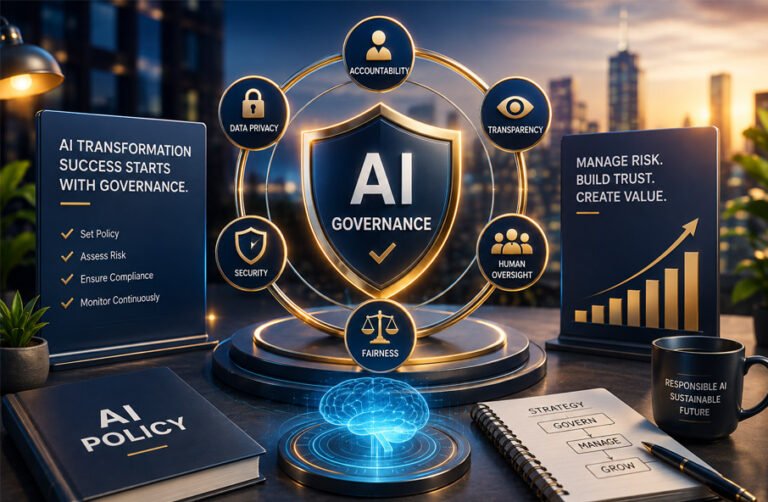
The Main Pillars of AI Governance
Good AI governance usually covers several connected areas.
Accountability means making it clear who owns each important AI system and who is responsible for its use.
Transparency means keeping enough information about how AI is used, tested, and managed so important decisions can be reviewed or explained.
Privacy and data protection control what information AI can process and how sensitive data is handled.
Security protects AI systems, accounts, integrations, and data against misuse or unauthorized access.
Fairness and bias management involves checking whether an AI system creates unfair or harmful results.
Human oversight defines when a person must review, approve, correct, or stop an AI action.
Risk management helps a business identify problems before they cause serious harm.
Continuous monitoring means checking important AI systems after deployment instead of assuming that a system that worked at launch will always remain reliable.
These principles only become useful when they are turned into real controls. A written AI policy has limited value if employees do not understand it or if nobody checks whether it is followed.
Data Governance, Privacy, and Security
AI systems depend heavily on data.
Before giving an AI tool access to company information, a business should understand what data it has, where that data is stored, who owns it, who can access it, and whether AI is allowed to process it.
Data quality also matters. Incorrect, incomplete, or badly organized information can lead to unreliable AI results.
Businesses should pay particular attention to personal information, financial records, confidential business information, intellectual property, and security-sensitive data. Rules may also be needed for data retention and deletion.
Third-party AI services create another question: what happens to information after it is submitted to the provider? Businesses should understand the provider’s data-handling terms, access controls, security practices, and relevant privacy requirements before sending sensitive information.
Security risks can also increase when AI is connected to other systems. An AI service with broad permissions may be able to read files, use business applications, or perform actions.
For this reason, businesses should give AI systems only the access they actually need.
AI cannot automatically fix weak data governance. In some cases, adding AI can make existing problems larger because the system can process and spread information much faster.
AI Agents and Human Oversight
Traditional generative AI often gives a user an answer and waits for the person to decide what happens next.
AI agents can go further. Depending on their design, they may use software tools, search internal information, perform several steps, send messages, update records, or trigger business workflows.
That increased ability creates a larger governance challenge.
A business should clearly define what an AI agent can access, what it can change, and which actions require approval from a person.
Its activity should also be recorded when appropriate so important actions can be reviewed later. Businesses need a practical way to remove permissions or stop the system if something goes wrong.
Human oversight should match the level of risk.
An AI system used to summarize an internal document may need limited review. An AI system that can significantly affect a customer, employee, or financial decision may need much stronger human control.
The goal is not to place a person behind every small AI action. It is to make sure humans remain responsible where the possible consequences are serious.
How Businesses Can Build an AI Governance Framework
A practical AI governance framework should begin with a simple question: Why is the business using AI?
The company should connect each important AI project to a clear business purpose instead of adopting AI simply because the technology is available.
The next step is to create an AI inventory. This should include important official AI tools, internal systems, third-party services, and significant automated workflows. Businesses should also try to identify unofficial AI use where possible.
Every important AI system should have an owner. That person or team should understand the system’s purpose, risks, performance, and continued use.
Businesses should then classify AI systems by risk. A low-impact writing assistant should not normally require the same controls as a system that can influence employment, financial, legal, or other high-impact decisions.
Clear policies should explain which AI tools are approved, which information may be used, what activities are restricted, and when human approval is required.
Important systems should also be tested before production. Testing may include accuracy, reliability, security, bias, failure cases, and other risks that matter for the specific use.
Governance should continue after launch. Businesses should monitor important systems because performance, data, threats, and business conditions can change.
Records should be kept for significant approvals, tests, system versions, changes, and incidents. If an AI system behaves unexpectedly, employees should know how to report the problem and the business should be able to investigate, restrict access, correct the issue, or stop the system.
Governance also needs regular review. Rules that were suitable for a simple AI assistant may not be enough when the same business begins using more capable AI agents or gives systems greater access to important data.
Who Should Be Responsible for AI Governance?
AI governance should not belong to one department.
Senior leaders should decide why the business is using AI, what level of risk is acceptable, which decisions must stay under human control, and when an AI system should be stopped. Technology teams can build and run the systems, but leadership sets the wider rules.
Legal and compliance teams help with laws and regulatory duties. Security and privacy teams protect systems and sensitive data. Data teams help manage data quality and access. HR may need to be involved when AI affects employees, hiring, training, or workplace rules.
Business teams also need responsibility. If an AI system is used in sales, finance, customer service, or operations, the relevant business owner should understand its purpose and remain accountable for the result.
Many organizations use a cross-functional AI governance group. This can bring together leadership, IT, security, legal, data, risk, HR, and business teams. The exact structure can be centralized or shared across departments, but important AI systems should always have clearly named owners.
AI Literacy and Employee Training
Employees cannot use AI responsibly if they do not understand its limits.
Training should explain that AI can produce incorrect information, expose confidential data if used carelessly, reflect bias, and require human checking in some situations. Workers should also know which AI tools are approved and what information they are allowed to enter.
Useful training can cover safe prompting, restricted data, security, bias, human review, acceptable use, and how to report a problem.
This also helps reduce shadow AI. If employees understand the rules and have useful approved tools, they are less likely to rely on unapproved services.
AI transformation therefore includes people as well as technology. Installing software without preparing employees is not enough.
AI Governance Standards and Frameworks
Businesses do not have to create every governance rule from the beginning. Several well-known frameworks can help.
The NIST AI Risk Management Framework, or AI RMF, organizes AI risk work around four functions: Govern, Map, Measure, and Manage. It is designed to help organizations identify, assess, and manage AI risks throughout the system lifecycle.
ISO/IEC 42001 focuses on an organization-wide AI management system. It covers policies, objectives, responsibilities, processes, risk management, and continual improvement.
The OECD AI Principles also provide useful guidance. They emphasize areas such as accountability, transparency, fairness, human-centered values, safety, security, and robustness.
These frameworks are useful references, but businesses still need to adapt them to their own systems, risks, industry, and legal duties.
AI Regulation and the EU AI Act
AI governance is also becoming a legal issue.
The European Union’s AI Act uses a risk-based approach. Different rules can apply depending on the type of AI system, how it is used, and the role of the organization.
As of 2 August 2026, the European AI Office and authorities in EU Member States have important responsibilities for supervising and enforcing major parts of the law. Some requirements continue to apply through a phased timetable.
The law can involve areas such as transparency, documentation, risk management, and oversight.
However, not every business has the same duties. Requirements depend on the system, location, use case, and legal role of the organization.
Businesses operating across different countries should therefore check the rules that apply to their own AI use rather than assuming one policy works everywhere.
Does AI Governance Slow Innovation?
It can, if it is badly designed.
Too many approval steps, unnecessary committees, and one-size-fits-all controls can slow even low-risk AI projects.
But weak governance can also slow work. If nobody knows the rules, each team may need to repeatedly ask the same questions about security, privacy, data, ownership, and approval.
Clear governance can reduce that uncertainty. Teams know what they can build, what data they can use, who approves the project, and what controls are required.
A practical approach is to use lighter controls for low-risk experiments and stronger checks for systems that affect important business decisions or people.
The goal is not maximum control. It is responsible speed.
Governance Alone Is Not Enough
Governance is important, but it cannot create successful AI transformation by itself.
Businesses also need reliable technology, good data, useful workflows, trained employees, clear leadership, and measurable business goals.
A weak process does not automatically become better because AI is added to it. In many cases, the workflow needs to be redesigned so AI actually improves how work is done.
Employee adoption also matters. A technically strong system may fail if workers do not trust it, understand it, or know when to use it.
Costs should also be considered. AI expenses can include more than software or model access. Businesses may also need integration work, security controls, human review, training, monitoring, maintenance, and compliance work.
This is why the most balanced view is that AI transformation is a problem of governance, but not only governance. Technology provides capability. People, processes, and leadership turn that capability into useful change.
Common AI Governance Mistakes
Some problems appear repeatedly when businesses introduce AI.
One is treating governance as an afterthought. Rules are created only after a security, privacy, or accuracy problem appears.
Another is unclear ownership. If no one is clearly responsible for an AI system, problems can be passed between IT, business teams, legal staff, and vendors.
Some companies also create policies that exist only on paper. If employees do not understand the rules and systems do not enforce them, the policy has little practical value.
Other common mistakes include giving AI too much access, failing to track unofficial AI tools, using poor-quality data, skipping testing, ignoring employee training, and failing to monitor systems after launch.
The opposite problem is also possible. Applying heavy controls to every small AI use case can make governance too slow and expensive.
A better approach is to match the level of control to the level of risk.
Bottom Line
AI transformation changes more than software. It changes how information is used, how decisions are supported, and in some cases what systems are allowed to do.
That is why businesses need clear ownership, data rules, security, risk controls, human oversight, monitoring, and accountability.
Strong governance can help a company move from small AI experiments to wider use without losing control. But governance works best when it is combined with good technology, reliable data, trained people, useful workflows, and clear business goals.
The simplest way to understand the topic is this: technology gives AI its capability, while governance defines how that capability can be used responsibly and effectively.
Frequently Asked Questions
What does “AI transformation is a problem of governance” mean?
It means that successful AI adoption depends on more than choosing a good model. Businesses also need rules about ownership, data access, risk, human review, security, and accountability.
What is AI governance?
AI governance is the set of policies, responsibilities, processes, controls, and oversight used to guide how AI is developed and used.
Why is AI governance different from traditional IT governance?
AI can produce probabilistic results, make mistakes that sound convincing, show bias, and change in performance over time. This often requires more continuous monitoring and stronger attention to explainability and human oversight.
Who should be responsible for AI governance?
Responsibility is usually shared across leadership, technology, security, legal, compliance, risk, data, HR, and business teams. Important AI systems should also have clearly named owners.
Does every AI system need the same level of governance?
A risk-based approach is more practical. A low-impact writing assistant can use lighter controls, while a system that affects people, money, or important business decisions may need stronger testing and oversight.
How does AI governance apply to AI agents?
Businesses should define what an agent can access, what actions it can take, what requires human approval, how its activity is recorded, and how its permissions can be removed.
Can strong AI governance help companies innovate faster?
Clear rules can reduce repeated questions about data, permissions, security, ownership, and approval. Poorly designed governance can slow innovation, but practical risk-based governance can make responsible AI use easier.
What AI governance frameworks can businesses use?
Common references include the NIST AI Risk Management Framework, ISO/IEC 42001, and the OECD AI Principles. Businesses should also understand any laws that apply to their AI systems and markets.
More To Explore:
What Is Snaptroid? How It Works, Features, Safety, and Risks
