


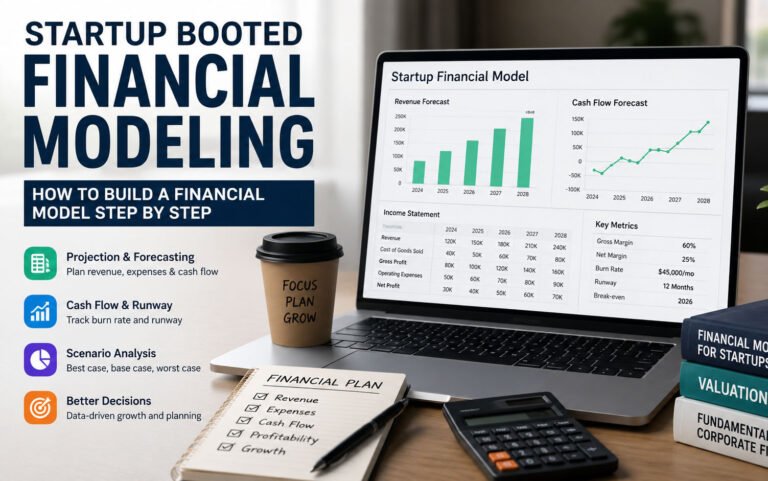
Startup booted financial modeling is financial planning for a startup that mainly relies on its own revenue, founder money, or reinvested profits instead of depending on repeated outside funding.
People usually search for this topic because they want to understand how a bootstrapped startup can plan revenue, control expenses, manage cash, and decide when it is safe to hire or grow.
This guide explains how to build a practical startup financial model step by step. It covers assumptions, revenue forecasting, expenses, hiring, cash flow, financial statements, runway, break-even, unit economics, scenarios, and regular model updates.
What Is Startup Booted Financial Modeling?
Startup booted financial modeling is the process of forecasting the financial performance of a bootstrapped or self-funded business.
The term “booted” is generally used as a shorter form of “bootstrapped.” It is not a separate accounting standard or a special type of software.
A bootstrapped startup usually depends more heavily on customer revenue, founder capital, and profits that are reinvested into the business. Because outside funding may not be available when cash becomes tight, financial planning needs to be closely connected to actual business performance.
A typical model estimates future revenue, expenses, cash flow, profitability, and other important financial metrics. It can help founders answer practical questions such as:
- How much revenue do we need each month?
- Can we afford another employee?
- How much can we spend on marketing?
- When could the business become profitable?
- How long will our available cash last?
- What happens if sales are lower than expected?
The main goal is not to predict the future perfectly. A useful financial model gives founders a structured way to make decisions using realistic assumptions instead of guesses.
Bootstrapped vs Venture-Backed Financial Modeling
Bootstrapped and venture-backed startups can use many of the same financial concepts, but their planning priorities are often different.
A bootstrapped startup usually needs growth to stay close to the amount of cash the business can generate or safely spend. It may need to reach profitability earlier because there may not be another funding round available to cover continued losses.
A venture-backed startup may have more room to accept short-term losses if investors have provided capital for faster hiring, marketing, product development, or market expansion.
The differences can be summarized simply:
| Area | Bootstrapped Startup | Venture-Backed Startup |
|---|---|---|
| Main funding source | Revenue and founder capital | Investor capital plus revenue |
| Growth approach | Usually controlled | Can be more aggressive |
| Profitability | Often an earlier priority | May be delayed |
| Cash management | Critical | Still important |
| Ownership | Usually more founder-controlled | Often diluted through funding |
| Risk tolerance | Usually lower | Can be higher |
These are general patterns, not strict rules. A bootstrapped company can grow quickly, and a funded company can still be highly disciplined with spending.
The main difference is that a bootstrapped financial model usually cannot assume that new investment will arrive whenever cash runs low.
What Should a Startup Financial Model Include?
A startup financial model should include enough information to explain how the business earns money, where it spends money, and how those decisions affect cash.
The main sections usually include:
- Financial assumptions
- Revenue forecast
- Expense forecast
- Hiring or headcount plan
- Profit and loss statement
- Cash-flow forecast
- Balance sheet
- Burn rate
- Cash runway
- Break-even analysis
- Unit economics
- Key performance indicators
- Scenario analysis
The exact structure depends on the business.
A small consulting startup may need only a simple revenue, expense, and cash model at first. A SaaS startup may also need MRR, churn, CAC, LTV, and subscription growth. An ecommerce business may need inventory, shipping, product margins, and returns.
A startup does not need to build the most complicated spreadsheet possible. The model should be easy to understand, easy to update, and useful for real decisions.
Step 1: Define Your Financial Assumptions
Every financial model starts with assumptions.
Assumptions are the numbers that drive the calculations in the rest of the model. If these inputs are unrealistic, the final forecast will also be unreliable.
Common assumptions include:
- Product or service price
- Number of expected customers
- Monthly customer growth
- Conversion rate
- Customer retention
- Churn rate
- Average order value
- Payment timing
- Salaries
- Marketing spend
- Supplier costs
- Software costs
- Hiring dates
- Tax estimates
- Founder contributions
Whenever possible, assumptions should come from real information.
For example, a founder can use existing customer data, signed contracts, previous sales, current pricing, marketing performance, or historical conversion rates.
A startup with little operating history may need to rely partly on estimates. In that case, those estimates should be clearly identified and kept conservative.
It is also useful to keep assumptions in a separate area of the spreadsheet instead of typing numbers directly into formulas throughout the model. This makes it much easier to change one assumption and see how it affects the whole forecast.
The source material also emphasizes that startup financial assumptions should be based on real pricing, customer behavior, conversion rates, and retention expectations whenever possible.
Step 2: Build a Revenue Forecast
A revenue forecast estimates how much money the business may earn during future months.
For a bootstrapped startup, the forecast should be based as much as possible on measurable business drivers.
Bottom-Up Forecasting
Bottom-up forecasting starts with the activities that actually create revenue.
For example:
Customers × monthly price = monthly revenue
If a SaaS startup expects 100 paying customers at $50 per month:
100 × $50 = $5,000 monthly revenue
Another model may use:
Website visitors × conversion rate × average order value
An agency could use:
Number of projects × average project fee
A sales-led business may use:
Qualified leads × close rate × average contract value
This method is useful because founders can examine each assumption separately. If conversion rates change or the average selling price increases, the model can be updated directly.
The supplied research also describes bottom-up forecasting as more closely connected to measurable business performance.
Top-Down Forecasting
Top-down forecasting starts with the total market and estimates what percentage of that market the startup might capture.
For example:
Market size: $100 million
Expected market share: 1%
Projected revenue: $1 million
This can help explain the size of an opportunity, but it is less useful for short-term operating decisions if the expected market share is only an assumption.
A startup may have a very large target market but still have only a small sales team, limited marketing budget, or low conversion rate.
For this reason, bottom-up forecasting is usually more practical for day-to-day startup financial modeling. Top-down forecasts can still be useful as supporting market context.
Step 3: Forecast Startup Expenses
The next step is to estimate what the startup will spend.
Expenses should be organized into clear categories so founders can see which costs stay stable and which costs increase as the business grows.
Fixed Costs
Fixed costs usually stay relatively stable over a certain period.
Examples include:
- Salaries
- Office rent
- Insurance
- Accounting
- Some software subscriptions
- Administrative costs
A cost does not need to remain unchanged forever to be considered fixed. It simply means the expense does not move directly with every individual sale.
Variable Costs
Variable costs increase or decrease with business activity.
Examples may include:
- Manufacturing
- Materials
- Packaging
- Shipping
- Payment-processing fees
- Sales commissions
- Usage-based hosting
- Certain contractor costs
Separating fixed and variable costs makes it easier to understand margins and calculate break-even later.
Founders should also include expenses that are easy to forget, such as taxes, legal fees, banking charges, software renewals, refunds, insurance, and one-time purchases.
Underestimating costs can make the forecast look much healthier than the real business.
For bootstrapped startups, controlling fixed costs is especially useful because fixed commitments continue even during slow months. The supplied sources recommend delaying unnecessary expenses and keeping cost growth connected to proven revenue where possible.
Step 4: Add a Hiring and Headcount Plan
Payroll can become one of the largest expenses in a startup.
A financial model should therefore show when new employees or contractors are expected to join and how much each person will cost.
A headcount plan may include:
- Job role
- Hiring month
- Salary
- Payroll taxes
- Benefits
- Bonus costs
- Contractor fees
- Recruitment costs
The full cost of an employee is often higher than the base salary. Employers may also pay taxes, benefits, equipment, software, recruitment costs, and other employment-related expenses.
For a bootstrapped startup, hiring decisions should ideally be linked to business capacity and financial performance.
Instead of saying, “Hire a salesperson in June,” the model can test whether the startup could afford that person if revenue is below forecast.
Some founders also use financial triggers. For example, a new hire may only be approved once monthly revenue reaches a certain amount or once the company has enough cash to support the additional payroll.
This helps prevent hiring too early and creating a fixed expense that the company cannot comfortably support.
Step 5: Build a Cash-Flow Forecast
Cash-flow forecasting shows when money actually enters and leaves the business.
This is different from simply forecasting revenue or profit.
A business can report revenue without receiving the cash immediately. For example, a client may receive an invoice in March but not pay until May.
That delay matters because salaries, suppliers, taxes, and software bills may still need to be paid before the customer payment arrives.
This is why a company can look profitable on paper but still experience a cash shortage.
A simple monthly cash forecast can follow this structure:
Beginning cash + cash received − cash paid = ending cash
Cash coming into the business may include:
- Customer payments
- Founder contributions
- Loans
- Investment, if any
- Other operating income
Cash going out may include:
- Payroll
- Supplier payments
- Marketing
- Software
- Rent
- Taxes
- Debt repayments
- Equipment
- Professional fees
The most important point is timing.
If $20,000 of customer invoices are expected in one month but only $8,000 is actually collected, the company cannot spend the full $20,000.
The cash-flow forecast should reflect when money is realistically expected to arrive.
It should also consider accounts receivable, which is money customers still owe, and accounts payable, which is money the startup owes suppliers and other businesses.
Payment terms such as Net 30 or Net 60 can have a large effect on available cash even when overall sales are healthy.
Step 6: Understand the Three Financial Statements
A more complete startup financial model usually connects three important financial statements: the profit and loss statement, cash flow statement, and balance sheet.
Together, they show profitability, cash movement, and the overall financial position of the business.
Profit and Loss Statement
The profit and loss statement, often called the P&L or income statement, shows whether the business generated a profit or loss during a period.
It normally includes:
Revenue
Money earned from customers.
Cost of goods sold or cost of services
Direct costs required to deliver the product or service.
Gross profit
Revenue minus direct costs.
Operating expenses
Costs such as salaries, marketing, software, rent, and administrative expenses.
Operating profit or loss
The result after operating expenses are deducted from gross profit.
Other items such as interest, depreciation, amortization, and taxes may also appear depending on the business.
The P&L helps founders understand whether the business model is economically profitable.
Cash Flow Statement
The cash flow statement tracks actual movements of cash.
It normally groups cash into three areas.
Operating activities cover cash generated or spent through normal business operations.
Investing activities cover areas such as equipment purchases or other long-term investments.
Financing activities cover loans, debt repayments, founder funding, and investor capital.
The cash flow statement helps explain why the cash balance may rise or fall even when the P&L shows a profit.
For a bootstrapped startup, this difference is especially important because running out of usable cash can create problems even when accounting results appear positive.
Balance Sheet
The balance sheet shows what the company owns and owes at a specific point in time.
It includes three main areas.
Assets may include:
- Cash
- Accounts receivable
- Inventory
- Equipment
- Other resources owned by the business
Liabilities may include:
- Accounts payable
- Loans
- Credit balances
- Taxes owed
- Other financial obligations
Equity represents the remaining ownership value after liabilities are deducted from assets.
Very small startups may begin with simpler revenue, expense, and cash forecasts. As the company grows, connecting the P&L, cash flow statement, and balance sheet creates a more complete view of financial health.
Step 7: Calculate Burn Rate and Cash Runway
Burn rate shows how quickly a startup is using cash.
For a bootstrapped startup, this number matters because there may not be another funding round available if cash becomes too low.
Gross Burn Rate
Gross burn rate is the total amount of cash the business spends during a period, usually one month.
If a startup spends $20,000 in a month, its gross monthly burn is $20,000.
This number shows the total cash cost of operating the business.
Net Burn Rate
Net burn rate looks at how much cash the company actually loses after considering incoming cash from operations.
A simple formula is:
Net burn = cash expenses − operating cash inflows
For example:
Monthly cash expenses = $20,000
Cash received from customers = $15,000
Net burn = $5,000 per month
The supplied sources use the same basic approach when explaining gross burn, net burn, and runway.
Cash Runway
Cash runway estimates how long the startup can continue operating if its current cash burn continues.
A simple formula is:
Cash runway = available cash ÷ monthly net burn
For example:
Available cash = $60,000
Net burn = $5,000 per month
Estimated runway = 12 months
Runway is most useful when the business is actually losing cash each month.
If the company is cash-flow positive, dividing cash by monthly profit does not create a meaningful runway figure. In that situation, founders should focus more on cash reserves, profitability, working capital, and future spending plans.
There is also no single runway target that applies to every startup.
The supplied sources suggest different ranges. One recommends around 12 months where possible, while others mention 3 to 6 months of cash reserves or 6 to 12 months of runway.
The right amount depends on how predictable revenue is, how quickly costs can be reduced, and how easily the business could access more funding if needed.
Step 8: Calculate Your Break-Even Point
Break-even is the point where revenue is enough to cover costs.
Once a startup reaches break-even, it is no longer operating at a loss on that basis.
There are two common ways to calculate it.
Break-Even in Units
For a product business, the formula can be:
Break-even units = fixed costs ÷ (selling price per unit − variable cost per unit)
If fixed costs are $10,000 per month and each product contributes $100 after variable costs, the business needs to sell 100 units to break even.
Break-Even Revenue
Another method uses gross margin.
The formula is:
Break-even revenue = fixed costs ÷ gross margin percentage
For example:
Fixed costs = $10,000
Gross margin = 50%
Break-even revenue = $20,000
This calculation appears in one of the supplied sources and is useful when the business wants to know the minimum revenue level needed to cover fixed costs.
Break-even analysis can help founders make decisions about pricing, hiring, sales targets, and marketing budgets.
It also gives a clearer answer to an important question: how much revenue does the business need before additional growth spending becomes easier to support?
Step 9: Measure Unit Economics
Unit economics shows whether the business makes enough value from each customer, order, project, or transaction.
The right unit depends on the business model.
For a SaaS company, the unit is usually a customer or subscription.
For ecommerce, it may be an order.
For an agency, it could be a client or project.
Customer Acquisition Cost
Customer acquisition cost, or CAC, measures how much the business spends to acquire a new customer.
A simple formula is:
CAC = sales and marketing costs ÷ new customers acquired
For example:
Sales and marketing spend = $5,000
New customers = 100
CAC = $50
CAC helps founders understand whether customer acquisition is becoming more or less expensive.
Customer Lifetime Value
Customer lifetime value, or LTV, estimates how much value a customer creates over the full relationship with the company.
A simple revenue-based formula might use:
Average customer revenue × expected customer lifespan
However, a more useful calculation may also consider gross margin because not all customer revenue becomes profit.
LTV is especially important for subscription businesses where customers may continue paying over many months or years.
LTV-to-CAC Ratio
Founders often compare LTV with CAC.
The supplied sources mention a commonly cited benchmark of around 3:1, meaning the estimated customer value is about three times the cost of acquiring that customer.
This should not be treated as a universal rule.
The right ratio can vary by industry, margins, growth stage, churn, and customer payback period.
A very high ratio is also not automatically ideal if it means the company is underinvesting in profitable growth.
Churn and Retention
Churn measures customer loss.
For a subscription company, ignoring churn can make a financial model far too optimistic.
For example, if a startup starts each month with 1,000 customers and loses 100, it has to replace those customers before it can produce net customer growth.
The supplied sources specifically warn that ignoring churn can seriously distort recurring revenue forecasts.
Retention should therefore be included directly in revenue assumptions when the business depends on repeat customers.
Step 10: Build Best, Base, and Worst-Case Scenarios
A startup financial model should not rely on one set of assumptions.
Business conditions change. Revenue may grow faster or slower than expected. Costs can rise. Customer payments may arrive late.
Scenario planning helps founders understand what the business could look like under different conditions.
The three common scenarios are:
- Best case: stronger-than-expected performance
- Base case: the most realistic current forecast
- Worst case: weaker but still realistic performance
Founders can change variables such as:
- Revenue growth
- Conversion rates
- Pricing
- Churn
- Gross margin
- Marketing efficiency
- Hiring dates
- Customer payment timing
- Supplier costs
One supplied source suggests testing revenue around 20% to 30% above and below the base case.
That range can be useful as an example, but it should not be used automatically.
The scenarios should match the actual uncertainty in the business.
For a bootstrapped startup, the downside case is especially important because it shows whether the company could remain stable if growth slows.
Step 11: Stress-Test the Financial Model
Stress testing goes further than normal forecasting.
Instead of asking what is likely to happen, it asks what happens if a specific part of the business performs badly.
Useful stress tests can include:
- Revenue falls by 20% or 30%
- Customer payments arrive one month late
- Marketing costs rise
- Churn increases
- Gross margin falls
- A major customer leaves
- A planned hire starts earlier
- Supplier prices increase
One supplied source specifically suggests testing situations such as a 30% revenue decline and unexpected cost increases.
Stress testing helps founders identify which assumptions create the greatest financial risk.
For example, if a small increase in churn causes cash to fall sharply within three months, churn is clearly an important variable to monitor.
This can also help founders prepare practical responses before a problem happens, such as delaying hiring, reducing marketing spend, changing payment terms, or building a larger cash reserve.
Step 12: Create a KPI Dashboard
A KPI dashboard brings the most useful financial and operating metrics into one place.
It should not include every number in the business.
The goal is to show the metrics that help founders make decisions.
Common startup KPIs include:
- Revenue
- Monthly recurring revenue
- Annual recurring revenue
- Gross profit
- Gross margin
- Operating expenses
- Cash balance
- Burn rate
- Runway
- Break-even progress
- CAC
- LTV
- Churn
- Cash collected
- Accounts receivable
- Forecast versus actual
- Headcount
The right dashboard depends on the business.
SaaS
A SaaS company may focus on MRR, ARR, churn, CAC, LTV, and gross margin.
The supplied research also identifies recurring revenue, CAC, LTV, churn, and margin as important SaaS metrics.
Ecommerce
An ecommerce business may pay more attention to orders, average order value, product margin, inventory, return rates, and shipping costs.
Agency or Service Business
An agency may focus on billable hours, project margin, client concentration, receivables, and utilization.
The dashboard should make it easy to see whether actual performance is moving toward or away from the financial plan.
Use a 13-Week Cash-Flow Forecast for Short-Term Planning
A 12-month model gives a useful overall view, but sometimes a business needs much more detail about the next few weeks.
A 13-week cash-flow forecast tracks expected cash movements week by week.
It can include:
- Customer receipts
- Payroll dates
- Tax payments
- Vendor bills
- Rent
- Debt repayments
- Large one-time purchases
The supplied research specifically recommends the 13-week format as a way to identify short-term cash gaps early.
It can be particularly useful when customers pay by invoice or revenue changes significantly from week to week.
For example, a monthly forecast may show that cash is positive at the end of June. A weekly forecast may still reveal that payroll is due on June 10 while a large customer payment is not expected until June 20.
That temporary gap matters.
The 13-week model should complement the longer financial forecast rather than replace it.
How Far Ahead Should You Forecast?
There is no single correct forecast period for every startup.
For most early-stage businesses, the next 12 months deserve the most detail.
Monthly projections make it easier to track:
- Revenue
- Expenses
- Cash
- Hiring
- Marketing
- Customer growth
The supplied articles commonly recommend a 12-month operating model, with some extending strategic forecasts to 24 or 36 months.
Longer forecasts can help with hiring, expansion, financing, and long-term planning.
However, the further the model looks into the future, the less certain the assumptions usually become.
A three-year revenue forecast should therefore not be treated with the same confidence as the next three months.
Short-term forecasts should usually contain more detail. Longer-term projections can be simpler and more strategic.
How Often Should You Update the Model?
A financial model becomes less useful when it is not updated.
A common approach is to update the model every month after actual financial results are available.
The process can be simple:
- Enter the actual results for the completed month.
- Compare actual results with the forecast.
- Identify the largest differences.
- Review the assumptions that caused those differences.
- Update future projections where needed.
- Extend the forecast by another month.
The supplied sources repeatedly recommend monthly updates and actual-versus-forecast comparisons.
More frequent reviews may be useful when cash is tight or the business is changing quickly.
A weekly review can make sense during a major launch, rapid hiring, a period of falling sales, or a short runway.
The goal is not to keep changing assumptions until old forecasts look correct.
The goal is to learn why the forecast was wrong and improve future planning.
Financial Modeling Tools for Startups
A startup does not need expensive financial software to build its first model.
The right tool depends on the complexity of the business and the experience of the person creating the forecast.
Google Sheets
Google Sheets works well for simple startup financial models.
It is useful for:
- Basic forecasting
- Collaboration
- Sharing
- Scenario planning
- Early-stage teams
It can be enough for many small bootstrapped businesses.
Microsoft Excel
Excel remains widely used for detailed financial modeling.
It supports complex formulas, scenario analysis, linked financial statements, and larger data sets.
It may be more suitable when the model becomes more advanced.
Accounting and Forecasting Tools
The supplied sources also mention tools such as QuickBooks, LivePlan, Fathom, Baremetrics, Causal, Runway, and Wave.
These tools serve different purposes.
Some focus on accounting. Others focus on forecasting, dashboards, SaaS metrics, or financial planning.
Their features, pricing, and integrations can change, so founders should check current product information before choosing one.
For many early-stage startups, a simple spreadsheet combined with accurate accounting records is enough to begin.
Common Financial Modeling Mistakes
Even a detailed model can give poor results if the assumptions or structure are weak.
Overestimating Revenue
Founders may assume growth will continue at a high rate without enough evidence.
A better approach is to connect revenue to realistic drivers such as customers, conversion rates, prices, and sales capacity.
Underestimating Expenses
Small costs can add up.
Taxes, insurance, legal fees, annual software renewals, bank charges, refunds, and employee-related costs should not be forgotten.
Ignoring Cash Timing
Revenue is not always collected immediately.
Treating every invoice as cash received can create a false view of liquidity.
Ignoring Churn
This is especially risky for subscription businesses.
A revenue forecast that adds new customers but never removes lost customers can become unrealistic very quickly.
Hiring Too Quickly
New employees increase fixed costs.
Hiring should be tested against revenue, cash reserves, and downside scenarios before the commitment is made.
Using Only One Scenario
A single forecast gives founders no view of what happens if assumptions change.
At minimum, it is useful to compare a realistic case with a weaker case.
Making the Model Too Complex
More formulas do not automatically make a model better.
If nobody can understand or update the spreadsheet, it becomes less useful.
Failing to Update the Model
A forecast based on old assumptions can quickly become irrelevant.
The supplied sources identify many of these same mistakes, including aggressive growth assumptions, poor cash-flow timing, underestimated fixed costs, ignored churn, missing downside scenarios, and infrequent updates.
Financial Modeling Best Practices
A useful startup booted financial model should remain simple enough to understand and detailed enough to support decisions.
Good practices include:
- Keep assumptions separate from formulas.
- Use real operating data whenever possible.
- Build revenue from measurable drivers.
- Separate fixed and variable costs.
- Track cash independently from accounting profit.
- Include payment timing.
- Include realistic hiring costs.
- Use more than one scenario.
- Document important assumptions.
- Compare actual performance with forecasts.
- Update the model regularly.
- Keep formulas consistent and easy to follow.
The supplied research also recommends conservative estimates, monthly updates, assumption tracking, and regular comparison between forecasts and actual results.
The model should help the founder make better decisions.
It does not need to look impressive if it already answers the important questions clearly.
When Should a Bootstrapped Startup Consider Fundraising?
Bootstrapping does not mean a business must avoid outside funding forever.
Some founders remain self-funded permanently. Others raise money later once the company has proven that the business model works.
External funding may make more sense when the startup has:
- Product-market fit
- Consistent revenue growth
- Healthy unit economics
- Repeatable customer acquisition
- A clear opportunity to expand faster
Possible sources of funding include angel investors, venture capital, revenue-based financing, strategic investors, grants, and loans where appropriate.
The supplied sources describe fundraising as something a bootstrapped business may consider after it has demonstrated traction rather than simply using capital to cover weak economics.
A financial model can help founders calculate:
- How much capital is needed
- When it will be needed
- How long it should last
- What the money will be used for
- Which milestones the company expects to reach
A strong model does not guarantee funding.
It simply helps founders explain their assumptions and capital needs more clearly.
DIY Financial Modeling vs Professional Help
Many early-stage founders can build a basic model themselves.
DIY modeling may be enough when the startup has:
- One or two revenue streams
- A small team
- Simple pricing
- Straightforward expenses
- Little debt
- No complex inventory or corporate structure
Excel or Google Sheets can handle this type of model.
Professional help may be more useful when the business has:
- Multiple companies or subsidiaries
- Complex inventory
- International operations
- Debt
- Deferred revenue
- Detailed investor reporting
- Complicated taxes
- Major financing decisions
Possible sources of help include an accountant, fractional CFO, FP&A professional, or financial consultant.
A financial forecast is also different from audited financial statements.
It does not replace professional accounting, tax, or legal advice when those services are required.
StartupBooted Financial Modeling Service
The keyword can also lead readers to StartupBooted.com, which is separate from the general idea of financial modeling for bootstrapped startups.
During the research, StartupBooted.com described financial modeling and budgeting as one of its consulting services.
Its service page said it provides areas such as:
- Financial modeling
- Strategic budgeting
- Scenario analysis
- Ongoing financial guidance
The page also stated that pricing for the service starts at $10,000.
That price should be treated as the amount advertised at the time of research, not a permanent fixed price.
StartupBooted appears to offer consulting rather than a downloadable financial-modeling application.
Reliable public information was not available in the collected material to confirm several details, including its named founder, current CEO, security certifications, native accounting integrations, or specific refund terms.
Readers considering the service should therefore verify the current scope, price, deliverables, confidentiality terms, and project process directly with the provider before paying.
Other websites with similar “Startup Booted” names should not automatically be treated as the same company unless their ownership is independently confirmed.
Bottom Line
Startup booted financial modeling helps a self-funded business understand how revenue, expenses, hiring, and growth affect its cash.
A useful model does not need to predict every future result correctly.
It should clearly show how the business makes money, where cash is being spent, how long available cash may last, when the company reaches break-even, and what happens when key assumptions change.
For most early-stage founders, a simple model that is regularly updated is more useful than a complicated spreadsheet that nobody uses.
The strongest models stay connected to real business data and help founders make practical decisions before cash problems become urgent.
Frequently Asked Questions
What does “startup booted financial modeling” mean?
It generally means financial modeling for a bootstrapped or self-funded startup.
The model focuses on revenue, expenses, cash flow, profitability, and sustainable growth without assuming that new investor capital will always be available.
What should a startup financial model include?
A useful model normally includes revenue assumptions, expense forecasts, cash flow, profitability, hiring, burn rate, runway, break-even analysis, unit economics, and different scenarios.
More complex companies may also use fully connected P&L, cash flow, and balance sheet forecasts.
Do I need accounting experience to build a startup financial model?
Not necessarily.
Many founders can build a basic model in Google Sheets or Excel.
Accounting or finance help becomes more useful when the business has complex taxes, debt, inventory, international operations, or investor reporting requirements.
How far ahead should a startup financial model forecast?
A detailed 12-month forecast is useful for many early-stage startups.
A company may also create 24- or 36-month projections for longer-term planning.
The further the forecast extends, the less certain the assumptions usually become.
How often should the model be updated?
Monthly updates are common.
Founders should compare actual results with previous forecasts and adjust future assumptions when the business changes.
Weekly cash reviews may be useful when cash is tight or the company is changing quickly.
What is the difference between burn rate and runway?
Burn rate measures how much cash the startup is losing during a period.
Runway estimates how long the current cash balance could support that burn.
For example, $60,000 in cash with a $5,000 monthly net burn gives about 12 months of estimated runway.
What is the difference between profit and cash flow?
Profit measures financial performance under accounting rules.
Cash flow tracks actual money moving into and out of the business.
A company can report a profit but still face a cash shortage if customers have not yet paid their invoices.
Can a bootstrapped startup raise investment later?
Yes.
Bootstrapping describes how the business has been financed so far. It does not prevent the founders from raising external capital later.
Some bootstrapped companies choose to raise money after proving revenue, customer demand, or healthy unit economics.
More To Explore:
Business Vertical Classification Categories: NAICS, SIC, GICS, and More
