


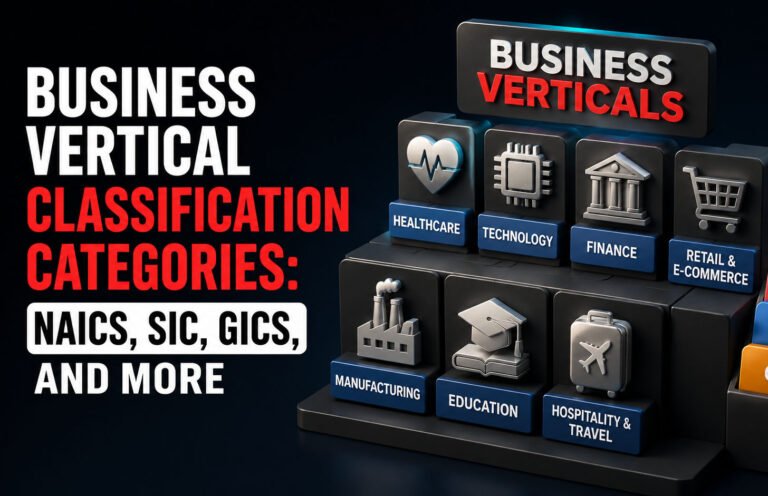
Business vertical classification categories are ways of grouping companies by the industries, products, services, customers, and markets they serve. Businesses use these categories to understand where they fit, who their competitors are, and which customers they should target.
The term can also refer to formal industry classification systems used by governments, investors, and researchers. These include NAICS, SIC, ISIC, NACE, GICS, and ICB. However, these formal systems are not the same as everyday business verticals.
This guide explains common business verticals, how they differ from industries and business models, and how the main classification systems work.
What Are Business Vertical Classification Categories?
Business vertical classification categories group businesses that operate in similar industries or serve similar markets. A vertical usually brings together companies with related products, services, customers, and business needs.
Healthcare is one simple example. Hospitals, clinics, medical device companies, health insurance providers, and telemedicine businesses all operate within the wider healthcare market, although they may belong to different subcategories.
A business vertical can be broad or very narrow. Technology is a broad vertical. Cybersecurity is narrower. Cybersecurity software made specifically for banks is even more specialized.
Several factors can help define a vertical. These include the company’s main industry, the products or services it offers, the customers it serves, common customer problems, regulations, and the competitors operating in the same market.
There is no single worldwide list of business verticals. A marketing company, government agency, financial data provider, and software company may organize industries differently because they use classifications for different purposes.
Business Vertical vs Industry
The words vertical and industry are often used in similar ways, but they are not always identical.
An industry normally describes a broad area of economic activity. A vertical often focuses more closely on a specific market, customer group, or specialized part of an industry.
For example, healthcare can be called an industry as well as a broad vertical. Inside healthcare, there may be more focused markets such as digital health, telemedicine, medical imaging, and practice management software.
The same structure appears in other areas:
- Finance → FinTech → digital payments
- Real estate → PropTech → property management software
- Education → EdTech → online tutoring platforms
- Legal services → LegalTech → contract management software
This distinction is especially useful in sales and marketing. A company may technically operate in the technology industry but build products only for healthcare organizations. In that case, healthcare may be its main target vertical.
Vertical Markets vs Horizontal Markets
A vertical market focuses on one industry or a narrow group of closely related customers. A horizontal market serves customers across many different industries.
A software platform designed only for hospitals is a vertical-market product. Its features may include patient workflows, healthcare integrations, and industry-specific compliance tools.
A general project management platform is different. Construction companies, advertising agencies, software teams, schools, and retailers may all use the same product. That makes it closer to a horizontal-market product.
| Vertical Market | Horizontal Market |
|---|---|
| Focuses on a specific industry | Serves many industries |
| Specialized features | General-purpose features |
| Narrower audience | Broader audience |
| Industry-specific knowledge | Cross-industry use |
| Focused marketing | Broad marketing |
Vertical specialization can make it easier to understand customer problems and create more relevant products. It can also help a company develop strong knowledge of industry regulations and workflows.
The limitation is market size. A company that serves only one narrow vertical may have fewer potential customers and can be more exposed to changes within that industry.
Common Business Vertical Categories
There is no official list containing a fixed number of business verticals. Different organizations use different categories. However, several broad verticals appear regularly in business, marketing, research, and sales.
Technology
The technology vertical covers companies that develop or support digital and electronic products and services.
It includes software development, SaaS platforms, IT services, cloud computing, artificial intelligence, cybersecurity, data analytics, hardware, and technology infrastructure.
Technology also overlaps heavily with other verticals. A software company may operate in technology while serving only financial institutions, hospitals, schools, or property companies.
Healthcare
Healthcare includes organizations involved in medical care, health services, medical products, and related technology.
Common parts of this vertical include hospitals, clinics, pharmaceutical companies, biotechnology firms, medical device manufacturers, laboratories, telemedicine services, health insurance, diagnostics, and healthcare IT.
Healthcare businesses often face specialized rules because they work with patient care, medical information, drugs, equipment, or insurance.
Financial Services
The financial services vertical covers businesses involved in managing, moving, lending, investing, or protecting money.
It includes commercial banks, investment banks, insurers, lenders, payment companies, asset managers, wealth management firms, mortgage companies, and FinTech businesses.
Digital banking, mobile payments, automated investing, and other financial technologies have created many narrower sub-verticals within this sector.
Retail and E-Commerce
Retail and e-commerce businesses sell products to consumers through physical stores, websites, apps, marketplaces, or a mix of these channels.
This vertical includes grocery stores, fashion retailers, electronics sellers, specialty shops, online marketplaces, direct-to-consumer brands, and other consumer retailers.
Many modern retailers operate both online and offline, so the line between traditional retail and e-commerce is often less clear than it once was.
Manufacturing
Manufacturing businesses turn materials, parts, or components into finished or semi-finished products.
Major areas include automotive manufacturing, electronics, industrial machinery, food processing, textiles, chemicals, aerospace, and consumer products.
Manufacturing can also overlap with technology through robotics, factory automation, industrial software, sensors, and connected equipment.
Education
The education vertical covers organizations that provide teaching, training, learning materials, and professional development.
It includes schools, colleges, universities, vocational training providers, corporate learning companies, online course platforms, EdTech firms, and certification providers.
Digital learning has created many narrower education markets, including virtual classrooms, learning management systems, and online tutoring.
Real Estate
The real estate vertical includes businesses involved in buying, selling, developing, managing, leasing, or investing in property.
It covers residential and commercial real estate, property management, brokerage, real estate development, industrial property, property investment, and PropTech.
PropTech companies use software and other technologies for areas such as listings, property management, building operations, and real estate transactions.
Transportation and Logistics
Transportation and logistics businesses move people, goods, and materials.
This vertical includes freight companies, shipping services, airlines, rail operators, public transport, warehouses, supply-chain companies, courier services, and last-mile delivery providers.
The growth of e-commerce has increased the importance of warehousing, fulfillment, delivery management, and supply-chain technology.
Hospitality and Travel
Hospitality and travel covers businesses that provide accommodation, tourism, food, events, and travel-related services.
Examples include hotels, resorts, restaurants, travel agencies, airlines, cruise services, tour operators, vacation rentals, and event businesses.
Customer service, booking systems, pricing, location, and seasonal demand can be important factors in this vertical.
Telecommunications
Telecommunications businesses provide the systems and services people and companies use to communicate.
This includes mobile networks, internet service providers, broadband companies, satellite communications, network infrastructure, voice services, and data services.
Telecommunications also overlaps with technology because many communication services depend on software, cloud infrastructure, and digital networks.
Other commonly used business verticals include energy, utilities, agriculture, construction, media, entertainment, professional services, legal services, government, and the public sector.
Vertical and Sub-Vertical Examples
Broad business verticals are often divided into smaller categories. These smaller markets are usually called sub-verticals, niches, or micro-verticals.
For example, financial services is a broad vertical. FinTech is a narrower area within it. A company that provides cross-border payment software for small businesses operates in an even more specific market.
The same pattern can be seen across several industries:
| Specialized Category | Main Vertical |
|---|---|
| HealthTech | Healthcare |
| FinTech | Financial services |
| EdTech | Education |
| PropTech | Real estate |
| LegalTech | Legal services |
| MarTech | Marketing |
This is especially common in SaaS. A company may build software, but the software itself may be designed for a very specific customer group.
For example, a cloud-based appointment system made only for dental clinics is a technology product, but its target vertical is healthcare and its micro-vertical may be dental practices.
A company can therefore be connected to more than one vertical. This does not necessarily mean that its official industry classification will also contain several equal categories. Formal classification systems follow their own rules.
The 4 Common Business Activity Categories
Another way to classify businesses is by the type of activity they perform. This is different from identifying an industry vertical.
Service Businesses
Service businesses mainly sell skills, expertise, labor, access, or other intangible services.
Examples include consulting firms, repair businesses, accounting firms, education providers, marketing agencies, and many professional services.
A service business can operate in almost any vertical. A cybersecurity consultant and a property management company are both service businesses, but they belong to different markets.
Merchandising Businesses
Merchandising businesses buy finished products and resell them to customers.
Retail stores and wholesalers are common examples. They generally do not manufacture the products they sell.
An electronics shop, clothing retailer, supermarket, and online reseller can all use this model.
Manufacturing Businesses
Manufacturing businesses create products by processing raw materials, parts, or components.
A furniture maker may turn wood and other materials into finished furniture. An automotive manufacturer combines thousands of components to build vehicles.
Manufacturing is both a broad economic activity and a major industry category in several formal classification systems.
Hybrid Businesses
Hybrid businesses combine more than one type of business activity.
A restaurant is a simple example. It prepares and sells physical food products while also providing service through seating, ordering, delivery, and customer care.
Many modern companies use hybrid models, especially when they combine products, subscriptions, services, and digital platforms.
These four categories describe how a business operates. They should not be confused with verticals such as healthcare, finance, technology, or real estate.
Other Ways Businesses Can Be Classified
Businesses can also be grouped according to their customers, products, location, or other characteristics. These approaches are useful, but they do not form one universal four-part standard.
Industry-Based Classification
Industry-based classification groups companies according to the area of the economy in which they operate.
Healthcare, banking, manufacturing, telecommunications, and construction are examples.
Formal systems such as NAICS and ISIC use detailed industry structures for statistical purposes.
Market-Based Classification
Market-based classification looks at the type of customer a business serves.
A business may be:
- B2B: business-to-business
- B2C: business-to-consumer
- B2G: business-to-government
These terms describe the relationship between the seller and the buyer. They do not identify the actual industry.
For example, a cybersecurity company can be B2B, while an online clothing retailer can be B2C.
Product-Based Classification
Product-based classification groups companies according to what they sell.
Businesses may be organized around software, financial products, food, machinery, healthcare products, consumer electronics, professional services, or other offerings.
This method is useful for product research and market analysis, although one company may sell products that fall into several categories.
Geographic Classification
Businesses can also be grouped according to the markets in which they operate.
A company may operate locally, regionally, nationally, or internationally.
Geographic classification is useful for sales, marketing, regulation, taxation, logistics, and expansion planning. However, geographic reach does not tell us the company’s industry.
Primary, Secondary, Tertiary, and Quaternary Sectors
Another common way to understand economic activity is to divide it into broad sectors. This model is much wider than normal business vertical classification.
Primary Sector
The primary sector covers activities that obtain natural resources.
Examples include agriculture, fishing, forestry, and mining.
These activities provide many of the raw materials used by other parts of the economy.
Secondary Sector
The secondary sector processes raw materials or components into other products.
Manufacturing and construction are major examples.
A factory producing vehicles or electronics belongs to the secondary sector because it turns materials and components into finished goods.
Tertiary Sector
The tertiary sector covers services.
Retail, banking, healthcare, transportation, hospitality, insurance, and many professional services fall into this broad category.
Modern economies often contain a large number of tertiary-sector businesses because services cover many different customer and business needs.
Quaternary Sector
The quaternary sector refers mainly to knowledge, information, research, and advanced intellectual services.
Examples can include information technology, scientific research, data services, research-driven consulting, and some education activities.
These four sectors provide a broad view of economic activity. They are not a replacement for detailed systems such as NAICS, ISIC, or NACE.
Formal Industry Classification Systems
Informal business verticals are useful for marketing and strategy, but governments, investors, researchers, and statistical agencies often need more structured systems.
Formal industry classification systems assign activities or companies to defined categories. Each system has its own purpose, structure, geographic scope, and rules.
The main systems readers are likely to encounter include NAICS, SIC, ISIC, NACE, GICS, and ICB.
NAICS
NAICS stands for North American Industry Classification System. It is used by statistical agencies in the United States, Canada, and Mexico to organize economic activity.
The system was introduced in 1997 and replaced SIC as the U.S. federal statistical standard.
NAICS is mainly production-oriented. Businesses and establishments are grouped according to similarities in the processes they use to produce goods or services.
The hierarchy becomes more detailed as more digits are added:
- 2 digits: sector
- 3 digits: subsector
- 4 digits: industry group
- 5 digits: NAICS industry
- 6 digits: national industry
The current completed U.S. edition is 2022 NAICS. Work on the 2027 revision is underway, so the revision year matters when working with codes or historical data.
NAICS also commonly works at the establishment level. A large company with several different types of operations may therefore have establishments classified differently.
SIC
SIC stands for Standard Industrial Classification.
It is an older system that was widely used in the United States before NAICS became the federal statistical standard in 1997.
SIC commonly uses four-digit industry codes. Although it is no longer the main U.S. federal statistical standard, SIC still appears in some government resources, historical datasets, commercial databases, regulatory systems, and business research tools.
A company should not assume that an SIC code and a NAICS code are interchangeable. The systems were designed differently, and a conversion may require a correspondence or crosswalk table.
ISIC
ISIC stands for International Standard Industrial Classification of All Economic Activities.
It is maintained through the United Nations statistical system and provides a common structure for organizing economic activities internationally.
ISIC is used in areas such as national accounts, employment statistics, enterprise statistics, and international economic comparisons.
Its hierarchy includes:
- Section
- Division
- Group
- Class
The United Nations Statistical Commission endorsed ISIC Revision 5 in 2023. The revision updates the classification to better reflect changes in the global economy and newer economic activities.
ISIC is particularly useful when data needs to be compared across countries.
NACE
NACE is the statistical classification of economic activities used in the European Union.
It is closely related to ISIC but provides the level of detail needed for European statistical reporting and analysis.
The updated framework is NACE Rev. 2.1.
Businesses, government agencies, researchers, and databases working with European economic data may therefore encounter NACE codes instead of NAICS codes.
NAICS and NACE should not be treated as direct replacements for each other. They come from different classification frameworks and may organize activities differently.
GICS
GICS stands for Global Industry Classification Standard.
It was developed for investment and financial-market analysis by MSCI and S&P Dow Jones Indices.
Unlike NAICS or ISIC, GICS is mainly intended to help investors, analysts, and portfolio managers organize public companies into comparable groups.
Its four-level structure includes:
- Sector
- Industry group
- Industry
- Sub-industry
The GICS framework contains 11 broad sectors, including Information Technology, Financials, Health Care, Energy, Industrials, Consumer Discretionary, Consumer Staples, Communication Services, Materials, Utilities, and Real Estate.
GICS should therefore not be confused with a government business-registration or statistical classification system.
ICB
ICB stands for Industry Classification Benchmark.
It is maintained by FTSE Russell, part of LSEG, and is mainly used in financial markets, investment research, indices, and portfolio analysis.
Its hierarchy includes:
- Industry
- Supersector
- Sector
- Subsector
ICB was launched in 2005 and has been revised as industries and financial markets have changed.
Like GICS, ICB is useful for grouping companies for investment analysis. It is different from systems such as NAICS, ISIC, and NACE, which are mainly designed for economic and statistical classification.
NAICS vs SIC vs ISIC vs NACE vs GICS vs ICB
These systems all classify economic or business activity, but they were created for different purposes. A code from one system should not be treated as a direct substitute for a code from another.
| System | Full Name | Main Purpose | Main Scope |
|---|---|---|---|
| NAICS | North American Industry Classification System | Economic and statistical classification | United States, Canada, Mexico |
| SIC | Standard Industrial Classification | Older industry classification | Mainly historical and administrative use in the U.S. |
| ISIC | International Standard Industrial Classification of All Economic Activities | International economic statistics | Global |
| NACE | Statistical Classification of Economic Activities in the European Community | European economic statistics | European Union |
| GICS | Global Industry Classification Standard | Investment and market analysis | Global financial markets |
| ICB | Industry Classification Benchmark | Investment, index, and portfolio analysis | Global financial markets |
NAICS, ISIC, and NACE are mainly used to organize economic activity for statistical and reporting purposes.
GICS and ICB serve a different need. They are designed mainly for investors, analysts, indices, and financial-market research.
SIC is older than NAICS. It still appears in some records and databases, but it is no longer the main U.S. federal statistical standard.
The same company can appear differently across these systems. This happens because each classification uses its own structure, definitions, and rules.
For example, a company may have a detailed NAICS code for its main economic activity while also being placed into a broader GICS sector for investment analysis.
Crosswalks and correspondence tables can help convert data between systems. However, these mappings are not always one-to-one. One category in one framework may match several categories in another.
How Businesses Are Assigned to a Vertical
There is no single rule for assigning an informal business vertical. The right classification depends on why the company is being categorized.
A marketing team may focus on the industry of the customer. A government agency may focus on the establishment’s main economic activity. An investor may use a financial classification such as GICS or ICB.
Common factors include the company’s main product or service, its primary customers, its main source of revenue, the way it produces goods or services, and the regulations that apply to its work.
The end use of a product can also matter. A software company that builds systems only for hospitals may be described as part of the healthcare vertical even though its technical activity is software development.
The purpose of classification should come first. A business choosing a market to target is doing something different from a company selecting an official industry code for reporting.
For formal classifications, businesses should use the definitions and rules of the specific system. Category names alone are not always enough. Descriptions, inclusions, exclusions, and related codes may need to be checked before choosing the best fit.
Can a Business Belong to More Than One Vertical?
Yes. Many modern companies operate across more than one vertical.
A healthcare software company is connected to both healthcare and technology. A FinTech company combines finance and technology. An e-commerce logistics provider may operate across retail, transportation, and supply-chain services.
For business strategy, companies often use a primary vertical and one or more secondary verticals.
A large company may also classify different divisions separately. One division may work in cloud computing, while another provides advertising, payments, or logistics.
Formal systems may handle this differently. Some classify the main activity of an establishment, while others classify a company based on its main business or revenue source.
This is why a company can reasonably have several market descriptions while still having one main official classification in a particular system.
Business Vertical vs Business Model vs Customer Type
These terms describe different parts of a business and should not be used as if they mean the same thing.
A business vertical describes the industry or market. Healthcare, finance, retail, and real estate are examples.
A business model describes how the company creates and earns revenue. Examples include subscriptions, marketplaces, licensing, direct sales, advertising, and transaction fees.
A customer type describes who buys from the business. Common examples include B2B, B2C, and B2G.
Customer size is another separate category. Businesses may target small businesses, mid-market companies, or large enterprises.
A company can therefore be described as:
B2B + SaaS + healthcare + enterprise
In this example:
- B2B describes the customer relationship.
- SaaS describes the software delivery or business model.
- Healthcare describes the vertical.
- Enterprise describes the customer size.
All four descriptions can be correct at the same time.
Why Business Vertical Classification Matters
Business vertical classification categories are useful because they give companies a clearer way to understand markets, customers, competitors, and economic activity.
The value depends on who is using the classification and why.
Marketing and SEO
Vertical classification helps marketers create content and campaigns for a more specific audience.
A company selling software to construction firms can use construction-related language, customer problems, case studies, and search terms instead of creating broad messages for every industry.
For SEO, knowing the target vertical can help with keyword research, content planning, competitor research, and landing page structure.
It can also help marketers identify search intent that is specific to an industry.
For example, a general keyword such as “project management software” may be much broader than “project management software for construction companies.”
Choosing a vertical does not automatically improve search rankings. It simply helps businesses create content that is more relevant to a specific audience.
Sales
Sales teams often use verticals to organize leads and accounts.
A salesperson targeting hospitals may need a different pitch from someone selling the same type of product to retailers.
Vertical segmentation can help teams understand common objections, buying processes, regulations, and customer priorities within a particular industry.
It can also make account research more focused.
Product Development
Industry-specific products often need features that general-purpose products do not.
Healthcare software may require specific privacy controls and medical workflows. Construction software may need project scheduling, site management, or contractor tools. Financial software may need transaction controls and reporting features.
Understanding the target vertical helps product teams decide which problems are most important to solve.
It can also guide integrations, workflows, terminology, and compliance requirements.
Market and Competitive Research
Vertical categories make it easier to compare similar companies.
Businesses can study competitors within the same market, compare products, track industry trends, and identify areas that may be underserved.
Market researchers also use classification systems to organize data and compare performance across sectors.
Without clear categories, comparisons between unrelated businesses can become less useful.
Investors and Financial Analysis
Investors use industry classifications to compare companies that face similar market conditions.
GICS and ICB are especially important in this area because they organize companies into sectors and smaller industry groups.
These systems support portfolio analysis, benchmarking, risk assessment, and sector-based investment strategies.
An investor may compare banks with other financial companies rather than comparing them directly with software, energy, or manufacturing firms.
Government and Statistical Uses
Governments and statistical agencies use formal classifications to organize economic data.
These classifications support areas such as employment statistics, business activity measurement, national accounts, economic planning, and industry analysis.
Systems such as NAICS, ISIC, and NACE make it easier to group similar economic activities and compare data over time.
Benefits of Vertical Specialization
Focusing on one vertical can help a business develop deeper knowledge of a particular market.
A company that serves one industry repeatedly may understand its workflows, terminology, regulations, and customer problems better than a general provider.
This can lead to more relevant products and services.
Vertical specialization can also make positioning clearer. Instead of competing as a general provider, a business can present itself as a specialist in one market.
Marketing and sales can become more focused because campaigns are built around a smaller group of customers with similar needs.
Product development may also become easier to prioritize. Teams can focus on industry-specific features instead of trying to satisfy every type of customer.
There are limits to this approach. A narrow vertical usually means a smaller total market. A company may also become more exposed to changes in one industry.
Higher conversion rates or stronger customer relationships are possible with good vertical targeting, but they are not guaranteed. Results still depend on product quality, competition, pricing, sales execution, and customer demand.
Challenges of Business Vertical Classification
One of the main problems with business vertical classification is overlap.
Many companies no longer fit neatly into one traditional industry. A company may combine software, finance, healthcare, logistics, or media in the same business.
Hybrid business models make classification harder. A company may sell products, provide services, operate a marketplace, and charge subscriptions at the same time.
New technology creates another problem. Formal classification systems are updated periodically, but new business models can appear faster than those systems change.
Different countries may also classify the same activity in different ways. A company working internationally may encounter NAICS, NACE, ISIC, or another local system depending on where it operates.
Cross-border comparisons can therefore require mapping between taxonomies.
Categories can also be too broad or too narrow. A broad label such as “technology” may not provide enough detail for marketing. A very narrow label may make market analysis difficult if only a small number of companies fit it.
Classification can change over time as a company grows, acquires other businesses, launches new products, or changes its main source of revenue.
For that reason, business classifications should be reviewed when the company’s activities change significantly.
How to Choose the Right Business Vertical
This question is most relevant to entrepreneurs, startups, agencies, and companies deciding which market they want to serve.
The first step is to study demand. A vertical should have real customers with problems that the business can solve.
Competition also matters. A crowded market is not always a bad choice, but a new company needs a clear reason why customers should choose it instead of existing providers.
Customer needs should be studied directly. Understanding buying behavior, budgets, common problems, regulations, and existing solutions can help show whether a vertical is a good fit.
Experience is another factor. A founder who already understands an industry may find it easier to build products, create useful content, and speak with potential customers in that market.
Profitability should also be considered. Market size alone does not show whether a business can build a sustainable model.
Regulation can affect the cost and difficulty of entering a vertical. Healthcare, finance, insurance, and other regulated industries may require more specialized processes than less regulated markets.
Businesses should also look at future expansion. A focused vertical can be a starting point, but adjacent markets may provide growth later.
A vertical should not be selected only because it is currently popular. Real demand, customer fit, competition, and business capability matter more.
How to Classify Your Business Correctly
Start by deciding why the classification is needed.
If the goal is marketing, a practical vertical such as healthcare, real estate, or financial services may be enough.
If the classification is needed for government reporting, statistical analysis, investment research, or another formal use, identify the required system first.
Next, determine the main activity of the business. Ask what the company actually produces, sells, or provides.
For formal systems, search the official classification and read the category description carefully.
Do not choose a code only because its title appears to match the business.
Check related categories, inclusion notes, and exclusions where available. A nearby classification may describe the business more accurately.
Large companies should also consider whether individual establishments or divisions need separate classifications.
Always record the classification system and revision. For example, NAICS 2022 is more precise than simply writing NAICS.
The classification should be reviewed when the business changes its main products, services, customers, or operations.
Common Business Classification Mistakes
One common mistake is treating an informal business vertical as if it were an official government category.
Healthcare may be a useful vertical label, but formal systems divide healthcare into many more specific activities and codes.
Another mistake is assuming that there are exactly seven business verticals. Lists of seven, ten, or another number are usually simplified examples rather than universal standards.
B2B and B2C are also sometimes mistaken for verticals. They describe who a business sells to, not the industry in which it operates.
The same problem occurs with SaaS. SaaS describes how software is delivered and commonly how it is paid for. It does not identify the customer’s industry.
Businesses can also choose the wrong formal code by looking only at a category title. Official descriptions and exclusions may change which category is correct.
Using an outdated classification revision can create problems when comparing data or completing current reporting.
NAICS should not be assumed to apply everywhere. European and international datasets may use NACE, ISIC, or other systems.
SIC and NAICS are also not interchangeable. A business may need a formal crosswalk to compare codes between them.
GICS should not be treated as a government registration system. Its main role is financial and investment classification.
Another mistake is assuming a company can have only one meaningful market association. A business can serve several verticals even when a formal system requires one main classification.
For marketing purposes, choosing a vertical that is too broad can also reduce usefulness. “Technology” may tell a sales team much less than “cybersecurity for financial institutions.”
Emerging Business Verticals and Classification Trends
Business verticals continue to change as technology, customer behavior, regulation, and investment priorities change.
Several areas are creating new sub-verticals or becoming more important within existing industries.
Artificial intelligence is one example. AI companies may serve healthcare, finance, manufacturing, education, cybersecurity, and many other markets.
Digital health combines healthcare with software, connected devices, data, and remote services.
FinTech continues to create specialized markets around payments, lending, digital banking, investing, and financial infrastructure.
Climate technology and green energy include businesses focused on areas such as renewable power, energy efficiency, emissions reduction, and environmental technology.
Cybersecurity has also become more specialized as businesses depend more heavily on digital systems.
Space technology is another growing area, including commercial satellites, launch services, data services, and related technologies.
These developments often lead to industry convergence, where products and services sit between traditional categories.
Hyper-specialization is also common. Instead of serving an entire industry, companies may focus on a very narrow customer group with a specific problem.
Data-driven segmentation can make these classifications even more detailed because companies can organize customers using industry, size, location, buying behavior, and other factors at the same time.
Formal classification systems are updated periodically to reflect changes in the economy. However, a new commercial term does not automatically become an official industry category.
Bottom Line
Business vertical classification categories help organize companies by industry, market, customer needs, and economic activity.
Common verticals include healthcare, technology, finance, retail, manufacturing, education, real estate, transportation, hospitality, and telecommunications. These are useful business categories, but they are not part of one universal official list.
Formal systems such as NAICS, SIC, ISIC, NACE, GICS, and ICB serve more specific purposes. Some are designed for economic statistics, while others are used mainly in financial markets.
The right classification depends on what the business is trying to do. Marketing teams may need a practical vertical. Government reporting may require an official industry code. Investors may use GICS or ICB.
Businesses that operate across several markets may also need more than one descriptive category.
Frequently Asked Questions
What are business vertical classification categories?
Business vertical classification categories are groupings used to organize companies according to their industry, products, services, customers, or market focus.
Healthcare, finance, technology, retail, manufacturing, and real estate are common examples.
What are the main business verticals?
There is no fixed worldwide list.
Common business verticals include technology, healthcare, financial services, retail, manufacturing, education, real estate, transportation and logistics, hospitality, telecommunications, energy, construction, and professional services.
Different organizations may use broader or narrower categories.
What are the 7 verticals of business?
Some simplified business guides use seven broad verticals: healthcare, technology, finance, retail and e-commerce, manufacturing, education, and hospitality and travel.
This is not an official universal classification. Many other important verticals exist, including real estate, telecommunications, logistics, energy, and government.
What are the 4 main categories of business?
A common activity-based model divides businesses into service, merchandising, manufacturing, and hybrid businesses.
These describe how a company operates rather than which industry it belongs to.
What are the four economic sectors?
The four commonly discussed economic sectors are primary, secondary, tertiary, and quaternary.
The primary sector deals with natural resources. The secondary sector covers manufacturing and processing. The tertiary sector covers services. The quaternary sector covers knowledge and information-based activities.
These broad sectors are different from detailed business vertical classifications.
What is the difference between a business vertical and an industry?
An industry usually describes a broad area of economic activity. A business vertical often refers to a more focused market or group of customers within an industry.
The terms can overlap in everyday business use.
For example, healthcare can be described as both an industry and a vertical, while telemedicine software is a much narrower vertical market.
Can a business belong to multiple verticals?
Yes.
A healthcare software company can be connected to both healthcare and technology. A FinTech company can be connected to finance and technology.
For marketing, a company may use primary and secondary verticals. Formal classification systems may still require one main category based on their specific rules.
What is the difference between NAICS and business vertical classification?
NAICS is a formal industry classification system used for economic and statistical purposes in North America.
Business vertical classification is a broader and more flexible business concept. Companies use verticals for marketing, sales, customer segmentation, product strategy, and market analysis.
A business may describe its target vertical as healthcare while using a much more specific NAICS code for formal statistical classification.
More To Explore:
SEO Instant Appear HighSoftware99.com Review: Features, Benefits & Alternatives
