

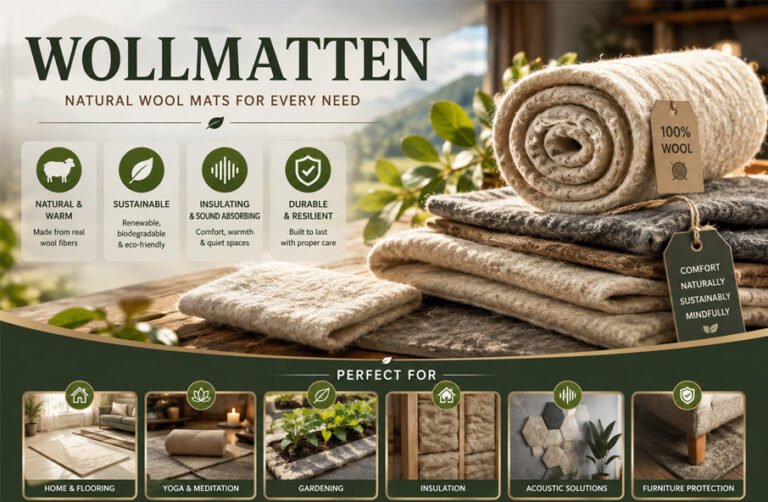
Wollmatten is a German term that generally means wool mats. It does not describe one specific product. Depending on the design, Wollmatten can be used as floor coverings, yoga mats, garden covers, protective pads, acoustic materials, or building insulation.
People searching for Wollmatten often want to know what these mats are made from, how they work, and which type is suitable for a particular use. This guide explains the main types of Wollmatten, their materials, uses, benefits, limitations, care needs, and important buying points.
What Is Wollmatten?
Wollmatten is the plural form of the German word Wollmatte. “Wolle” means wool, while “Matten” means mats.
In simple terms, Wollmatten are mats made completely or partly from wool. Sheep’s wool is the most common material. However, the term does not describe one fixed design or technical standard.
A Wollmatte may be a soft floor mat placed beside a bed, a thick felt pad protecting furniture, a wool surface used for meditation, or an insulation product fitted inside a wall. Garden products made from wool may also be sold as Wollmatten.
This means two products with the same general name can perform very differently. Their purpose depends on their materials, construction, thickness, density, backing, and intended use.
What Are Wollmatten Made From?
Most Wollmatten use sheep’s wool as their main fibre. Some products contain almost entirely wool, while others combine wool with different materials.
Possible additional materials include synthetic fibres, cotton, natural fibre foundations, latex, adhesives, binders, dyes, coatings, and non-slip backing.
This is important because a product advertised as a wool mat may not be made entirely from wool. Even a label saying “100% wool” can sometimes refer only to the visible pile or surface. The backing and other parts may contain different materials.
The complete material composition matters when choosing a Wollmatte. It can affect cleaning, grip, durability, moisture resistance, environmental impact, and whether the finished product can biodegrade.
For technical products such as insulation or acoustic mats, the material label alone is not enough. Buyers also need to check tested performance and the manufacturer’s intended use.
How Are Wollmatten Made?
Wool mat production depends on the type of product.
Raw wool normally goes through cleaning and sorting to remove dirt and unwanted material. The fibres may then be carded to separate and organize them before the mat is formed.
Several manufacturing methods are commonly used.
Felting joins wool fibres into a dense sheet using combinations of moisture, pressure, heat, friction, or mechanical action. Felt mats can be thin and firm or thick and soft.
Needle punching uses special mechanical needles to repeatedly push through the fibres and entangle them. This method is often used for dense felt-style products, including some garden and technical mats.
Weaving uses wool yarn arranged in a textile structure. Woven products are common for decorative floor coverings.
Tufting inserts wool yarn into a foundation material. The back may then be secured using another layer or adhesive.
Some Wollmatten can also be knotted or compressed, depending on their intended purpose. Manufacturers may add backing, edge finishing, coatings, or protective treatments afterward.
The manufacturing method changes how a mat feels and performs. A tightly felted wool pad can be firm and protective, while a woven or tufted wool mat may be softer and better suited to flooring.
Main Types of Wollmatten
Wollmatten are available in several forms. The correct type depends mainly on what the mat needs to do.
Wool Floor Mats
Wool floor mats are used in bedrooms, living rooms, offices, hallways, reading areas, and other indoor spaces.
They can make a hard floor feel warmer and softer underfoot. Wool also adds natural texture to rooms with wood, stone, tile, concrete, or similar surfaces.
Floor Wollmatten may be woven, tufted, felted, braided, or made using other textile methods. Some are designed mainly for decoration, while others are built to handle regular foot traffic.
Backing is especially important for floor mats. A mat placed on smooth flooring may need a non-slip surface or a separate rug pad to prevent movement.
Felt and Protective Wool Mats
Dense wool felt can be used as protective padding.
These mats may be placed on desks, tables, shelves, benches, or underneath furniture and equipment. The material creates a soft barrier between hard surfaces and can help reduce scratches, pressure marks, and minor vibration.
Thickness and density matter for this type of Wollmatte. A thin felt sheet may work well for light objects, while heavy furniture or equipment may require a denser material.
Yoga and Meditation Mats
Some Wollmatten are designed for yoga, meditation, and relaxation.
Wool can provide a warm and cushioned surface for seated meditation, breathing exercises, Yoga Nidra, Yin yoga, and restorative positions. It can feel warmer than many thin rubber or synthetic exercise mats.
However, softness does not always provide strong grip. For active yoga, standing poses, quick transitions, or sweaty exercise, users should check the product’s traction and backing carefully.
A wool meditation mat and a high-grip exercise mat therefore serve different needs.
Garden Wool Mats
Garden Wollmatten are made for outdoor and agricultural uses.
Depending on the product, wool mats can be placed around plants, shrubs, young trees, raised beds, or containers. Some are designed to protect plant pots and roots against cold conditions.
Wool ground covers may also reduce the amount of light reaching weed seedlings. This can help limit weed growth. They may also slow moisture loss from the soil.
Some untreated natural wool products are designed to break down gradually. As wool decomposes, it can return organic material to the soil. However, the rate depends on climate, moisture, mat thickness, treatment, and soil contact.
Garden products should be chosen specifically for outdoor or soil use. An indoor wool floor mat should not automatically be used as garden material.
Wool Insulation Mats
Sheep’s wool can be processed into insulation mats for walls, roofs, ceilings, and floors.
Wool fibres naturally have a crimped or wavy structure. This creates small spaces that hold still air. Because trapped air slows heat movement, thick wool insulation can help reduce heat transfer.
Building insulation must meet different requirements from decorative Wollmatten. Thickness, density, thermal performance, fire information, installation method, and local building rules all need to be considered.
A normal wool rug or felt floor mat should never be used as a substitute for certified insulation simply because both contain wool.
Acoustic Wool Mats
Wool is also used in materials intended to manage sound.
Its irregular fibrous structure can absorb some sound energy instead of reflecting all of it back into a room. Wool mats or panels may therefore help reduce echo and make spaces with many hard surfaces feel less acoustically harsh.
Purpose-made acoustic wool products may be used in offices, studios, meeting rooms, music spaces, or home entertainment areas.
Sound absorption should not be confused with soundproofing. A wool mat may reduce reflected sound inside a room without preventing sound from travelling through walls or floors. Technical acoustic projects should use tested products with suitable performance information.
How Do Wollmatten Work?
Many useful properties of Wollmatten come from the structure of wool fibres.
Wool fibres are naturally crimped rather than completely straight. When many fibres are placed together, small pockets of air form between them. These air spaces contribute to thermal insulation and can also give wool a springy, cushioned feel.
Wool is also able to absorb and release moisture vapour as conditions around it change. This can help the material respond to changing indoor humidity.
However, moisture management does not mean wool is waterproof. A Wollmatte that stays wet for a long time can develop stains, smells, distortion, or other damage.
The fibrous structure can also absorb part of the sound energy in a room. This helps explain why rugs, wool panels, curtains, and other soft materials can reduce echo compared with completely bare hard surfaces.
Wool fibres also have natural elasticity. They can bend and recover from normal pressure, which can help a well-made Wollmatte keep its shape.
Actual performance still depends on the finished product. Fibre quality, thickness, density, backing, construction, treatments, and installation can all change how well a Wollmatte performs.
Benefits of Wollmatten
One of the main benefits of Wollmatten is natural warmth. Wool’s crimped structure traps air, which helps create a warmer surface over cold flooring and allows purpose-made products to provide thermal insulation.
Wool can also be comfortable underfoot. Floor and wellness mats may offer softness, cushioning, and some resilience when the product has suitable thickness and construction.
Another useful property is moisture-vapour management. Wool can interact with moisture in the surrounding air and later release it as conditions change. This can support indoor comfort, although it should never be confused with waterproofing.
Wool mats can also provide some acoustic benefit. Large floor coverings can reduce sound reflections in rooms, while purpose-made acoustic products can provide stronger sound absorption.
Wool has naturally favourable fire behaviour compared with many easily ignited fibres. It tends to char rather than melt like some synthetic materials. However, a finished Wollmatte should not automatically be described as fireproof because backing, adhesives, dyes, and other components can change its behaviour.
Wool is also a renewable natural fibre because sheep grow new fleece after shearing. Pure untreated wool can biodegrade under suitable conditions. This can be useful for some garden products and may reduce long-term persistence compared with certain synthetic materials.
These benefits do not apply equally to every Wollmatte. The intended use, wool content, thickness, density, construction, and additional materials determine what a particular product can actually provide.
Limitations of Wollmatten
Wollmatten have many useful qualities, but they are not the best choice for every situation.
One common drawback is price. Wool products can cost more than basic synthetic mats, especially when they use high-quality fibres, dense construction, or skilled manufacturing.
Some new wool mats may shed loose fibres. Light shedding can reduce over time, but heavy or continuing fibre loss may point to weak construction or unsuitable cleaning.
Wool can also be sensitive to moisture. It can manage moisture vapour, but a mat that stays wet for too long may develop smells, stains, distortion, or other damage. This makes ordinary wool floor mats less suitable for bathrooms, damp basements, and outdoor areas unless they are specifically designed for those conditions.
Cleaning also needs more care than with many synthetic mats. Hot water, strong rubbing, harsh chemicals, or unsuitable washing can cause shrinking, felting, colour changes, or backing damage.
Natural wool can also attract moths and other textile pests when stored in dark, quiet, and undisturbed places. Clean, dry storage helps reduce this risk.
Some people may notice a natural wool smell, especially in minimally processed products. Coarse wool may also feel rough against sensitive skin.
Another limitation is that the word Wollmatten does not guarantee performance. Two wool mats may look similar but differ greatly in strength, grip, density, insulation, and care needs.
Are Wollmatten Sustainable?
Wool is a renewable natural fibre because sheep grow new fleece after shearing. Pure, untreated wool can also biodegrade under suitable conditions.
This can give wool an environmental advantage over some plastic-based materials, especially when a product has a long useful life.
However, not every Wollmatte is fully natural or biodegradable.
A finished mat may contain synthetic backing, plastic mesh, latex, adhesives, dyes, coatings, binders, or pest treatments. These added materials can change how the product breaks down at the end of its life.
Environmental impact also depends on more than fibre type. Sheep farming, processing, transport, energy use, cleaning, product lifespan, and disposal all matter.
For buyers who care about sourcing, certifications can provide extra information. The Responsible Wool Standard is one example used to address wool sourcing, animal welfare, land management, and chain-of-custody requirements. Recycled wool products may use different certification systems.
The best approach is to check the full material composition and sourcing details rather than relying only on words such as “natural,” “green,” or “eco-friendly.”
How to Choose the Right Wollmatten
The first step is to decide what the mat must do.
A bedroom floor mat, yoga mat, garden cover, acoustic panel, and insulation product all need different qualities. Choosing by appearance alone can lead to the wrong product.
Check the dimensions carefully. For floor use, measure the space and consider how the mat will sit around furniture. For insulation, measure the available depth and make sure the product is designed for that application.
Material content is also important. Check the wool percentage, but do not stop there. Look at the backing, binders, coatings, edge materials, dyes, and any synthetic fibres.
Thickness and density should be considered together. A thick mat may feel soft, but density helps show how well it may resist compression and maintain its form.
Backing is especially important for floor and yoga Wollmatten. It affects grip, movement, moisture behaviour, cleaning, and sometimes recyclability or biodegradability.
For technical products, look for verified information instead of general claims. Building insulation should have tested thermal performance and appropriate safety information. Acoustic products should provide suitable sound-absorption data where needed.
For garden wool mats, check whether the product is safe for soil contact and whether it is designed to break down naturally.
Care instructions should also be checked before buying. If a mat requires professional cleaning or cannot tolerate water, that may affect whether it is practical for your home.
How to Clean and Care for Wollmatten
Cleaning should always follow the manufacturer’s instructions because not all Wollmatten are made in the same way.
For floor mats, regular gentle vacuuming can remove dust and loose dirt before it becomes deeply embedded. Use a setting that suits the pile and avoid excessive suction on delicate surfaces.
Spills should be treated quickly. Blot the area with a clean cloth instead of rubbing it. Rubbing can spread a stain and disturb the fibres.
Avoid using bleach or strong household cleaners unless the manufacturer specifically allows them. Wool can react badly to unsuitable chemicals and high alkalinity.
Do not assume a wool mat is machine washable. Wet cleaning can cause shrinking, distortion, colour movement, slow drying, or damage to the backing.
If a Wollmatte becomes wet, dry it thoroughly according to its care instructions. Never store wool while it is damp.
Large, valuable, handmade, or heavily soiled wool mats may be safer to clean professionally.
For long-term storage, clean and dry the mat first. Keep it in a dry, ventilated place and check it from time to time for moisture or insect activity.
Floor mats can also be rotated occasionally if sunlight and foot traffic are uneven. This can help reduce uneven fading and wear.
Wollmatten vs Other Materials
The best alternative to Wollmatten depends on how the mat will be used.
Synthetic Mats
Synthetic mats are commonly made from materials such as polypropylene, polyester, nylon, or foam.
People often choose them because they can be cheaper, easier to clean, and more suitable for wet or high-traffic areas. Many also offer predictable grip and a wide range of colours and designs.
Compared with wool, synthetic mats may be less warm or natural in feel. They can also persist for a long time after disposal if they are not recycled.
Synthetic mats are often a better choice for bathrooms, outdoor areas, intense exercise, or places where frequent washing is important.
Cotton Mats
Cotton mats are soft, light, and often easier to wash at home.
They are commonly used in kitchens, bathrooms, bedrooms, and casual indoor spaces. Cotton can feel comfortable and is widely available.
Compared with wool, cotton often absorbs liquid more quickly and may flatten faster under pressure. Wool usually provides better warmth and natural resilience.
Cotton can be a practical choice when easy washing matters more than insulation or long-term shape retention.
Mineral Wool and Fibreglass Insulation
Mineral wool and fibreglass are widely used building insulation materials.
They are commonly chosen because they are available in many markets, have well-established technical data, and can provide strong thermal performance.
Sheep-wool insulation may appeal to people who prefer flexible natural fibres, but the best choice depends on local building rules, moisture conditions, cost, availability, and tested performance.
No insulation product should be chosen only because it is natural. Technical ratings and correct installation are more important.
Cellulose and Wood-Fibre Insulation
Cellulose insulation is usually made from recycled paper fibres, while wood-fibre products use processed plant material.
Both are used as alternatives to conventional insulation and may appeal to people looking for fibre-based building materials.
Their performance, cost, installation method, and moisture behaviour differ from wool. The most suitable option depends on the building design and local requirements.
Garden Ground Covers
Gardeners can use several alternatives to wool mats, including jute, coir, straw, cardboard, bark, compost, and landscape fabric.
Natural materials such as straw and cardboard can break down over time and may be useful when temporary soil coverage is needed.
Reusable landscape fabric can last longer and may provide stronger long-term weed control, but it is often made from synthetic material.
Garden Wollmatten can be useful when biodegradability and natural fibre content matter, but the best choice depends on climate, plants, soil, and how long the cover needs to remain in place.
Buying Tips: What to Check Before Paying
The most important buying rule is simple: choose the product by its purpose, not only by the word “Wollmatten.”
Check the complete material label. Look at the wool percentage, backing, binders, coatings, dyes, and other fibres.
Compare thickness and density. A thick mat is not automatically stronger or more durable.
Examine the backing carefully. Smooth floors may need non-slip support, while garden or biodegradable uses may require a product without synthetic backing.
Read the care instructions before buying. Make sure the cleaning method fits how you plan to use the mat.
For technical uses, check verified thermal, acoustic, or fire information where relevant.
Also be cautious with broad marketing claims. Terms such as “waterproof,” “soundproof,” “fireproof,” “chemical-free,” or “fully biodegradable” should only be trusted when they are supported by clear product information.
Price alone does not show quality. A more expensive mat may use better materials or construction, but the product still needs to match the intended use.
Bottom Line
Wollmatten are a broad group of wool-based mats used for flooring, yoga, gardening, protection, acoustics, and insulation.
Their main advantages come from wool’s natural warmth, cushioning, resilience, and ability to manage moisture vapour. Pure untreated wool can also biodegrade under suitable conditions.
However, not all Wollmatten are the same. Construction, thickness, density, backing, treatments, and intended use can change how a mat performs.
The best choice is the one that matches the job, has clear material information, and comes with suitable care and performance details.
Frequently Asked Questions
What does Wollmatten mean?
Wollmatten is the German plural term for wool mats. The singular form is Wollmatte. The word is general and can describe several types of wool-based products.
Are Wollmatten always made from 100% wool?
No. Some are made mostly or entirely from wool, while others contain synthetic fibres, backing, adhesives, dyes, coatings, or other materials.
A “100% wool” label may sometimes describe only the visible wool surface, so the full product composition should be checked.
Are Wollmatten waterproof?
No. Wool can manage moisture vapour and may resist small amounts of liquid for a short time, but it is not naturally waterproof.
Products used in wet areas should be specifically designed for those conditions.
Can Wollmatten be washed?
Some can, but many cannot be machine washed.
Cleaning depends on the construction, dyes, backing, and manufacturer’s instructions. Incorrect washing can cause shrinking, distortion, colour changes, or backing damage.
Are Wollmatten good for yoga and meditation?
They can work well for meditation, Yin yoga, Yoga Nidra, breathwork, and restorative exercises because wool provides warmth and cushioning.
For fast, standing, or sweaty yoga, check grip carefully. A soft wool surface may not provide enough traction.
Can Wollmatten be used in gardens?
Yes, if the product is designed for garden use.
Garden wool mats can be used around plants, raised beds, containers, shrubs, or trees. Depending on the product, they may help with weed control, moisture retention, frost protection, or soil coverage.
Are Wollmatten biodegradable?
Pure untreated wool can biodegrade under suitable conditions.
However, the whole mat may not be biodegradable if it contains synthetic backing, adhesives, coatings, plastic mesh, or blended fibres.
How long do Wollmatten last?
There is no single lifespan for all Wollmatten.
Durability depends on fibre quality, density, construction, traffic, moisture, sunlight, cleaning, and storage. A well-made wool mat that is used and maintained correctly can remain useful for many years, while a poorly made or heavily exposed product may wear much sooner.
More To Explore:
