

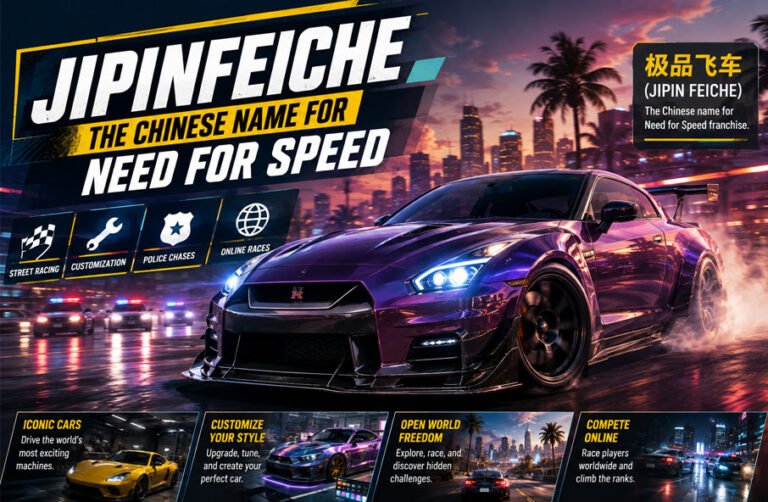
Jipinfeiche is the romanized form of 极品飞车 (Jípǐn Fēichē), the Chinese name commonly used for Electronic Arts’ Need for Speed racing game franchise. People often search for Jipinfeiche after seeing the word in gaming videos, guides, forums, or Chinese-language game discussions.
The spelling can be confusing because the Chinese characters, spaces, and tone marks are often removed online. This article explains what Jipinfeiche means, how it connects to Need for Speed, the history of the series, its gameplay, cars, customization, racing modes, police pursuits, and other important parts of the franchise.
What Does Jipinfeiche Mean?
Jipinfeiche comes from the Chinese name 极品飞车. In standard pinyin, it is written Jípǐn Fēichē. When people type it online, they often remove the tone marks and spaces, creating the single word Jipinfeiche.
The first part, 极品 (jípǐn), can describe something excellent, top-class, or high quality. The second part, 飞车 (fēichē), is connected with speeding or fast-moving vehicles. Together, the words suit the high-speed racing theme of Need for Speed.
A direct word-for-word English translation is less useful than understanding how the name is actually used. In gaming, 极品飞车 is strongly associated with Need for Speed.
This is why searches for Jipinfeiche often lead to information about Need for Speed games, cars, gameplay videos, customization guides, downloads, and racing discussions.
Is Jipinfeiche the Same as Need for Speed?
Yes. In the gaming context, Jipinfeiche refers to 极品飞车, the Chinese name used for the Need for Speed franchise. It should not normally be treated as the name of a completely separate racing series.
The confusion mainly comes from the way the word is written. Someone who does not know Chinese may see “Jipinfeiche” written in Latin letters and assume it is a new game, website, app, or company.
The connection becomes much clearer when the Chinese characters are included:
Jipinfeiche → Jípǐn Fēichē → 极品飞车 → Need for Speed
Electronic Arts uses 极品飞车 on its Chinese-language Need for Speed pages. Individual games can then add extra Chinese words to distinguish one release from another.
Some websites have given Jipinfeiche other meanings, including productivity systems, workflow tools, lifestyle ideas, or independent gaming projects. However, the established gaming use has much stronger support. The sources we reviewed also identify Jipinfeiche directly with the Need for Speed name.
The History of Need for Speed
The Need for Speed franchise began in 1994. Its early games focused on high-performance cars, competitive racing, and the experience of driving powerful vehicles at high speeds.
Over time, the series expanded considerably. Different releases introduced larger collections of vehicles, improved graphics, new environments, different race formats, police pursuits, customization systems, stories, and online play.
Different development teams have worked on the series during its long history. Because of this, individual Need for Speed games can feel quite different from one another.
One major change came with the increased focus on street racing. Titles such as Need for Speed: Underground placed greater attention on modified cars, city streets, music, nighttime environments, and vehicle customization. Players could make both visual and performance changes instead of simply selecting a car and entering races.
Police pursuits also became an important part of the franchise. Games such as Need for Speed: Most Wanted helped make high-speed police chases one of the series’ most recognizable gameplay elements.
Not every release uses the same formula. Some focus more strongly on street racing, while others give greater attention to open-world driving, police action, multiplayer racing, or other ideas.
How Jipinfeiche Gameplay Works
There is no single gameplay system shared by every Need for Speed release. However, many games in the series use an accessible, arcade-style approach to racing.
The main focus is usually on speed, responsive driving, exciting events, and competition rather than recreating every technical detail of professional motorsport. This makes many entries easier to understand for casual players while still giving experienced players room to improve.
A typical game may involve choosing a car, entering events, earning progress, unlocking new content, improving vehicles, and taking part in increasingly difficult races.
Driving skill still matters. Players can improve by learning when to brake, how to enter and leave corners, when to accelerate, and how different cars behave.
A good racing line can help maintain speed through turns. Braking too late can cause the car to leave the road or lose control, while braking too early can cost valuable time.
Different cars also behave differently. A powerful vehicle may be fast on straight roads but harder to control through tight corners. Another car may have a lower top speed but provide better handling.
Gameplay varies by release, so readers should check the specific Need for Speed game they want to play rather than assuming every title works in exactly the same way.
Cars and Vehicle Customization
Cars are at the center of the Jipinfeiche or Need for Speed experience. Different games include different selections of sports cars, muscle cars, supercars, exotic vehicles, and other performance-focused models.
The available manufacturers and vehicles depend on the individual release.
Customization has also become an important feature in many Need for Speed games. It allows players to change a vehicle rather than leaving it in its standard appearance.
Visual customization may include paint, wheels, decals, vinyl designs, spoilers, body parts, and other cosmetic changes. The exact options depend on the game.
This became especially important during the Underground period, when modified cars and street-racing culture became a stronger part of the franchise.
Customization also gives players more control over how their cars look. Two players can begin with the same vehicle model and create very different versions using different colors, wheels, body parts, and designs.
Not every Need for Speed title offers the same level of customization, so individual game features should always be checked separately.
Performance Upgrades and Tuning
Visual customization changes how a car looks. Performance upgrades change how it drives.
Depending on the particular game, players may be able to improve components related to engines, tires, brakes, suspension, handling, and other performance areas.
More power is not always the best solution. A very fast car can still be difficult to race effectively if it has weak braking, poor grip, or difficult handling.
A more balanced setup can often be easier to use. Players may need to think about several areas, including acceleration, top speed, cornering ability, braking, and stability.
Tuning can also depend on the type of event. A setup designed for fast roads may not work as well in a race with many tight corners.
Testing is therefore useful. Players can try a setup, see where the car performs poorly, and make further changes.
The available tuning options vary widely across the franchise. Some games provide simple upgrades, while others allow more detailed changes.
Racing Modes and Challenges
Need for Speed games are not limited to one type of racing event.
Depending on the release, players may find circuit races, sprint races, drift competitions, time-based challenges, police-related events, and other activities.
A circuit race usually takes place across several laps, while a sprint generally follows a route from one point to another. Drift events focus more on controlled sliding and scoring than simply reaching the finish line first.
Time challenges test how quickly players can complete a route or objective.
Different events may require different driving skills. A car that performs well in a high-speed sprint may not be the best choice for a technical course with many corners.
This is one reason vehicle selection and tuning can matter. Players can choose cars and setups that better fit the type of event they are entering.
The exact race modes differ between games, so no single list applies to the entire franchise.
Police Pursuits
Police pursuits are one of the best-known features in several Need for Speed games.
Instead of competing only against other racers, players may also have to escape police vehicles. These chases can involve roadblocks, pursuing cars, changing routes, and making quick decisions while driving at high speed.
The objective can be different from a normal race. Speed is still important, but the player may also need to avoid obstacles, find alternative roads, maintain control, and create enough distance to escape.
Need for Speed: Most Wanted is one of the most recognizable examples of the franchise using police pursuits as a major gameplay feature.
Police chases can also make knowledge of the map more useful. Knowing where roads lead or where alternative routes are available can help during an escape.
However, police pursuits are not equally important in every Need for Speed release. Some games focus on them heavily, while others place more attention on standard racing or other gameplay systems.
Open-World Driving and Exploration
Several Need for Speed games use open-world environments rather than keeping players only on closed racing tracks.
An open world allows players to drive around a larger area between events. They may explore streets, learn routes, travel to activities, test upgraded cars, or simply drive without immediately starting another race.
Exploration can also have practical benefits. Learning roads, intersections, turns, and shortcuts can make racing easier later.
Map knowledge can be especially helpful during police pursuits. A player who knows alternative routes may have more options when trying to escape.
Open-world design also makes customized vehicles more useful outside normal races. Players can test handling, acceleration, and other changes while driving freely.
Not every Need for Speed game uses the same map structure. Some provide large connected environments, while others use a more traditional event-based design.
Story, Rivals, and Progression
Some Need for Speed games include stories, characters, rivals, and progression systems. These elements give players goals beyond simply winning individual races.
Rivals often act as major opponents. Defeating them may unlock new events, vehicles, areas, upgrades, or other rewards. In some games, the story also includes illegal racing groups, police investigations, personal competition, or other racing-related conflicts.
The amount of storytelling changes from one game to another. Some releases use cinematic scenes and clear characters, while others focus more directly on racing and progression.
Progression usually gives players reasons to keep playing. As they complete events, they may gain access to faster cars, stronger upgrades, harder races, or new parts of the map.
Because each release follows a different design, Jipinfeiche should not be described as having one fixed story or progression system.
Online Racing and the Need for Speed Community
Online racing allows players to compete against real people instead of only computer-controlled opponents.
Human players can be less predictable. Some race aggressively, while others focus on smooth driving, careful overtaking, or protecting their position. This can make multiplayer races feel different each time.
Online features depend on the specific Need for Speed title. Supported games may include competitive races, shared open-world sessions, rankings, challenges, or other multiplayer activities.
The wider Need for Speed community is also important. Players share gameplay videos, car builds, tuning ideas, screenshots, tutorials, racing tips, and discussions about older and newer releases.
Community activity helps older games stay visible even after newer titles are released. Fans still discuss favorite cars, maps, soundtracks, police chases, customization systems, and memorable events from classic entries.
Jipinfeiche on Mobile
The Chinese 极品飞车 name is also used for mobile games connected with the Need for Speed franchise.
One important example is 极品飞车:集结, a mobile racing game developed by Tencent’s TiMi team with official authorization from Electronic Arts.
The game uses an open-world design and includes racing, exploration, multiplayer activities, car collection, and customization. Official listings also describe a large number of licensed vehicles from many real-world manufacturers.
It is available through Chinese mobile gaming services, including iOS listings in China, and current platform information also shows Android and PC support.
This does not mean every mobile game connected with Jipinfeiche has the same features. The name refers to the wider Chinese Need for Speed identity, while each individual game has its own design, platforms, pricing, and system requirements.
Some mobile versions are free to download but include in-app purchases. These can include virtual currency, passes, subscriptions, or other paid items depending on the release and platform.
Players should always check the exact game before comparing prices or device requirements.
Why Older Need for Speed Games Are Still Popular
Older Need for Speed games continue to attract players for several reasons.
Nostalgia is one factor. Players often remember specific cars, songs, characters, maps, races, and police pursuits from games they played years earlier.
Gameplay is another reason. Some older releases have strong progression systems, memorable environments, enjoyable handling, or customization styles that newer games do not fully replace.
Different generations of Need for Speed also offer different experiences. A player who prefers street racing may return to an older title, while someone who enjoys police pursuits may prefer a different entry.
Online videos, fan discussions, mods, guides, and community content can also help classic games remain visible.
New technology does not automatically make an older racing game less enjoyable. For many players, the design of a specific release matters more than its age.
Why Is There Confusing Information About Jipinfeiche Online?
Jipinfeiche has been described in several different ways online.
Some websites present it as a productivity system, workflow platform, lifestyle idea, automotive concept, or independent racing game. Others describe it only as a general racing-community keyword.
There is not strong primary evidence supporting these unrelated meanings as the established definition of Jipinfeiche.
The clearest and best-supported use comes from the Chinese name 极品飞车, which is directly connected with Need for Speed. One of the sources we reviewed states clearly that Jipinfeiche is the pinyin form of 极品飞车 and should not be treated as a separate racing franchise.
Part of the confusion comes from romanization.
When Jípǐn Fēichē is written without Chinese characters, tone marks, or spaces, it becomes Jipinfeiche. To someone unfamiliar with Chinese pinyin, that can look like the name of a separate app, website, company, or game.
Another source we reviewed describes Jipinfeiche more loosely as a community-driven gaming keyword and says there is limited evidence for a standalone commercial product.
That caution is useful, but it does not remove the stronger evidence linking 极品飞车 with Need for Speed.
Readers should therefore be careful with articles that assign completely different meanings to the word without showing an official source.
Downloads, Safety, and Privacy
There is no single universal “Jipinfeiche download” because Jipinfeiche refers to the Chinese name connected with the Need for Speed franchise, not one separate piece of software.
Before downloading anything, users should first identify the exact game they want.
Official game stores, publisher pages, console stores, and recognized mobile app stores are safer choices than unknown download sites.
Unofficial websites may use popular gaming keywords to attract visitors. Some may offer APK files, modified games, fake installers, or download buttons that lead to unrelated software. The source material also warns users to verify downloads and avoid unknown files from unofficial websites.
Privacy also depends on the actual service being used. An EA game, Tencent mobile title, console account, PC platform, or mobile store may each have different privacy rules and data practices.
Users should review permissions, privacy policies, account settings, and data collection terms before creating an account or installing software.
System requirements also vary by game. A recent PC release may need much stronger hardware than an older title, while a mobile release may have separate Android or iOS requirements.
Users should also avoid unauthorized copies or modified files that may break copyright rules, software licenses, or platform terms of service.
Tips for New Players
New players do not need to focus only on buying or unlocking the fastest car.
Learning basic driving skills usually makes a bigger difference.
Brake before entering a corner instead of waiting until the car is already turning. Accelerate smoothly when leaving the turn. Learn how different cars respond, because some vehicles are easier to control than others.
Try several cars before choosing a favorite. The vehicle with the highest top speed may not be the best option on a track with many corners.
Upgrade cars gradually. Balance power with grip, braking, and handling rather than improving only engine performance.
Learning familiar routes can also help. Knowing where sharp turns, shortcuts, or difficult sections appear makes it easier to prepare for them.
Avoid unnecessary collisions. Crashes usually reduce speed and can make recovery difficult.
Players can also improve by watching experienced racers, testing different setups, and looking at where mistakes happen after each race. Similar beginner advice appears in the source material, including learning tracks, braking before corners, testing vehicle setups, and analyzing mistakes.
Bottom Line
Jipinfeiche is best understood as the romanized form of 极品飞车 (Jípǐn Fēichē), the Chinese name associated with Electronic Arts’ Need for Speed franchise.
It is not a separate racing series. The unfamiliar spelling mainly comes from writing Chinese pinyin without spaces or tone marks.
Need for Speed has changed greatly since its first release in 1994. Across different games, the franchise has included fast cars, street racing, customization, tuning, police pursuits, open-world driving, online competition, stories, and different types of racing events.
Not every title includes the same features. Prices, platforms, system requirements, multiplayer options, and customization systems depend on the specific game.
Readers searching for Jipinfeiche should therefore first identify which Need for Speed title they are interested in and use official sources when checking downloads, supported devices, or current features.
Frequently Asked Questions
What does Jipinfeiche mean?
Jipinfeiche is the simplified romanized spelling of Jípǐn Fēichē (极品飞车). In gaming, this is the Chinese name commonly associated with the Need for Speed franchise.
Is Jipinfeiche the same as Need for Speed?
Yes. In the gaming context, Jipinfeiche refers to the Chinese name used for Need for Speed. It is not normally the title of a separate racing franchise.
Is Jipinfeiche a separate video game?
No. Jipinfeiche itself is not a separate racing series. People using the keyword are usually referring to Need for Speed games, cars, gameplay, customization, or related content.
When did Need for Speed begin?
The Need for Speed franchise began in 1994. Later games added different combinations of street racing, customization, police pursuits, online play, open-world environments, and other features.
Who owns Need for Speed?
Need for Speed is an Electronic Arts franchise. Different development studios have worked on individual games over the years.
Can you customize cars in Jipinfeiche?
Many Need for Speed games include vehicle customization. Depending on the release, players may be able to change paint, wheels, decals, body parts, spoilers, performance parts, and other elements. The available options vary by game.
Does Jipinfeiche have online multiplayer?
Some Need for Speed games support online multiplayer, while others have different or more limited online features. Players should check the specific release they plan to play.
Is Jipinfeiche safe to download?
The safest approach is to identify the exact Need for Speed game and download it from an official publisher page, recognized game store, console store, or trusted app store. Avoid unknown APK files, modified installers, and suspicious download websites.
More To Explore:
Classroom 30X Complete Guide: Games, Devices, Safety, and More
