


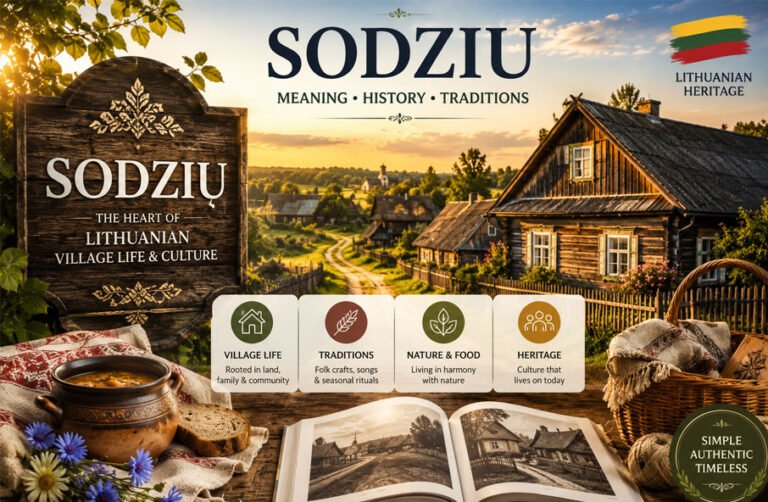
Sodziu is commonly used online as a simplified spelling of the Lithuanian word sodžius. The word is mainly connected with a village or rural settlement and has strong links with Lithuania’s older countryside life.
People often search for Sodziu because online explanations give it several different meanings. Some describe it as a village, while others connect it with homesteads, culture, community, or simple living. This guide explains the established meaning, its history, and how traditional Lithuanian rural communities lived.
What Does Sodziu Mean?
The word Sodziu usually refers to the Lithuanian term sodžius. Its clearest meaning is a village or rural settlement.
Historically, the word was connected with groups of people living and farming in the Lithuanian countryside. A sodžius could contain homes, farm buildings, fields, gardens, animals, and other spaces needed for everyday rural life.
Modern websites sometimes give Sodziu a much wider meaning. They connect it with family, belonging, nature, heritage, and a slower way of living. These ideas can be associated with traditional village life, but they are not separate dictionary definitions of the word.
The spelling also needs some explanation. Lithuanian uses letters that are not always typed correctly on English-language websites. Because of this, sodžius may appear online as sodziu, sodzius, or other simplified forms.
The original spelling, sodžius, is the more accurate form when discussing the Lithuanian word.
Sodziu, Kaimas, and Sodyba
Several Lithuanian words are connected with rural places, but they do not mean exactly the same thing.
Sodžius is an older word linked with a village or rural settlement. It also has a historical meaning connected with older forms of Lithuanian countryside settlements.
Kaimas is the common modern Lithuanian word for a village. Over time, sodžius became close in meaning to kaimas in everyday use.
Sodyba normally refers to a homestead, farmstead, or country property. It is usually more focused on one household and its buildings than on an entire village.
This difference is useful because some online articles translate Sodziu simply as “homestead.” That can be too broad. A historical sodžius was usually connected with a settlement or group of rural households rather than only one private country home.
There can be some overlap between these terms depending on historical or regional use, but village, settlement, and homestead should not automatically be treated as identical.
The History of Sodziu
The historical idea of a sodžius reaches back several centuries.
Lithuanian historical references connect this type of rural settlement especially with the period from around the 12th to the 16th centuries. Rural families lived close to the land they worked, and settlements developed as households were established across farming areas.
These communities did not always grow according to a formal plan. A family might build a home near useful agricultural land, water, pasture, or forest. Other households could later appear nearby, slowly creating a larger settlement.
Agriculture shaped the development of these places. Fields were needed for grain and other crops. Animals needed grazing areas and shelters. Families also needed gardens, storage buildings, paths, wells, and spaces for everyday work.
Because of this, a sodžius was closely connected with both people and agricultural land. It was not simply a group of houses.
Over time, Lithuanian rural settlement patterns changed. The word kaimas became the normal term for a village, while sodžius became increasingly associated with older or traditional rural life.
This history is one reason the word can now carry cultural associations with Lithuanian heritage and family roots.
How Traditional Sodžiai Were Organized
There was no single design used for every traditional sodžius.
Many early settlements had an irregular or scattered layout. Homes were not necessarily placed in straight rows along a central street. Instead, individual farmsteads could be spread across the available land.
The surrounding environment often influenced where people built. Streams provided water. Forests supplied timber and other materials. Fields and meadows were important for crops and animals. Hills, wetlands, and soil conditions could also affect settlement patterns.
A rural household could include a main home together with barns, storage buildings, sheds, gardens, wells, fences, and areas for livestock.
Living and working spaces were closely connected. Farming, food preparation, storage, repairs, animal care, and family life often happened within the same farm area.
Some modern descriptions present traditional Sodziu settlements as carefully designed communities built around courtyards or village greens. That should not be treated as a general rule. Older Lithuanian sodžiai could be much less regular.
As settlements developed, buildings and yards also changed. More structures could be added when a household grew or its farming needs increased.
The Valak Reform and Changing Villages
One of the biggest changes to Lithuanian rural settlements came with the Valak Reform during the 16th century.
The reform reorganized agricultural land and changed how many villages were arranged. Instead of older, loosely formed settlements, many communities were reorganized into more regular patterns.
Fields were divided more systematically. Farmsteads were often moved or arranged along roads, creating the type of street village that became common in parts of Lithuania.
This changed both farming and village appearance.
Older sodžiai could have scattered buildings, while reorganized villages were more likely to have a clearer road or street structure. Farm boundaries and agricultural plots also became more organized.
In regions such as Aukštaitija, many older sodžiai disappeared as a distinct settlement type during the second half of the 16th century.
The word did not disappear completely. Instead, its meaning became increasingly similar to kaimas, the general Lithuanian word for village.
Understanding this reform helps explain why the historical meaning of sodžius is different from simply describing any modern Lithuanian village.
Farming and Seasonal Life
Agriculture was at the center of traditional Lithuanian rural life.
Families depended on crops and animals for food and other household needs. Common work included planting, mowing grass, harvesting grain, threshing, caring for livestock, processing flax, preparing dairy products, and storing food.
The type of work changed with the seasons.
Spring was connected with preparing land, planting, repairing tools, and beginning another farming cycle. Summer brought intensive field work, including haymaking and caring for crops.
Autumn was an important harvest period. Families collected crops and prepared food and supplies for winter.
Winter reduced some outdoor agricultural work, but rural households were still active. People cared for animals, repaired tools and equipment, prepared food, worked with textiles, and completed other indoor jobs.
Traditional farming depended heavily on natural conditions. Rain, temperature, soil quality, and the timing of the seasons could directly affect a family’s harvest.
Children could also help with appropriate household and farming tasks. They learned many practical skills by watching parents, grandparents, and other relatives.
Some modern articles describe historical Sodziu farming as “organic,” “zero-waste,” or an early environmental lifestyle. These are modern terms. Rural families certainly reused materials and depended closely on local resources, but their main goal was usually practical survival and efficient household management rather than following a modern sustainability movement.
Family and Community Life
Family was an important part of traditional village life.
Most daily work was organized around households, but families did not always work completely alone. Neighbors could help each other with difficult jobs, especially during major farming periods.
Harvesting, construction, weddings, funerals, religious events, and local celebrations could bring members of the community together.
Children learned many skills inside the household. They could help with gardens, animals, food, firewood, textiles, and other simple jobs as they became old enough.
Older family members also played an important role. Knowledge about farming, cooking, crafts, local traditions, songs, and customs was often passed directly from one generation to another.
The user’s collected source also describes Sodziu as strongly connected with shared work, stories, seasonal traditions, and cultural identity.
It is important, however, not to idealize village life. Rural families often faced difficult physical work, uncertain harvests, limited money, and harsh weather.
Community cooperation was valuable partly because many jobs were difficult to complete without help.
Traditional Homes and Architecture
Wood was one of the most important materials in traditional Lithuanian rural architecture.
Many village houses and farm buildings were wooden because timber was widely available and could be used for many different purposes. Wood was also used for furniture, tools, storage items, household objects, fences, crosses, and decorative work.
A farmstead often needed several buildings rather than one house. Depending on the household, these could include barns, sheds, storage areas, animal shelters, and other working structures.
The design of a home was usually practical. Rural families needed spaces for sleeping, cooking, food preparation, storage, tools, clothing, and everyday household work.
Farm buildings were arranged according to the needs of the household and the available land. Fields, gardens, animals, and work areas remained closely connected with the home.
The source material collected for this article also describes wooden buildings, handmade furniture, tools, barns, gardens, and farming spaces as important parts of traditional rural communities.
There was not one universal “Sodziu architecture.” Building traditions differed between Lithuanian regions, local environments, periods, and economic conditions.
Lithuania’s Regional Village Traditions
Lithuanian rural culture was not the same everywhere.
The country is commonly divided into several major ethnographic regions:
- Aukštaitija
- Žemaitija
- Dzūkija
- Suvalkija, also called Sūduva
- Mažoji Lietuva, or Lithuania Minor
Each region developed its own local traditions.
Differences could appear in village layouts, house styles, farming practices, dialects, traditional clothing, food, music, crafts, and customs.
Local geography also mattered. Communities near large forests could use woodland resources differently from people living in more open farming areas. Soil, waterways, climate, and available building materials could all affect daily life.
For this reason, it is better to think of Sodziu as part of Lithuania’s wider rural history rather than as one fixed village style.
The shared features were the close relationship between households, agricultural work, land, and local traditions. How those features appeared could differ considerably from one region to another.
Food and Everyday Cooking
Food in traditional Lithuanian villages depended heavily on what families could grow, raise, gather, or preserve.
Common ingredients included rye, potatoes, dairy products, vegetables, meat, mushrooms, berries, and grains. The exact foods varied by region, season, and household.
Rye bread was especially important. Bread was a basic part of daily meals, and home baking remained an important family tradition in many rural areas.
Food also had to last through colder months. Families used methods such as drying, smoking, salting, fermenting, and storing root vegetables. These methods helped reduce waste and made food available when fresh ingredients were harder to find.
Milk from cows could be turned into butter, cheese, sour cream, and other dairy foods. Meat was often preserved for later use. Forests provided mushrooms and berries that could be eaten fresh or stored.
Many foods now seen as part of Lithuanian national cuisine have strong rural roots. Still, it is better to describe them as traditional Lithuanian countryside foods rather than specific “Sodziu dishes.”
Crafts, Folklore, and Traditions
Practical crafts were an important part of rural life.
Woodworking was widely used because wood was easy to shape and had many purposes. People made furniture, tools, carts, household items, storage containers, religious objects, and parts of farm buildings.
Textile work was also common. Spinning, weaving, sewing, and knitting helped families make clothing, blankets, and other useful items.
These activities were not only artistic traditions. In many cases, they were necessary household skills.
Oral traditions were another part of village culture. Stories, songs, sayings, and local customs were passed between generations. Older family members often helped preserve this knowledge.
Traditional Lithuanian songs, known as dainos, were connected with work, family life, seasonal events, and celebrations. Different regions developed their own musical styles and customs.
Religious and seasonal events also shaped rural life. Christmas, Easter, harvest celebrations, weddings, funerals, and other community events often involved food, music, gatherings, and local traditions.
Today, museums, cultural groups, festivals, and craft workshops help preserve some of these practices.
Sodziu and the Natural Environment
Traditional rural life depended directly on the natural environment.
Fields provided grain, vegetables, and animal feed. Meadows supported livestock. Forests supplied timber, firewood, berries, mushrooms, and other useful materials.
Water was also essential. Wells, streams, rivers, and other local water sources could influence where people built homes and farm buildings.
Weather affected almost every part of farming. Too much rain could damage crops, while drought could reduce harvests. Long winters created different challenges for food storage, heating, and animal care.
People learned to watch seasonal changes because those changes affected when work could begin.
This close relationship with nature is one reason modern writers sometimes connect Sodziu with sustainability. That connection can be useful, but it should be understood carefully.
Traditional rural families often reused materials, repaired tools, preserved food, and depended on local resources because it was practical and necessary. They were not following a modern environmental movement in the way we understand that term today.
Why Sodziu Became Associated With Lithuanian Heritage
Over time, sodžius became connected with more than settlement history.
For many people, rural places can represent family roots, grandparents, childhood, inherited land, or older ways of living. This gives the word a wider cultural meaning.
People who moved from villages to cities may still keep strong links with family homes or rural communities. These connections can remain important even when daily life becomes more urban.
Because of this, Sodziu is sometimes used in writing, photography, tourism, and cultural projects to suggest ideas such as home, belonging, tradition, and connection with nature.
These meanings should be described as cultural associations, not strict dictionary definitions.
It is also important not to romanticize old village life. Rural families often dealt with hard physical work, difficult weather, limited income, and fewer services.
The cultural value of Sodziu comes from its real connection with rural history, not from the idea that life in the past was always simple or easy.
Sodziu in Modern Lithuania
Modern Lithuania is much more urban than it was in earlier centuries, but rural communities still remain important.
Some villages continue to support farming families. Others have smaller populations than they once did. In some places, old homes are used mainly for weekends, holidays, or visits to relatives.
There is also interest in restoring traditional wooden houses and keeping family properties in the countryside.
Some people grow gardens, keep small farms, or spend more time outside large cities while still using modern technology and working in modern jobs.
This does not mean that Sodziu has become a formal lifestyle movement. It is better to say that some modern people are interested in values commonly associated with rural life, such as more space, local food, traditional skills, and closer contact with nature.
Rural areas also face challenges.
Jobs may be limited. Schools, shops, medical care, and other services can be farther away. Public transport may be less frequent. Older houses can also require expensive repairs.
Population decline is another concern in some villages, especially when younger people move to cities or other countries.
These changes show that modern village life is different from historical sodžius life, even when older traditions remain visible.
Rural Tourism and Cultural Preservation
Rural tourism gives visitors a way to learn about Lithuanian countryside traditions.
Some guesthouses and farm stays offer local food, traditional saunas, nature activities, and access to rural landscapes.
Visitors may also find museums, craft workshops, folk festivals, restored farmsteads, wooden churches, and historic village areas.
These experiences can help preserve local traditions while also supporting small businesses and rural communities.
Cultural preservation can include restoring old buildings, documenting traditional crafts, teaching local recipes, recording songs and stories, and protecting regional customs.
Visitors should remember that rural villages are also real communities where people live and work. Private homes should be respected, and permission should be requested before entering property or taking close photographs of residents.
A good rural visit should focus on learning rather than treating village life as a performance.
Modern Uses and Interpretations of Sodziu
Today, the word Sodziu sometimes appears in modern cultural and commercial settings.
Photographers and bloggers may use it when sharing images of traditional houses, fields, farms, food, or village landscapes.
Businesses may also use names such as Sodžius to create a connection with rural heritage, local products, nature, or traditional values.
The word can appear in tourism projects, food branding, farms, guesthouses, cultural organizations, and other rural businesses.
In these cases, Sodziu may suggest ideas such as authenticity, simplicity, home, or tradition.
These are modern uses of the word rather than new dictionary meanings.
Some writers also compare Sodziu with rural ideas from other cultures. Examples may include Japanese satoyama, Scandinavian farm traditions, Slavic villages, or traditional farming communities in other parts of the world.
Such comparisons can help readers understand common rural themes, but those traditions are not forms of Sodziu. The Lithuanian term has its own history and cultural setting.
Common Misunderstandings About Sodziu
There is a large amount of confusing information online about this term.
One of the main problems is that several different words and ideas are often combined.
The most important difference is between sodžius and žodžiu.
Sodžius is connected with a village or rural settlement.
Žodžiu comes from the Lithuanian word žodis, meaning “word.” Depending on context, žodžiu can mean something like “verbally,” “in a word,” “in short,” or “basically.”
These are different Lithuanian words.
Some websites incorrectly say that Sodziu means both “village” and “basically.” This usually comes from confusing sodžius with žodžiu.
The simplified spelling Sodziu adds to the confusion because Lithuanian letters such as ž are often removed or changed on English-language websites.
There are also several unsupported claims online.
Some pages describe Sodziu as a traditional textile or fabric-dyeing method. Reliable evidence for this meaning is weak.
Other pages connect the word with Korean soju. The Lithuanian sodžius and Korean soju are unrelated terms.
There is also no strong evidence that Sodziu is a known software platform, app, digital service, or technology product.
Another common claim is that Sodziu is an official philosophy of sustainability, simple living, or community life. These ideas may be modern interpretations of traditional village culture, but they are not part of the formal definition of sodžius.
Why Sodziu Still Matters
Sodziu remains useful because it helps explain an important part of Lithuanian rural history.
The word is connected with older settlement patterns, farming communities, traditional homes, family life, and local customs.
It also helps readers understand how language can keep cultural meaning even after society changes.
Modern Lithuania is very different from the country of several centuries ago, but rural heritage is still visible in villages, architecture, food, crafts, family properties, and cultural events.
Sodziu can therefore be understood in two ways.
First, it has a documented historical and linguistic meaning connected with a village or rural settlement.
Second, it has developed wider cultural associations with land, family, tradition, and Lithuanian countryside identity.
Keeping these two levels separate makes the meaning clearer and avoids many of the inaccurate explanations found online.
Bottom Line
Sodziu is mainly connected with the Lithuanian word sodžius, meaning a village or rural settlement.
Historically, the word was associated with older Lithuanian countryside settlements shaped by farming, household life, local land, and community needs.
Over time, Sodziu also became connected with wider ideas such as family roots, rural heritage, traditional food, crafts, wooden architecture, and countryside culture.
These cultural associations are useful, but they should not be confused with the word’s literal meaning.
The clearest way to understand Sodziu is as a term rooted in Lithuanian village history and rural life, with a broader cultural meaning that developed around that history.
Frequently Asked Questions
What does Sodziu mean in English?
Sodziu is usually connected with the Lithuanian word sodžius, which can be translated as village or rural settlement.
Some historical uses may overlap with ideas related to farmsteads, but “village” or “rural settlement” is usually the clearest general meaning.
Is Sodziu the same as a Lithuanian village?
In many contexts, yes.
The word sodžius became close in meaning to kaimas, the common Lithuanian word for village.
However, sodžius also has an older historical meaning connected with earlier Lithuanian settlement forms.
What is the difference between sodžius and sodyba?
Sodžius generally refers to a village or rural settlement.
Sodyba usually refers to a single homestead, farmstead, or country property.
The words can overlap in some historical uses, but they should not be treated as exact synonyms.
Is Sodziu still used today?
The word and related forms still appear in cultural, historical, rural, and commercial contexts.
It may be used when discussing Lithuanian village heritage or as part of the name of a business, property, association, or tourism project.
Its use can vary by region and context.
Does Sodziu mean “basically” or “in short”?
Not in the sense associated with sodžius.
The Lithuanian word žodžiu can sometimes be used in conversation in a way similar to “in short” or “basically.”
It is a separate word from sodžius.
Many online explanations confuse the two.
Is Sodziu a Lithuanian lifestyle or philosophy?
There is no clear evidence that Sodziu is an official lifestyle or philosophy.
Modern writers sometimes use the word when talking about simple living, community, local food, heritage, or sustainability.
These are broader cultural interpretations rather than the formal meaning of the word.
Can tourists experience traditional Lithuanian village life?
Yes. Visitors can learn about Lithuanian rural culture through villages, farm stays, museums, cultural festivals, traditional food, craft workshops, historic buildings, and other countryside experiences.
The exact experience depends on the region and location.
More To Explore:
