


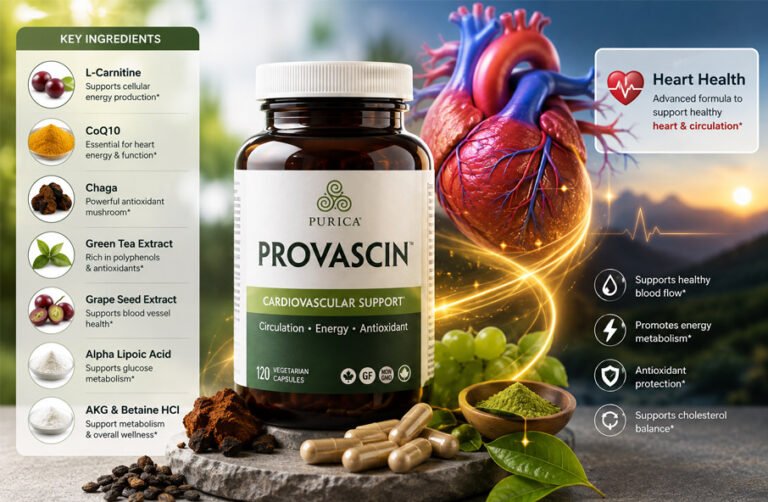
Provascin is a name linked to cardiovascular and circulation support. Most reliable information points to PURICA Provascin, a multi-ingredient natural health supplement rather than a prescription heart medicine. However, different online pages describe Provascin in different ways, which can make the product confusing to research.
This article explains what Provascin is, what ingredients it contains, how the formula may work, what it was used for, its possible benefits, and what scientific evidence says about its effectiveness. Later sections will also cover dosage, side effects, drug interactions, safety, availability, and common claims.
What Is Provascin?
Provascin is best documented as a multi-ingredient natural health supplement made by PURICA. It was promoted mainly for cardiovascular wellness, circulation, energy metabolism, antioxidant support, and healthy cholesterol function.
The product was sold in capsule form. Historical listings show 120-capsule and 240-capsule bottles. Canadian retailer records also show that PURICA Provascin was available by at least 2015.
Unlike a medicine built around one pharmaceutical ingredient, Provascin combined several nutrients, metabolic compounds, a mushroom ingredient, and plant extracts. The idea was to support several processes connected with cardiovascular and general metabolic health.
One supplied source describes PURICA Provascin as a broad cardiovascular-support formula for adults rather than a treatment for heart disease.
The word support is important. A supplement may contain ingredients involved in normal body functions without being proven to diagnose, treat, prevent, or cure a medical condition.
Because the established PURICA version now appears to be discontinued, readers who find a product currently using the Provascin name should check the manufacturer and ingredient label carefully rather than assuming it is the same formula.
Is Provascin a Supplement or Prescription Medicine?
The best-documented PURICA Provascin is a natural health supplement, not a prescription cardiovascular medicine.
Confusion exists because some newer websites describe Provascin as if it were a blood-pressure drug. Others suggest that the name may apply to both supplements and prescription products. One supplied source notes that online descriptions can differ widely and may describe either a supplement or a prescription-style product.
However, research has not established a separate prescription medicine called Provascin with a clearly identified pharmaceutical ingredient, manufacturer, official prescribing information, or regulatory record.
Another source is more direct and describes the commonly identified PURICA product as a natural health supplement rather than a prescription drug.
This difference matters because supplements and prescription drugs are not regulated or tested in the same way. Prescription medicines are developed for defined medical conditions and normally require evidence of safety and effectiveness before approval. Dietary supplements follow a different regulatory system.
Provascin should therefore not be confused with prescription medicines used for high blood pressure, high cholesterol, blood clots, heart failure, or other cardiovascular conditions. It should also not be used as a substitute for medicine prescribed by a healthcare professional.
Provascin Ingredients
Historical PURICA product information lists eight main active ingredients per capsule.
| Ingredient | Amount per capsule |
|---|---|
| L-Carnitine | 188 mg |
| Alpha-ketoglutaric acid | 125 mg |
| Certified organic micronized Chaga | 125 mg |
| Coenzyme Q10 | 38 mg |
| Betaine hydrochloride | 31 mg |
| DL-alpha-lipoic acid | 13 mg |
| Grape seed extract | 9 mg |
| Green tea extract | 9 mg |
The same formula appears in more than one historical product source, which gives reasonable confidence that these amounts describe the established PURICA version. One of the supplied sources also lists these eight ingredients and exact quantities.
The non-medicinal ingredients were reported as hypromellose, microcrystalline cellulose, and plant-source magnesium stearate. Historical descriptions also presented the product as gluten-free and non-GMO.
PURICA also used the name Nutricol for a combination involving grape seed and green tea extracts. These ingredients were mainly positioned around antioxidant support.
Each active ingredient has a different role.
L-carnitine helps transport fatty acids into mitochondria, where they can be used in energy production. This is one reason it often appears in products marketed for cardiovascular, exercise, or metabolic support.
Alpha-ketoglutaric acid participates in the citric acid cycle, one of the body’s main cellular energy pathways.
Chaga is a fungus that contains biologically active compounds and has been studied mainly for possible antioxidant and other biological effects. Most strong claims about Chaga still go beyond what human clinical evidence can prove.
CoQ10, or coenzyme Q10, is involved in mitochondrial energy production and also acts as an antioxidant. It has been widely studied in cardiovascular research, although results depend on the condition, population, and dose.
Betaine hydrochloride is a form of betaine used in some nutritional products. Evidence involving other forms of betaine should not automatically be applied to betaine HCl.
Alpha-lipoic acid participates in energy metabolism and also has antioxidant activity.
Grape seed extract contains polyphenols with antioxidant properties.
Green tea extract contains compounds such as catechins, including EGCG. Concentrated green tea extracts can be very different from ordinary brewed green tea in both dose and biological effects.
The ingredient list helps explain why Provascin was marketed for several areas of wellness. However, the presence of researched ingredients does not prove that the complete formula produces the same results seen in studies of individual compounds.
How Does Provascin Work?
Provascin does not have one single active ingredient or one simple mechanism. Its formula combines substances that take part in several different biological processes.
L-carnitine and CoQ10 are mainly connected with mitochondrial energy production. Mitochondria help cells convert nutrients into usable energy. Because heart and muscle cells require large amounts of energy, these ingredients are often included in cardiovascular and energy-support supplements.
Alpha-ketoglutaric acid is also involved in normal cellular energy metabolism. Betaine-related compounds take part in other metabolic processes.
Several other ingredients are mainly associated with antioxidant activity. These include alpha-lipoic acid, grape seed extract, green tea extract, Chaga, and CoQ10.
The overall idea behind the formula is therefore to combine metabolic, energy-related, and antioxidant ingredients rather than relying on one direct drug-like effect. The supplied research describes these pathways but also makes clear that explaining how ingredients participate in normal biology is not the same as proving that Provascin creates a specific therapeutic result.
For example, an ingredient may reduce oxidative activity in a laboratory experiment. That does not automatically mean taking a supplement containing that ingredient will prevent heart disease in humans.
The same rule applies to energy metabolism. An ingredient can be involved in energy production without necessarily making a healthy person feel more energetic.
What Is Provascin Used For?
Historical descriptions mainly positioned Provascin as a cardiovascular and general wellness supplement.
The commonly reported intended uses included support for cardiovascular health, healthy circulation, cellular energy, antioxidant activity, metabolic function, and healthy cholesterol levels.
Some older retailer and manufacturer-related material also connected the product with glucose metabolism, weight management, stress reduction, muscle and tissue support, and chronic venous insufficiency.
One older marketing description also referred to removing “toxic tissue waste.” This is a vague phrase and should not be treated as a clearly defined medical benefit. There is no strong product-specific clinical evidence showing that Provascin removes a measurable toxin or waste product from human tissue.
The same caution applies to circulation, cholesterol, and blood-pressure claims. These may explain why the product was marketed to people interested in cardiovascular wellness, but they do not establish that Provascin can treat hypertension, high cholesterol, vascular disease, or other diagnosed conditions.
A person with chest pain, shortness of breath, fainting, persistent swelling, unusual weakness, or other possible cardiovascular symptoms should not rely on a supplement to manage those symptoms.
Potential Benefits of Provascin
The possible benefits of Provascin come mainly from the biological roles and existing research surrounding its individual ingredients.
CoQ10 and L-carnitine are involved in cellular energy processes. This provides a reasonable basis for including them in a formula designed around heart, muscle, and energy support.
Alpha-lipoic acid, Chaga, grape seed extract, green tea extract, and CoQ10 contain or support compounds associated with antioxidant activity. Antioxidants are involved in protecting cells from oxidative processes, although this does not mean antioxidant supplements automatically prevent disease.
The formula was also marketed around circulation and metabolic support. Ingredients connected with cellular energy, oxidative stress, and metabolism may help explain this positioning.
However, readers should separate potential nutritional support from proven medical benefit.
A study showing that CoQ10 affects one cardiovascular outcome does not prove that Provascin will produce the same effect. The amount used in a clinical study may also be very different from the amount present in the product.
The same applies to L-carnitine, alpha-lipoic acid, grape seed, and green tea compounds. Research involving isolated ingredients may use different doses, extracts, treatment periods, and study populations.
For this reason, it is more accurate to say that Provascin contains ingredients with potentially relevant biological functions than to say that the product itself has been proven to improve cardiovascular health.
Does Provascin Really Work?
There is not strong direct clinical evidence showing that the complete Provascin formula reliably produces major cardiovascular benefits.
This is the main limitation when evaluating the product.
Several ingredients have been studied individually. CoQ10 has a large research history because of its role in energy production and antioxidant activity. L-carnitine has also been investigated in cardiovascular, metabolic, and exercise-related research. Alpha-lipoic acid, grape seed compounds, and green tea compounds have been studied in different health areas.
But research on an ingredient is not the same as research on a finished multi-ingredient supplement.
A well-designed Provascin trial would need to test the exact formula, at the exact dose, in a defined group of people, and measure clear outcomes. Studies of separate ingredients cannot simply be combined to prove that the finished product provides all of their suggested benefits.
One supplied source makes this distinction directly, noting that ingredient-level evidence cannot automatically establish that the complete commercial formula works.
Another source notes that there is no strong, widely recognized evidence showing that the complete product causes a specific reduction in blood pressure, cholesterol, cardiovascular events, or other major disease outcomes.
This means there is not enough direct evidence to say that Provascin reliably lowers blood pressure. It also should not be presented as a proven cholesterol treatment, heart-disease treatment, or method for preventing heart attacks.
Laboratory and animal research can help scientists understand how ingredients behave, but human clinical studies provide much stronger evidence when deciding whether a finished product actually improves health outcomes.
User testimonials are also limited. Someone who feels better after starting a supplement may also have changed their diet, exercise, sleep, medication, or other habits. A personal review cannot show that Provascin itself caused the improvement.
The most balanced conclusion is that some Provascin ingredients have scientific research behind them, but the complete Provascin formula does not have strong direct evidence proving that it treats or prevents cardiovascular disease.
Provascin Dosage and How It Was Taken
Historical PURICA product information gave different daily amounts depending on how the supplement was being used. Older retailer listings described 3 to 4 capsules daily for general preventive use and 6 to 8 capsules daily for people with existing cardiovascular concerns.
These are historical directions, not current medical advice. The established PURICA Provascin product now appears to be discontinued, and old dosage instructions should not automatically be followed today.
The amount matters because taking more capsules also increases the intake of every active ingredient in the formula. A higher dose means more L-carnitine, CoQ10, Chaga, green tea extract, alpha-lipoic acid, and the other ingredients.
There is also no well-established timeline for how quickly Provascin should produce a noticeable effect. The complete formula has not been studied well enough to give a reliable answer.
If someone finds a current product using the Provascin name, the safest source for dosage is the actual product label. People who take prescription medicines or have a medical condition should also check with a doctor or pharmacist before using it.
Provascin Side Effects and Safety
Provascin contains several biologically active ingredients, so it should not be treated as risk-free simply because it is a natural health supplement.
Possible concerns mentioned in product-related material and ingredient research include digestive discomfort, nausea, headache, changes in blood sugar, and sensitivity or allergic reactions.
However, reliable product-specific data showing how often these effects happened with PURICA Provascin is not available. For that reason, it would be inaccurate to describe them as common Provascin side effects.
Green tea extract deserves extra attention because concentrated extracts can behave differently from normal brewed green tea. The dose and type of extract can affect both possible benefits and safety.
Chaga is another active ingredient that may not be suitable for everyone. It has been studied for several biological effects, but strong safety and benefit claims should not be based only on laboratory findings.
Anyone who develops a new or persistent symptom after taking a multi-ingredient supplement should stop and seek professional advice. Serious symptoms such as difficulty breathing, swelling, chest pain, or a severe allergic reaction require urgent medical attention.
Drug Interactions and Who Should Be Cautious
The main safety concern with Provascin is not only side effects. It is also the possibility of interactions with medicines and health conditions.
Historical product information advised extra caution for people using blood thinners, blood-pressure medicines, diabetes medicines, or immunosuppressive treatment.
People with liver disease, kidney disease, diabetes, iron deficiency, seizure disorders, or autoimmune conditions were also advised to get professional guidance before use.
Pregnant or breastfeeding people should also be cautious. The formula contains several active substances, and there is not enough product-specific evidence to assume it is safe during pregnancy or breastfeeding.
People with allergies to mushrooms or plant extracts should check the ingredient list carefully because Provascin contains Chaga, grape seed extract, and green tea extract.
It is also sensible to tell a doctor about supplement use before surgery. Some supplement ingredients can affect blood clotting, blood sugar, or other processes that may matter during a medical procedure.
People who already take several supplements should compare ingredient lists before adding Provascin. Using multiple products can increase the risk of duplicate ingredients or higher total intake than expected.
Can Provascin Replace Heart or Cholesterol Medicine?
No. Provascin should not be treated as a replacement for prescribed heart, blood-pressure, cholesterol, or blood-clot medicines.
A nutritional supplement may support normal body functions, but that is very different from treating a diagnosed medical condition.
For example, hypertension, high cholesterol, heart failure, abnormal heart rhythm, and blood clots may require medicines that have been tested for specific medical uses. A supplement with ingredients such as CoQ10 or L-carnitine is not automatically an alternative to those treatments.
Stopping or reducing prescribed medicine in favor of Provascin could be dangerous.
For someone already receiving cardiovascular treatment, the useful question is not whether Provascin can replace the medicine. The better question is whether a supplement with these ingredients can be used safely alongside the person’s existing treatment.
Is Provascin FDA Approved?
The phrase FDA approved can be confusing when used for dietary supplements.
Prescription drugs in the United States usually go through a formal approval process that requires evidence for specific uses. Dietary supplements are regulated differently and generally do not receive the same type of premarket approval for effectiveness.
That means a supplement being sold legally does not prove that its complete formula has been clinically shown to prevent or treat disease.
At the same time, saying that a supplement is not “FDA approved” does not automatically mean it is illegal. The key point is that supplements and prescription medicines follow different regulatory systems.
For Provascin, there is no strong basis for presenting it as an FDA-approved treatment for cardiovascular disease.
Is Provascin Still Available?
The best-documented PURICA Provascin product appears to have been discontinued.
Historical listings show both 120-capsule and 240-capsule bottles. Major Canadian retailer pages now describe the product as discontinued or no longer carried.
Older prices can still be found online, but they should not be treated as current prices. Those listings only show what the product cost at the time they were published.
A reliable exact discontinuation date has not been established from the available sources. The reason for discontinuation is also not clearly documented.
This matters because an old retailer page may still appear in search results even when a product is no longer actively sold.
If a current seller offers something called Provascin, readers should check the manufacturer, ingredient list, serving size, expiration date, and packaging before assuming it is the same PURICA formula.
How to Check a Provascin Product Before Buying
Because information online can be inconsistent, the product itself should be checked carefully before purchase.
A useful checklist is:
- Confirm the exact manufacturer and product name.
- Read the full ingredient list.
- Check the amount of each active ingredient.
- Check the serving size and directions.
- Look at the expiration date.
- Confirm that the company has clear contact information.
- Check whether the product is being sold as a supplement or medicine.
- Look for regulatory notices, safety warnings, or recalls.
- Be cautious of claims to cure heart disease, reverse hypertension, dissolve blood clots, or replace prescription medicine.
- Ask a pharmacist if the product identity is unclear.
The actual product label is more useful than an article that simply repeats the Provascin name without showing who made it or what it contains.
Common Provascin Claims and Misconceptions
One common claim is that Provascin is a prescription heart medicine. The established PURICA product does not support that claim. It is documented as a natural health supplement.
Another claim is that Provascin lowers blood pressure. There is not enough direct evidence on the complete formula to say that it reliably does this.
The same applies to cholesterol. Provascin was historically marketed around healthy cholesterol support, but that is not the same as proving that it can treat high cholesterol.
Another misconception is that natural ingredients are automatically safe. Natural substances can still cause side effects, affect blood sugar, change how medicines work, or cause allergic reactions.
It is also wrong to assume that research on one ingredient proves the whole product works. A study on CoQ10, for example, does not automatically prove that a product containing CoQ10 will produce the same result.
A final source of confusion is the idea that every product using the name Provascin must have the same formula. That should not be assumed. Different online pages describe different ingredient sets, and some of those descriptions do not match the documented PURICA formula.
Bottom Line
Provascin is best understood as PURICA’s multi-ingredient cardiovascular-support supplement.
The documented formula contains L-carnitine, alpha-ketoglutaric acid, Chaga, CoQ10, betaine hydrochloride, DL-alpha-lipoic acid, grape seed extract, and green tea extract.
Several of these ingredients have been studied individually for energy metabolism, antioxidant activity, and cardiovascular-related functions. However, research on individual ingredients does not prove that the complete Provascin formula treats or prevents heart disease.
There is also not strong direct evidence showing that Provascin reliably lowers blood pressure or cholesterol.
The established PURICA product appears to be discontinued. Anyone who finds a current product using the Provascin name should verify the manufacturer and formula before buying it.
People who take prescription medicines or have cardiovascular, liver, kidney, blood-sugar, autoimmune, or other medical conditions should discuss supplement use with a doctor or pharmacist.
Frequently Asked Questions
What is Provascin?
Provascin is best documented as a multi-ingredient natural health supplement made by PURICA. It was marketed mainly for cardiovascular, circulation, antioxidant, energy, and metabolic support.
Is Provascin a prescription medicine?
The established PURICA Provascin is not a prescription cardiovascular drug. Some online pages describe the name differently, but a separate prescription Provascin with a clearly identified active drug and regulatory record has not been well verified.
What ingredients are in Provascin?
The documented formula contains L-carnitine, alpha-ketoglutaric acid, Chaga, CoQ10, betaine hydrochloride, DL-alpha-lipoic acid, grape seed extract, and green tea extract.
Does Provascin lower blood pressure?
There is not enough strong direct evidence to say that the complete Provascin formula reliably lowers blood pressure. People with hypertension should follow their clinician’s treatment plan.
Can Provascin lower cholesterol?
Provascin was historically marketed for healthy cholesterol support, but it has not been established as a replacement for cholesterol-lowering medicine.
What are the possible side effects of Provascin?
Possible concerns include digestive discomfort, nausea, headache, changes in blood sugar, allergic reactions, and interactions with medicines. Reliable product-specific rates for these effects are not available.
Can Provascin be taken with other medicines?
Extra caution is needed with blood thinners, blood-pressure medicines, diabetes medicines, immunosuppressants, and other long-term treatments. A doctor or pharmacist can check the full ingredient list for possible interactions.
Is Provascin still available?
The established PURICA Provascin appears to be discontinued. Older retailer pages may still appear online, so any product currently using the name should be checked carefully to confirm the manufacturer and ingredients.
More To Explore:
Zavalio.com Review: How It Works, Content, Features, and Safety
