


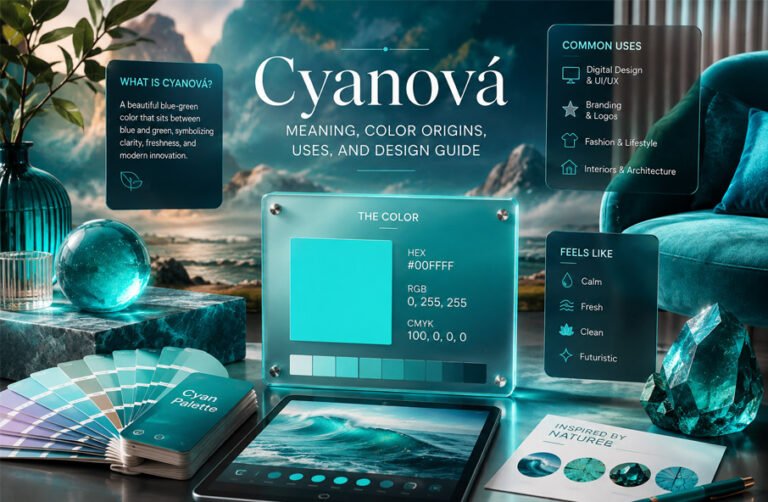
Cyanová is a color-related word connected to cyan, the bright blue-green color found between blue and green. The term mainly comes from Czech and Slovak language use, but it has also started appearing in English-language design, branding, and digital culture discussions.
People often search for Cyanová because the word can look like a brand name, surname, artist name, or newly created color. In reality, its strongest meaning is linguistic and color-related. This guide explains what Cyanová means, where the word comes from, how cyan works in digital and print color systems, and how blue-green shades are used in modern design.
What Does Cyanová Mean?
At its simplest, Cyanová is connected to the color cyan. Cyan is a blue-green color positioned visually between blue and green.
In Czech and Slovak, adjectives can change their endings depending on the grammatical gender of the noun they describe. Cyanová is used as a feminine form. For example, the Czech phrase “cyanová barva” describes a cyan color because barva, meaning “color,” is feminine.
The accented final á can make Cyanová look unusual to English-speaking readers. It may resemble a European surname, stage name, or brand. This has caused some confusion in online searches.
Cyanová should not automatically be understood as a new pigment, new technology, or officially created color. Recent English-language websites sometimes use the word more broadly for cyan-inspired or blue-green aesthetics, but this use is informal.
The safest meaning is therefore simple: Cyanová is a color-related expression based on cyan, with wider creative uses developing online.
Where the Word Cyan Comes From
The history of Cyanová starts with the word cyan.
Cyan is linked to the ancient Greek word kyanos, which was associated with blue or dark blue colors. Over time, related forms entered European scientific and artistic language.
Cyan became an established modern color term during the development of color science, photography, and printing. It later became especially important in commercial printing because cyan is one of the main colors used in the CMYK process.
Cyanová itself should not be described as an ancient Greek word. The historical connection applies mainly to the base word cyan. The Czech and Slovak form developed through their own grammatical systems.
This difference is important. The color has a long linguistic and technical history, while the broader use of “Cyanová” as an aesthetic or creative idea is much more recent.
Is Cyanová an Official Color?
Cyanová is not a separately standardized international color name in the same way that cyan is.
Color systems used in web design, printing, photography, and professional graphics define cyan through technical values. They do not normally define a separate color standard called Cyanová.
This means Cyanová does not have one universally accepted:
- Hex code
- RGB value
- CMYK formula
- Pantone value
Some websites connect Cyanová directly with #00FFFF, but that value technically represents pure digital cyan. It should not be treated as proof that every shade called Cyanová must look exactly the same.
One of the collected sources also makes this distinction clear. It describes Cyanová as a Czech and Slovak expression related to cyan and says it should not be confused with a universally standardized new color.
This explains why images labeled Cyanová may vary. One designer may use a very bright cyan, while another may choose a softer turquoise-like or darker blue-green shade.
When exact color matching matters, it is better to use a specific Hex, RGB, CMYK, or other color value instead of relying only on the name Cyanová.
Cyanová and Cyan in Color Science
Cyan occupies the visual area between blue and green. It is commonly associated with wavelengths in roughly the 490 to 520 nanometer region of visible light.
However, color perception is more complex than assigning one exact wavelength to every color. A cyan appearance can also be produced by combining different wavelengths of light.
This becomes especially important when comparing screens with printed materials.
Digital displays create colors with light. Printed materials use inks or pigments that absorb and reflect light. Because the two systems work differently, a cyan color shown on a monitor may not look exactly the same after printing.
Several factors can affect how cyan appears, including display calibration, screen brightness, printer settings, ink, paper, lighting conditions, and color profiles.
For this reason, professional design work often uses color-management systems to keep colors as consistent as possible across different devices and materials.
Cyanová in RGB and Digital Screens
Phones, computer monitors, televisions, and many other digital displays commonly use the RGB color model.
RGB stands for:
Red, Green, and Blue.
Different levels of these three light colors are combined to create the colors seen on a screen.
Pure digital cyan is produced when green and blue are shown at full strength while red is turned off.
Its standard values are:
RGB: 0, 255, 255
Hex: #00FFFF
This creates the vivid, luminous cyan commonly seen in digital graphics.
These values describe standard pure cyan. They do not mean that every Cyanová-inspired design must use exactly the same color.
Designers often adjust cyan by lowering brightness, changing saturation, or shifting it slightly toward blue or green. This produces many related shades suitable for different purposes.
Cyan and related blue-green colors are commonly used in websites, apps, digital illustrations, dashboards, gaming interfaces, data displays, and visual effects.
They can be especially noticeable on dark backgrounds, which is one reason cyan-like accents often appear in modern technology interfaces.
Cyanová in CMYK Printing
Printing works differently from digital screens.
Most commercial color printing uses the CMYK system:
C – Cyan
M – Magenta
Y – Yellow
K – Black
Cyan is therefore one of the main process inks used to reproduce colors in magazines, packaging, posters, brochures, photographs, and many other printed products.
A common theoretical reference for pure cyan is:
C 100%, M 0%, Y 0%, K 0%
Cyan plays a basic role in creating many other printed colors. By combining cyan with magenta, yellow, and black in different amounts, printers can reproduce a wide color range.
The collected material confirms cyan’s central role in CMYK printing.
A printed cyan may not look exactly like #00FFFF on a computer screen. Screens produce light, while printing depends on ink reflecting light from a physical surface.
Paper type, ink quality, printing equipment, color profiles, and room lighting can all change the final appearance.
Designers who need accurate brand or product colors should therefore check physical print samples instead of assuming the screen version will reproduce perfectly.
Cyanová Compared With Similar Colors
Cyanová belongs to the same general visual area as several other blue-green colors. This is why it is often confused with aqua, turquoise, teal, aquamarine, and sometimes azure.
Cyan is the established technical color at the center of this topic. In digital web color systems, pure cyan is #00FFFF.
Aqua is especially close. In standard CSS color naming, aqua and cyan both refer to #00FFFF.
Turquoise is also blue-green, but it often appears less electrically bright and can lean more toward green depending on the shade.
Teal is normally much darker than pure cyan. It creates a deeper and more restrained blue-green appearance.
Aquamarine usually describes lighter blue-green shades and is also the name of a gemstone.
Azure belongs more clearly to the blue family and should not simply be treated as another name for cyan.
One collected source describes teal as darker and turquoise as somewhat different from Cyanová, but it also presents Cyanová as having a particular medium-brightness appearance. That last point should not be treated as a technical rule because Cyanová itself does not have one fixed international color specification.
The practical difference is that cyan has established technical values, while Cyanová is used more loosely. If exact color matching matters, the numerical value is more reliable than the name.
Cyanová in Modern Design
Cyan and nearby blue-green colors are widely used in modern visual design because they can work well on both light and dark layouts.
In digital interfaces, cyan-like colors are often used for buttons, links, active states, selected items, charts, highlighted data, icons, and other elements that need attention.
They are especially noticeable against black, navy, charcoal, and other dark backgrounds. A bright cyan accent can make an interface easier to scan without requiring large decorative elements.
However, strong visibility does not automatically make a color suitable for every design.
Brightness, saturation, spacing, typography, surrounding colors, and contrast all affect the result. The same cyan can look energetic in one interface and distracting in another.
A softer blue-green shade can work well with white or pale backgrounds. A darker teal-like variation can create a more restrained appearance. Bright cyan can be useful when a design needs a stronger digital or technology-focused accent.
The collected sources also note common uses such as backgrounds, interface elements, logos, illustrations, packaging, typography accents, and promotional materials.
Good use of Cyanová is therefore less about choosing one specific shade and more about choosing the right blue-green value for the job.
Cyanová in Branding
Color is often one of the most recognizable parts of a brand identity. A consistent palette can connect a company’s website, app, advertising, presentations, social media, packaging, and other visual materials.
Cyan and similar blue-green shades are often associated in design with ideas such as freshness, clarity, cleanliness, calmness, and modern technology. These are common visual associations, not guaranteed psychological effects.
Technology companies can use bright cyan as an interface or logo accent. A wellness brand may prefer a softer blue-green. A company connected with water or environmental services may use similar colors because they visually suggest water, nature, or cleanliness.
The exact result depends on the shade.
Using pure bright cyan everywhere can make a brand feel too intense or make it look similar to other technology-focused brands. A more useful approach is often to build a complete palette.
For example, a brand may use a muted cyan for backgrounds, a brighter cyan for buttons or highlights, and a dark blue-green shade for text or supporting graphics. One of the collected sources describes this type of broader palette approach rather than treating cyan as a single decorative color.
Consistency matters more than simply choosing a fashionable color. A brand should use clear color values and apply them the same way across digital and printed materials.
Cyanová can therefore be useful as a general creative direction, but exact Hex, RGB, or CMYK values are still needed when building a professional brand system.
Cyanová and Color Psychology
Cyan and other blue-green colors are often linked with ideas such as calmness, freshness, clarity, cleanliness, and openness. These associations help explain why similar shades are common in technology, wellness, environmental, and water-related design.
However, color psychology is not exact. People do not react to the same color in exactly the same way. Culture, personal experience, brightness, saturation, surrounding colors, and the type of product or message can all change how a shade is understood.
Some online sources make stronger claims that Cyanová can reduce stress, improve focus, lower anxiety, or reduce eye strain. These claims should be treated carefully. There is not enough reliable evidence to say that simply viewing a cyan or blue-green color will produce these effects for everyone.
It is more accurate to say that designers often choose cyan-like colors because they can create a clean, cool, or modern visual impression.
Cyanová in Fashion, Interiors, and Physical Spaces
Cyanová-inspired colors can also be used outside digital screens.
In fashion, blue-green shades can appear in clothing, shoes, accessories, cosmetics, and editorial photography. Brighter cyan can create a stronger visual effect, while softer blue-green shades can work well in lighter seasonal collections.
Interior designers may use similar colors on walls, furniture, fabrics, tiles, lighting, and decorative details. Cyan-like shades are often used in bathrooms, bedrooms, workspaces, and other areas where a cool color palette is wanted.
The final appearance depends on more than the color value.
A shade that looks bright on a phone screen may look softer on fabric. The same color can appear darker in a room with low light and lighter near a large window. Surface texture also matters. Glossy glass, painted walls, metal, and cloth can all reflect the same color differently.
For important projects, physical samples are useful before choosing a final paint, material, or fabric.
Cyanová in Nature and Visual Culture
Blue-green colors appear frequently in nature.
Clear shallow water can look cyan when sunlight passes through the water and reflects from sand or other surfaces below. Cyan-like colors can also appear in the sky, ice, minerals, birds, fish, insects, and some plants.
These colors do not always come from a simple cyan pigment.
In some cases, the color is produced by the way light is scattered or reflected. In animals and insects, structural coloration can also create bright blue-green effects without the surface containing a pigment that exactly matches the visible color.
Natural scenes such as oceans, open skies, and ice have helped build many of the visual associations people have with cyan. This is one reason blue-green palettes are often used in travel, water, environmental, and outdoor design.
Cyanová in AI and Generative Design
AI image tools and generative design systems have made descriptive color terms more useful.
A designer can enter an exact value such as #00FFFF when a precise pure cyan is needed. However, a broader term such as Cyanová can also be used as part of a visual description.
For example, a prompt may describe a design as blue-green, luminous, clean, aquatic, futuristic, soft, or modern. These descriptive terms can help guide the overall mood rather than forcing one exact shade.
There is one limitation. Cyanová does not have a fixed technical definition in AI systems. Different tools may interpret the word differently.
One generator might produce bright cyan. Another might create turquoise, aqua, or teal-like results.
For consistent work, designers should still check the actual color values, contrast, brand palette, print appearance, and mobile display after the AI-generated design is created.
How to Use Cyanová in Design
Cyanová works best when the exact purpose of the color is clear.
In many designs, cyan-like shades are more useful as accents than as the main color covering the entire page. A bright cyan can guide attention toward a button, selected item, icon, chart, or important message.
Neutral colors often work well with blue-green shades. White, gray, charcoal, black, and beige can help cyan stand out without making the layout too busy.
Warm colors can also create useful contrast. Coral, orange, and yellow can work against a cool cyan or blue-green background when used carefully.
Brightness should match the purpose of the design. A strong electric cyan can suit technology, gaming, or futuristic visuals. A muted blue-green shade may work better for softer branding, interiors, or editorial design.
The most important point is to choose an exact value for the final project. The name Cyanová is useful as a general visual idea, but a Hex, RGB, CMYK, or other color value gives much better consistency.
Accessibility and Readability
Cyanová does not have its own accessibility standard.
For websites and apps, designers should follow normal accessibility rules for color contrast and readable text.
A bright cyan may work well against a dark background, but the same shade can be difficult to read against white or another light color. The result depends on the exact foreground and background values.
Color should also not be the only way to communicate important information.
For example, if a form shows an error using color, it should also include text or another clear indicator. This helps users who have difficulty distinguishing certain colors.
Designers should test contrast, different screen brightness levels, mobile devices, and light and dark modes when relevant.
Cyanová and Sustainability Claims
Blue-green colors are often used in environmental and sustainability-related branding.
They can visually suggest water, clean technology, renewable energy, nature, or environmental protection. This makes cyan-like palettes common in businesses connected with water systems, climate tools, energy, and ecological products.
The color itself, however, is not sustainable.
A company does not become environmentally responsible because it uses cyan or green in its logo or website. Environmental claims need to be supported by real products, processes, data, or policies.
Using environmental colors without supporting evidence can create a misleading impression.
Cyanová should therefore be treated as a visual choice, not proof of environmental performance.
Is Cyanová a Person, Brand, or Musician?
The unusual spelling of Cyanová can make it look like a person’s surname, artist name, or brand.
Reliable public information does not currently establish the exact term Cyanová as one well-documented celebrity with confirmed details such as age, family, career, relationships, or net worth.
A separate music creator has used the similar name Cyanova, without the accented final á. That profile has been described as belonging to a French-Belgian singer, songwriter, and musician. However, the similar spelling does not prove that Cyanova and Cyanová are the same identity.
Other companies and projects also use similar names.
This is why search results can be confusing. The safest approach is to check the exact spelling and context before assuming that a Cyanova or Cyanová result refers to the color term.
Why Is Cyanová Appearing More Often Online?
Cyanová has several features that make it easy to notice in search results.
The word is unusual in English, includes an accented character, and looks similar to a name or brand. At the same time, the root “cyan” clearly connects it with a known color.
Different people may therefore search the term for different reasons. Some want a translation. Others want color information, design ideas, a person, a brand, or an online username.
Recent websites have also started using Cyanová as a wider aesthetic term for blue-green design, branding, fashion, digital art, and visual culture.
That does not mean Cyanová has become an official new color system or formal design movement. It shows how an existing linguistic term can gain a broader informal meaning through online use.
Bottom Line
Cyanová is best understood as a Czech and Slovak color expression connected to cyan, the established blue-green color between blue and green.
Cyan has clear technical roles in RGB screens and CMYK printing. Pure digital cyan is commonly represented as #00FFFF and RGB 0, 255, 255.
Cyanová itself does not have one universal Hex, RGB, CMYK, Pantone, or other international standard.
Its broader modern meaning comes mainly from informal use in design, branding, digital art, fashion, interiors, and visual culture. When exact color matching matters, it is better to use specific numerical color values rather than relying only on the word Cyanová.
Frequently Asked Questions
What does Cyanová mean?
Cyanová is mainly a Czech and Slovak color-related form connected to cyan. It can describe something that is cyan-colored, especially when used with a feminine noun.
Is Cyanová a real color?
Cyanová is a real color-related word, but it is not a separately standardized international color. Cyan is the established technical color.
What is the hex code for Cyanová?
There is no universal Hex code for Cyanová. The standard Hex value for pure digital cyan is #00FFFF, but Cyanová may be used more broadly for different blue-green shades.
What is the RGB value of cyan?
Pure digital cyan is RGB 0, 255, 255.
Different Cyanová-inspired shades may use other RGB values depending on how light, dark, blue, or green the design needs to be.
Is Cyanová the same as turquoise or teal?
Not exactly. Cyan, turquoise, teal, and aqua all belong to the wider blue-green color area, but they are not always the same shade.
Teal is usually darker, while turquoise can shift more toward green. Cyanová does not have one fixed technical value, so it may sometimes be used loosely for nearby shades.
Can Cyanová be used in websites and branding?
Yes. Cyan-like blue-green colors can work well in websites, apps, logos, dashboards, packaging, social graphics, and brand systems.
Designers should still check contrast, readability, accessibility, and consistency across different screens and printed materials.
Is Cyanová an official Pantone or CSS color?
Cyanová itself is not an official named CSS color and does not have one universal Pantone value.
CSS recognizes cyan and aqua, both of which use the Hex value #00FFFF.
Is Cyanová a person or singer?
There is no strong public evidence that the exact name Cyanová belongs to one widely documented celebrity.
A separate creator has used the similar name Cyanova without the accented á, but the two should not automatically be treated as the same person or identity.
More To Explore:
Witelovers Meaning: A Complete Guide to the Online Aesthetic
