

Onnilaina is best known as the name of a former Finnish short-term loan service. It was connected with CC Rahoitus Oy and operated in Finland’s quick-loan market.
People searching for Onnilaina today often find very different explanations. Some pages describe an old Finnish lender, while others present the name as a modern finance concept, digital brand, or unrelated website. The historical evidence supports the lending connection most strongly.
This article explains what Onnilaina was, what its name means, how its loans worked, what borrowers could expect, and the risks linked with this type of short-term credit.
What Is Onnilaina?
Onnilaina was associated with Finland’s short-term consumer-credit market. Historical sources connect the name with small online loans commonly known in Finland as pikavippi, or quick loans.
The service was linked with CC Rahoitus Oy. It was not a traditional bank and does not appear to have offered a broad range of banking products. Its main purpose was to provide relatively small consumer loans that could be requested remotely.
These loans were generally unsecured. This means borrowers did not normally need to provide an asset, such as a house or vehicle, as security for the loan.
It is also important to understand that Onnilaina was a brand or service name, not an official category of loan. Modern websites sometimes describe “onnilaina” as if it were a general financial term, but historical evidence does not support that meaning.
What Does Onnilaina Mean?
The name is commonly explained using two Finnish words.
Onni is associated with luck, happiness, or good fortune. Laina means a loan or something borrowed. Together, the name can roughly be understood as “lucky loan” or “happy loan.”
Historical material also refers to the advertising phrase “Kyllä Onni lainaa!”, which played on the same wording.
The meaning of the brand name should not be confused with the financial terms of the loan. A positive name does not mean that borrowing was cheap, safe, or suitable for every customer. The real value of any loan depends on its interest, fees, repayment period, and total amount due.
The History of Onnilaina
Onnilaina appeared during the growth of Finland’s online quick-loan market in the 2000s.
Available historical references show that the service existed by at least 2007. Stronger Finnish media reporting from 2008 also identified CC Rahoitus Oy as a company providing quick loans through the Onnilaina website.
The exact official launch date of the Onnilaina brand has not been reliably confirmed. The registration date of CC Rahoitus Oy should therefore not be presented as the launch date of Onnilaina itself.
At the time, online short-term lending offered consumers a different experience from traditional bank borrowing. Applicants could seek smaller amounts remotely, often for a short period, without going through the same process normally required for a larger bank loan.
Onnilaina belonged to this early online lending environment rather than today’s wider fintech market.
CC Rahoitus Oy and Onnilaina
Historical reporting connects Onnilaina with CC Rahoitus Oy, a Finnish company.
Available Finnish company information identifies CC Rahoitus Oy with business ID 2077917-0. The company was registered in November 2006 and entered the Trade Register in December 2006. Its Trade Register status later ended in October 2019.
These company dates are useful for understanding the background of Onnilaina, but they do not prove exactly when the lending brand launched or stopped accepting applications.
A 2008 Finnish media report also examined CC Rahoitus Oy as part of wider reporting into payday-loan companies. The report discussed people connected with the company and raised concerns about their backgrounds.
Those reports need to be interpreted carefully. They provide historical context about the company and people associated with it, but they do not by themselves prove that every Onnilaina loan or every part of the service was unlawful.
How Did Onnilaina Work?
Onnilaina appears to have followed the basic model used by many Finnish quick-loan providers of that period.
A customer sought a relatively small amount of money through a remote application process. The loan did not normally require traditional collateral. If approved, the borrower received the money and had to repay the amount together with applicable costs within a short period.
Historical material also suggests that SMS communication played a role in the service. Some old cost examples specifically mention SMS charges in addition to other borrowing costs.
The exact step-by-step application process is not fully documented in the sources available today. For that reason, it would be inaccurate to claim details such as the exact approval time, identity-checking process, or application screens without original records.
Modern features sometimes mentioned in newer articles should also not be assigned to the historical Onnilaina service without evidence. There is no reliable proof that the original service used features such as AI credit scoring, mobile apps, automated loan comparison, customer dashboards, or modern open-banking tools.
Loan Amounts, Repayment Periods, and Costs
Historical sources do not give one completely consistent set of Onnilaina loan terms.
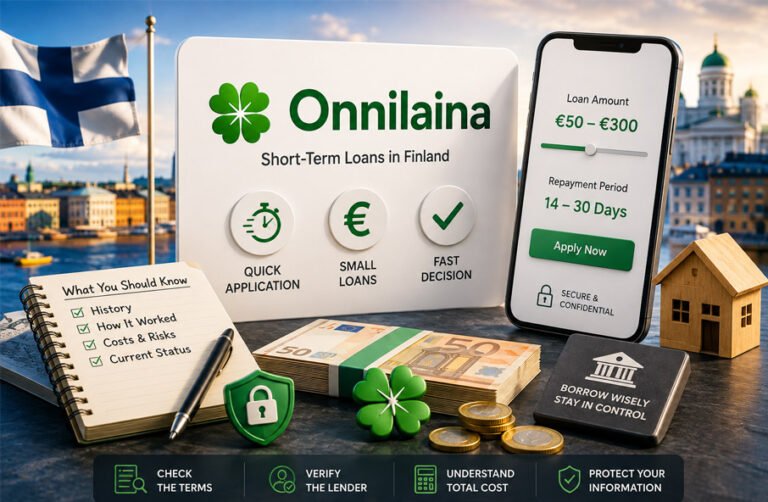
Available listings suggest that borrowers could obtain amounts ranging from tens of euros to a few hundred euros. Some modern summaries report a range of around €50 to €300, while certain older references suggest lower maximum amounts.
Because the figures differ, it is safer to say that Onnilaina offered relatively small loans rather than claim that one fixed range applied throughout its entire operation.
Historical comparisons also mention repayment periods of 14 or 30 days. One old loan comparison listed a minimum borrower age of 19 years.
Costs could be significant compared with the amount borrowed.
For example, one historical discussion described a €100 Onnilaina loan with around €20 in loan costs plus approximately €3.80 in SMS charges. This would result in about €123.80 being repaid after 14 days.
Other user discussions mention €100 loans with repayment totals of about €120 or €125.
These figures should be treated carefully. They came from historical comparisons and user reports rather than a complete official Onnilaina price list. Different totals could reflect different dates, repayment terms, fees, or incomplete reporting.
They still show why the total repayment amount mattered. A small loan could become noticeably more expensive once charges were added.
Risks of Short-Term Quick Loans
The main risk with quick loans is that a small principal can create a much larger short-term repayment obligation.
A borrower may receive only €100 or €200, but fees and other costs can increase the amount that must be repaid. When the repayment period is only a few weeks, finding the full amount can become difficult.
This can create another problem. A borrower who cannot repay one short-term loan may consider taking another loan to cover the first one. Repeating this process can increase debt instead of solving the original cash shortage.
Historical Finnish discussions mention Onnilaina alongside other quick loans in posts from people dealing with debt problems. These personal reports do not show that every Onnilaina customer had the same experience, but they illustrate a wider risk associated with fast short-term credit.
Speed should therefore be separated from affordability. A loan may be easy to request without being easy to repay.
Finnish Loan Rules Then and Now
Finland’s consumer-credit rules have changed significantly since the years when Onnilaina was active.
Modern Finnish rules place stronger limits on the cost of consumer credit. Current regulations generally restrict contractual interest to the reference rate under Finland’s Interest Act plus 15 percentage points, while the interest rate cannot exceed 20%. Other credit costs are also subject to limits.
Important changes took effect on October 1, 2023, strengthening regulation of consumer credit and online payments.
Earlier periods followed different rules. For example, credit agreements made between September 2019 and September 2023 were generally subject to a 20% maximum contractual interest rate, while still older agreements could fall under earlier legislation.
This matters when discussing Onnilaina because today’s limits cannot simply be applied to loans issued many years ago. A historical loan must be understood according to the law and agreement that applied when it was made.
For readers, the main point is that Onnilaina belonged to an earlier period of Finland’s quick-loan market. Modern consumer-credit rules are stricter, and they should not be used to reconstruct Onnilaina’s old prices or terms without historical evidence.
Is Onnilaina Still Operating?
There is no reliable evidence that the original Onnilaina lending service is still operating in the same form today.
Historical records connect Onnilaina with CC Rahoitus Oy. That company later left the Finnish Trade Register in 2019. This does not prove the exact date when Onnilaina stopped lending, but it does support the view that the original service is no longer active in its earlier form.
Recent pages discussing Onnilaina should not be treated as proof of a relaunch. A website or article can reuse an old brand name without any connection to the original company.
For that reason, readers should not assume they can still apply for an original Onnilaina loan today.
Why Onnilaina Is Confusing Today
Search results for Onnilaina now show several very different explanations.
Some pages describe it correctly as a former Finnish quick-loan service. Others present it as a modern digital lending concept, a loan comparison platform, a general finance term, or even a broader digital identity.
This is one reason the keyword is confusing. The same name is being used in different contexts.
The historical meaning has the strongest evidence. Onnilaina is documented as a Finnish short-term lending brand connected with CC Rahoitus Oy. Newer meanings should be treated separately unless they can be linked to a verified current company or service.
The third source we reviewed shows how far the newer interpretations can go. It discusses Onnilaina mainly as an example of a searchable digital identity or unique keyword rather than as a financial company.
That type of discussion may help explain modern search behavior, but it does not replace the documented history of the original lending brand.
Onnilaina.fi, Onnilaina.com, and Onnilaina.org
Different domains using the Onnilaina name should not automatically be treated as the same business.
Onnilaina.fi
The historical Finnish service was associated with the onnilaina.fi name.
Recent research suggests that the old domain no longer functions as the original lending platform. Available evidence indicates that it has become inactive, redirected, or otherwise separated from the historical service.
A domain can continue to exist after the original company has stopped operating. It can also be sold or reused later.
Onnilaina.com
The .com domain creates another source of confusion.
Some indexed pages under onnilaina.com have described loan-related services or modern online lending. However, the root domain has also shown a basic server directory rather than a normal active lending website.
There is no reliable evidence showing that the current onnilaina.com is operated by CC Rahoitus Oy or that it represents the original Finnish Onnilaina service.
Readers should therefore treat it as a separate website unless ownership and company details prove otherwise.
Onnilaina.org
Onnilaina.org is an even clearer example of name reuse.
The available content on this domain is about food, vegetables, nutrition, and vegan cooking. One article discusses white vegetables such as cauliflower, potatoes, garlic, onions, parsnips, and turnips.
This content has no clear connection with the historical Finnish lender.
The example shows why a matching domain name is not enough to establish a business relationship.
Domains can expire, change owners, be sold, or be repurposed for completely different topics.
Is Onnilaina Safe?
It is not useful to give the historical Onnilaina brand a simple current “safe” or “unsafe” rating because the original service does not appear to be operating in its old form.
The more important question is whether a present-day website using the Onnilaina name is legitimate.
A technically secure website is not automatically a trustworthy lender. HTTPS, a professional design, or an automated website-safety score only shows part of the picture.
For a financial service, readers should verify the legal company behind the site, its current business status, who actually provides the loan, and whether the service has the required authorization where applicable.
The loan terms also matter. Interest, fees, repayment dates, late charges, and the total amount payable should be clear before any agreement is accepted.
Privacy is equally important. Loan applications may involve identity details, income information, bank information, and other sensitive data. A person should know who receives that information and how it is used before submitting it.
A familiar name alone does not prove safety.
Common Misunderstandings About Onnilaina
Several misunderstandings appear repeatedly in current search results.
“Onnilaina is a type of loan.”
This is misleading. Historically, Onnilaina was a brand or service associated with Finnish short-term lending. It was not a universal loan category.
“Every Onnilaina website belongs to the original company.”
There is no basis for this assumption. Domains and brand names can be reused by unrelated owners.
“Onnilaina is a new fintech platform.”
Some recent articles use this description, but the historical evidence points much more clearly to the former Finnish quick-loan service.
“The name means the loan was favorable.”
The name may combine words linked with luck or happiness and loans, but that says nothing about the real borrowing cost.
“A new article proves Onnilaina is active again.”
It does not. An article published today can discuss a service that stopped operating years ago. Current activity requires current business evidence.
What to Check If You Find an Onnilaina Loan Website Today
If a website currently offers loans under the Onnilaina name, check it as you would any unfamiliar financial service.
First, identify the legal company behind the website. Look for a registered business name, company number, address, contact details, terms, and privacy policy.
Then check whether the site is actually a lender. Some financial websites are brokers or comparison services that pass applications to other companies.
Find out which company would provide the money and which company would appear on the loan agreement.
Review the full financial terms before applying. The most useful figures are the interest rate, fees, repayment schedule, late-payment rules, and total amount payable.
Also check how personal data is handled. A loan website may ask for financial and identity information, so the privacy policy should explain why that information is collected and who can receive it.
Be cautious if the site hides the company name, creates unnecessary urgency, or asks for sensitive information before explaining the agreement.
A professional design, HTTPS connection, or high search ranking does not prove that a financial service is legitimate.
Bottom Line
Onnilaina is best understood as a former Finnish short-term lending service associated with CC Rahoitus Oy.
It operated in the quick-loan market and offered relatively small unsecured loans with short repayment periods. Historical sources also show that costs could be high compared with the amount borrowed.
The name itself is commonly linked with Finnish words for luck or happiness and loan, but it was a brand name rather than a special type of financial product.
There is no reliable evidence that the original Onnilaina service is still operating in its historical form. Modern websites and articles using the same name may have different owners, purposes, and business models.
Anyone who finds a current financial website using the Onnilaina name should verify the company, lender, costs, regulatory status, and privacy terms independently before providing personal information or accepting a loan.
Frequently Asked Questions
What was Onnilaina?
Onnilaina was a Finnish short-term online loan service associated with CC Rahoitus Oy. It was part of the country’s quick-loan, or pikavippi, market.
What does Onnilaina mean in Finnish?
The name is commonly explained as a combination of onni, meaning luck or happiness, and laina, meaning loan. This gives a rough meaning such as “lucky loan” or “happy loan.”
Who owned or operated Onnilaina?
Historical reporting connects the service with CC Rahoitus Oy, a Finnish company involved in short-term lending.
How much could people borrow from Onnilaina?
Historical sources suggest amounts ranging from tens of euros to a few hundred euros. Some sources mention around €50 to €300, but available records are not consistent enough to confirm one fixed range for every period.
Is Onnilaina still active?
There is no reliable evidence that the original Finnish Onnilaina lending service is still active in the same form today.
Is Onnilaina.com the original Onnilaina?
There is no verified evidence howing that the current onnilaina.com is the same service historically connected with CC Rahoitus Oy.
Was Onnilaina legal?
Onnilaina operated in Finland’s consumer-credit market during its active period. However, lending rules have changed over time. It would be inaccurate to judge all historical Onnilaina loans using today’s regulations without looking at the law and agreement that applied at the time.
Is it safe to use a website called Onnilaina today?
The name alone does not prove that a website is safe or legitimate. Check the legal company, regulatory status, lender identity, loan costs, repayment terms, contact information, and privacy policy before using any financial service.
More To Explore:
Business Vertical Classification Categories: NAICS, SIC, GICS, and More
