


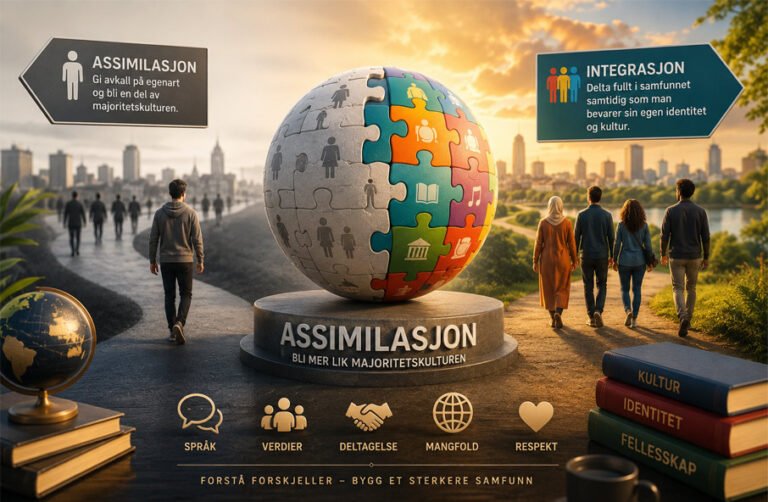
Assimilasjon is the Norwegian word for assimilation. The term is most often used when talking about culture, immigration, minorities, language, and integration. It can also have different meanings in psychology, linguistics, biology, and other fields.
People usually search for assimilasjon to understand how it differs from integration, how cultural assimilation happens, and whether assimilation can be voluntary or forced. This guide explains those meanings, the main theories behind assimilation, and how the concept is used in different settings.
What Does Assimilasjon Mean?
Assimilasjon generally means that something becomes more similar to something else or becomes incorporated into it.
The word comes from the Latin assimilare, which means roughly “to make similar.” This basic idea appears in all the different uses of the term.
In sociology, assimilation usually describes a process in which a person or minority group becomes more similar to the larger or dominant society.
In linguistics, it describes sounds becoming more similar to nearby sounds. In psychology, it can describe fitting new information into existing knowledge. Biology also uses the term for processes in which substances are taken in and made part of an organism.
Assimilasjon is therefore not a product, platform, company, or service. It is a concept used in several academic and social fields.
For most readers, however, the most important meaning is cultural assimilation.
What Is Cultural Assimilation?
Cultural assimilation happens when a person or group gradually adopts important parts of the majority culture.
This may happen after immigration, long-term contact between groups, or through participation in schools, workplaces, institutions, and wider society.
Assimilation can affect many parts of life. A person may begin using the majority language more often, follow common social customs, build relationships mainly within the wider society, or change parts of their cultural identity.
It can also involve changes in traditions, values, behavior, religious practices, food, clothing, family customs, or social expectations.
However, assimilation is not always complete.
A person may become highly assimilated in one part of life while keeping strong connections to their original culture in another. For example, someone may speak Norwegian at work and participate fully in Norwegian society while continuing to speak another language at home and follow family traditions.
This is why assimilation is better understood as a process with different degrees, rather than a simple choice between being assimilated or not assimilated.
Assimilation can also happen across generations. Children or grandchildren of immigrants may have stronger connections to the majority language and culture than earlier generations, although this does not happen in the same way for every family.
How Does Assimilation Happen?
Assimilation usually develops gradually through everyday contact with the wider society.
Education is one common influence. Children who attend schools where the majority language is used may become fluent in that language and become familiar with the country’s history, customs, social rules, and cultural references.
Employment can have a similar effect. People who work mainly with members of the wider society often use the majority language more frequently and become familiar with common workplace behavior and expectations.
Friendships and social networks can also affect assimilation. When people form close relationships outside their original cultural group, they may adopt new habits, expressions, interests, or social practices.
Marriage and family relationships can play a role as well. Families with members from different cultural backgrounds may combine languages, traditions, and customs.
Media, government institutions, public services, and everyday life also expose people to the majority culture.
Language is especially important. Learning the majority language can make education, employment, public services, and social participation easier. However, learning another language does not automatically mean giving up the first language or original cultural identity.
There is no single path that everyone follows. Some people adopt many aspects of the majority culture quickly. Others maintain strong cultural differences for generations while still participating successfully in society.
Voluntary vs. Forced Assimilation
Assimilation can happen voluntarily, but it can also be encouraged or imposed through pressure.
Voluntary Assimilation
Voluntary assimilation happens when people choose to adopt parts of another culture.
A person may decide to use the majority language more often because it helps with work, school, friendships, or everyday communication. They may also adopt local customs because they feel comfortable with them or want to participate more fully in society.
This does not necessarily mean rejecting their original background.
People can adopt new cultural practices while keeping older ones. The amount of change depends on personal choice, family life, social environment, and individual circumstances.
Forced Assimilation
Forced assimilation is very different.
It happens when governments, schools, institutions, or dominant groups pressure people to abandon their language, traditions, religion, cultural practices, or identity.
Methods can include restricting minority languages, limiting cultural institutions, controlling education, discouraging traditional practices, or using laws and public policy to push minorities toward the dominant culture.
Historical assimilation policies in several countries have targeted Indigenous peoples, ethnic minorities, and linguistic minorities.
The main difference is choice.
Voluntary assimilation involves personal decisions and normal cultural contact. Forced assimilation involves coercion, strong pressure, or policies designed to weaken a group’s separate identity.
Because of this difference, forced assimilation can raise serious human-rights concerns.
Assimilasjon vs. Integration
Assimilation and integration are related, but they are not the same.
Assimilation generally means becoming more similar to the majority culture, sometimes while losing or reducing parts of the original cultural identity.
Integration means taking part in the wider society while still being able to keep meaningful parts of one’s own cultural identity.
An integrated person may speak the national language, work, study, understand local laws, take part in public life, and feel connected to the country while still keeping another language, religion, ethnicity, family tradition, or cultural identity.
This distinction is important because successful participation in society does not require every person to become culturally identical.
Norwegian commentator Ervin Kohn has described the boundary between integration and assimilation as fluid. In his view, a person can be fully integrated into Norwegian society while still keeping a strong Jewish, ethnic, religious, or cultural identity.
His own example is personal rather than scientific evidence, but it helps explain the practical difference between the two ideas.
A person may therefore be strongly connected to Norway and still preserve cultural traditions from another background.
The amount of cultural change can vary widely. Some people keep most of their original traditions. Others gradually adopt more of the majority culture. For this reason, integration and assimilation are not always completely separate categories in everyday life.
Assimilation, Acculturation, and Diversity
Another related term is acculturation.
Acculturation describes cultural and psychological changes that can happen when people from different cultural backgrounds remain in long-term contact.
Assimilation can be one possible result of this process, but acculturation is a broader concept.
A person may experience cultural change without becoming fully assimilated. They may adopt parts of the wider culture while still keeping their original identity.
Integration is another possible pattern. In integration, people remain connected to their heritage culture while also participating in the wider society.
Other patterns discussed in acculturation research include separation and marginalization.
Separation generally means maintaining the original culture while having limited involvement with the wider society.
Marginalization generally refers to weak connections with both the heritage culture and the wider society.
Assimilation is also closely connected to discussions about diversity.
When minority groups keep their languages, traditions, cultural knowledge, and different experiences, society contains more cultural diversity.
Extensive assimilation can reduce some of these differences, especially if later generations stop using a minority language or no longer pass traditions to their children.
Ervin Kohn argues that integration is preferable to assimilation because it allows people to participate in Norwegian society while also preserving different cultural stories, languages, and perspectives.
That is an opinion about what society should prefer rather than part of the basic definition of assimilation.
Claims that diversity always produces stronger economic results should also be treated carefully. Some business studies have reported links between diversity and company performance, but such findings do not prove that diversity alone causes better financial results.
Major Theories of Assimilation
Assimilation became an important subject in sociology, particularly during the twentieth century as researchers studied immigration, ethnic relations, and social change.
Early theories often tried to explain how minority groups gradually became part of a larger society.
One influential figure was sociologist Robert E. Park, who was associated with the Chicago School of sociology.
Park and related researchers discussed group relations through stages such as contact, competition, accommodation, and assimilation.
In simple terms, the idea was that different groups first come into contact, may compete or experience conflict, gradually develop ways of living together, and may eventually become more similar.
These early theories were influential, but modern researchers do not generally treat complete assimilation as an unavoidable final stage.
Real societies are more complicated.
Groups may stay culturally distinct for long periods. People may become economically or socially integrated without losing their identity. Discrimination, laws, institutions, family choices, and community networks can also affect how cultural change happens.
Berry’s Acculturation Model
Psychologist John Berry developed one of the best-known models for studying acculturation.
The model considers two main questions.
The first is whether people want to maintain their original cultural identity.
The second is whether they want regular contact and participation with the wider society.
These questions lead to four broad strategies.
Assimilation occurs when people participate strongly in the wider society but do not place much importance on maintaining their heritage culture.
Integration occurs when people maintain their original culture while also participating in the wider society.
Separation occurs when people strongly maintain their heritage culture but have limited involvement with the wider society.
Marginalization refers to a situation in which people have weak connections with both.
The model is useful because it shows that cultural change is not limited to assimilation.
However, it should not be treated as a perfect description of every person’s experience. Real identities can change depending on family, work, religion, language, location, and social setting.
A person may also fit different categories in different parts of life.
Gordon’s Dimensions of Assimilation
Sociologist Milton M. Gordon presented another important way of understanding assimilation in his 1964 book Assimilation in American Life.
Gordon argued that assimilation has several dimensions rather than being one simple process.
Cultural or behavioral assimilation involves adopting the cultural patterns of the wider society. This can include language, customs, and everyday behavior.
Structural assimilation involves entering important institutions and social networks within the wider society.
Marital assimilation refers to widespread marriage between people from different cultural or ethnic groups.
Identificational assimilation happens when people increasingly identify with the larger society.
Attitude-receptional assimilation refers to a reduction or absence of prejudice toward the minority group.
Behavior-receptional assimilation refers to a reduction or absence of discrimination.
Civic assimilation involves the disappearance of major conflicts over political values and power between groups.
Gordon’s model shows why assimilation cannot be measured only by language use.
A person may speak the majority language and follow common customs while still remaining socially connected mainly to their original community. Another person may be highly involved in majority institutions but continue to maintain a strong ethnic identity.
Later research has therefore moved away from assuming that every group follows the same fixed path toward complete assimilation.
Assimilation in Norwegian History
Assimilasjon has an important historical meaning in Norway because of the country’s former Norwegianization policy, known as fornorskingspolitikken.
These policies were mainly directed at Sámi people, Kvens/Norwegian Finns, Forest Finns, and other minority groups. The goal was often to strengthen Norwegian language, culture, and national identity while reducing the use of minority languages and traditions.
Schools played an important role. In many areas, Norwegian was promoted as the main or required language of education. Minority languages were restricted or discouraged.
Government institutions and public policies also influenced cultural life, language use, and access to traditional ways of living.
The effects were not limited to language. Assimilation policies could affect identity, family traditions, education, community life, and the passing of cultural knowledge from one generation to the next.
This history shows why forced assimilation is different from ordinary integration. Integration allows people to participate in society while keeping their identity. State-driven assimilation can instead place pressure on people to abandon it.
Norway, Religious Diversity, and Social Change
Norway has also gone through major changes in how it treats religious and cultural diversity.
The original Norwegian Constitution of 1814 contained restrictions against some religious groups. Jews were initially excluded from entering the country, while Jesuits and some religious orders were also restricted.
Religious freedom expanded gradually.
The Dissenter Act of 1845 gave more freedom to Christian groups outside the established Church of Norway.
The constitutional restriction against Jews was removed in 1851. The ban affecting Jesuits was removed much later, in 1956.
These examples are not the same as assimilation policies, but they show that Norwegian society was once more focused on religious and cultural homogeneity than it is today.
Over time, laws and public attitudes became more accepting of different religious, cultural, and ethnic identities.
Truth and Reconciliation in Norway
Norway later established a Truth and Reconciliation Commission to investigate the effects of Norwegianization policies and historical injustices.
The commission examined the treatment of Sámi people, Kvens/Norwegian Finns, and Forest Finns.
It looked at government policies, discrimination, language loss, cultural changes, education, and effects on traditional livelihoods.
The commission delivered its report to the Norwegian Parliament, the Storting, on June 1, 2023.
The report also considered how past policies continued to affect communities in the present.
In November 2024, the Norwegian Parliament formally apologized for abuses connected with Norwegianization policies and acknowledged responsibility for their consequences.
This history is important when discussing assimilasjon because it shows how government-led assimilation can have long-term effects on language, culture, and identity.
Forced Assimilation and Human Rights
Modern human-rights standards give stronger protection to minority and Indigenous cultures.
The United Nations Declaration on the Rights of Indigenous Peoples, commonly called UNDRIP, specifically protects Indigenous peoples against forced assimilation and destruction of their culture.
Article 8 addresses this issue directly.
Human-rights protections can involve areas such as language, cultural traditions, identity, heritage, community institutions, and participation in society.
This does not mean that all cultural change is a human-rights violation.
People may voluntarily learn a new language, adopt local customs, or identify more strongly with the society where they live. These are normal forms of cultural change when they happen through personal choice.
The legal concern appears when authorities or institutions use coercion, discrimination, restrictions, or other measures to weaken or remove a group’s identity.
Whether a specific policy is illegal depends on the facts and the national and international laws that apply.
Is Forced Assimilation Genocide?
Forced assimilation and genocide are not automatically the same thing under international law.
Genocide has a specific legal definition.
The Genocide Convention covers certain acts committed with the intent to destroy, in whole or in part, a national, ethnic, racial, or religious group.
One of the listed acts is the forcible transfer of children from one protected group to another group.
This means some practices connected with forced assimilation could potentially be relevant to genocide law if the required legal conditions are met.
However, it would be inaccurate to say that every assimilation policy is legally genocide.
The specific actions, intent, affected group, and evidence all matter.
The phrase cultural genocide is also used in public and academic discussions, but it should not automatically be treated as identical to the legal definition of genocide.
Possible Effects of Assimilation
The effects of assimilation depend on how it happens.
Voluntary cultural adaptation can sometimes make communication and participation easier. Learning the majority language may help people use public services, study, work, and build wider social networks.
However, these benefits do not require full assimilation. Many of the same advantages can come through integration.
Assimilation may also have negative effects.
Minority languages can become less widely used. Traditions may not be passed to younger generations. Cultural knowledge can weaken over time.
Some people may experience tension between their family background and the expectations of the wider society.
Generational differences can also develop. Younger family members may identify more strongly with the majority culture than older relatives.
When assimilation is forced, the effects can be much more serious. Language restrictions, discrimination, cultural suppression, and loss of community institutions can affect groups for generations.
There is no single result that applies to everyone. Assimilation experiences vary by country, family, community, and individual choice.
Assimilation in Linguistics
In linguistics, assimilation has a completely different meaning.
It describes a process in which one speech sound becomes more similar to another sound.
This often happens because speech is produced continuously. The tongue, lips, vocal cords, and other speech organs are already moving toward the next sound while the previous sound is being produced.
As a result, nearby sounds can influence each other.
Contact Assimilation
Contact assimilation happens when the sounds are next to each other.
Progressive assimilation occurs when an earlier sound influences a later sound.
Regressive assimilation occurs when a later sound influences an earlier one.
Assimilation can affect features such as voicing, place of articulation, or nasal quality.
Distance Assimilation
Distance assimilation happens when the affected sounds are not directly next to each other.
Examples can include processes related to vowel harmony and historical sound changes such as umlaut.
The important idea is the same: one sound becomes more similar to another.
Dissimilation is the opposite process. In dissimilation, similar sounds become less similar.
Assimilation in Psychology
Assimilation also has an established meaning in psychology.
One of the best-known uses comes from psychologist Jean Piaget and his theory of cognitive development.
In Piaget’s theory, assimilation happens when a person understands a new experience by fitting it into knowledge or mental structures they already have.
For example, a young child who knows what a dog is may see another four-legged animal and first call it a dog. The child is trying to understand the new animal using an existing mental category.
A related process is called accommodation.
Accommodation happens when the person changes their existing mental structure because the new information does not fit well enough.
In the same example, the child may later learn that the animal is a horse and create a separate mental category for horses.
Psychological assimilation is therefore very different from cultural assimilation, even though both involve fitting something new into an existing structure.
Assimilation in Biology and Geology
Assimilation is also used in biology.
In a biological sense, it can describe the process by which substances are taken into an organism and converted into materials that become part of it.
In plants, assimilation can involve the use of inorganic substances to create organic compounds.
Photosynthesis is an important example. Plants take in carbon dioxide and use energy from light to help produce sugars and other organic material.
In physiology, assimilation can describe nutrients being absorbed and then used to build or maintain cells and tissues.
The word also appears in geology.
Geological assimilation happens when surrounding rock material becomes incorporated into molten magma.
This can change the chemical composition of the magma.
These scientific meanings are different from social assimilation, but they all share the same general idea of something being incorporated into something else.
Common Misunderstandings About Assimilasjon
One common misunderstanding is that assimilation and integration are the same. They are related, but integration allows people to participate in society while keeping important parts of their original identity.
Another misunderstanding is that assimilation always means completely losing a culture. In reality, assimilation can happen in different areas and at different levels.
A person may adopt the majority language while still keeping family traditions, religion, or another cultural identity.
Assimilation and acculturation are also not exact synonyms. Acculturation is a broader process of cultural change. Assimilation is one possible pattern within that process.
Voluntary and forced assimilation should not be treated as the same thing. One may result from personal choices, while the other can involve strong pressure or government policy.
Forced assimilation is also not automatically genocide under international law. Genocide requires specific acts and legal intent.
Finally, cultural assimilation should not be confused with linguistic, psychological, biological, or geological assimilation. These meanings use the same word but describe very different processes.
Bottom Line
Assimilasjon means assimilation, but its exact meaning depends on the subject.
In society and culture, it usually describes a process in which a person or minority group becomes more similar to the majority culture.
This can involve language, customs, behavior, social relationships, and identity.
Assimilation can be voluntary, but history also includes examples of forced assimilation through government policies and institutions.
Integration is different because people can participate fully in society while keeping important parts of their cultural background.
The term also has separate meanings in linguistics, psychology, biology, physiology, and geology.
Understanding the context is therefore the easiest way to understand what assimilasjon means.
Frequently Asked Questions
What does assimilasjon mean?
Assimilasjon is the Norwegian word for assimilation. In general, it means becoming more similar to something else or becoming incorporated into it.
What is cultural assimilation?
Cultural assimilation is the process by which a person or minority group adopts parts of the majority culture. This can involve language, customs, behavior, social relationships, and identity.
What is the difference between assimilation and integration?
Assimilation generally involves becoming more similar to the majority culture, sometimes while reducing parts of the original identity. Integration means participating in the wider society while still keeping meaningful parts of one’s own culture.
Can someone be integrated without being assimilated?
Yes. A person can speak the national language, work, study, follow local laws, and participate fully in society while still keeping another cultural, ethnic, linguistic, or religious identity.
Is assimilation always voluntary?
No. Assimilation can happen voluntarily, through normal cultural contact, or through pressure. History also includes forced assimilation policies used by governments and institutions.
Is forced assimilation illegal?
Some forms of forced assimilation can violate human-rights protections, especially when they involve Indigenous peoples or protected minority groups. The exact legal situation depends on the actions involved and the laws that apply.
Is assimilation the same as genocide?
No. Forced assimilation and genocide are not automatically the same under international law. Genocide has a specific legal definition and requires particular acts and intent.
What does assimilation mean in language?
In linguistics, assimilation happens when one speech sound becomes more similar to another sound. It can occur between nearby sounds or, in some cases, sounds that are farther apart.
More To Explore:
Incfidelibus Meaning: What Is It and Is It a Real Latin Word?
