

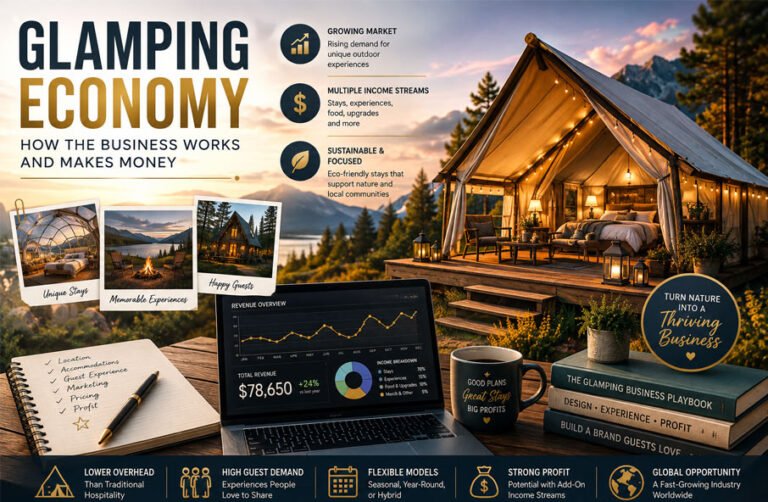
The glamping economy is the business activity built around comfortable, higher-end outdoor stays. Glamping combines camping with features normally found in hotels or holiday rentals, such as proper beds, electricity, private bathrooms, heating, and attractive outdoor spaces.
People search for the glamping economy because the market has grown beyond simple luxury tents. It now includes cabins, domes, yurts, treehouses, RVs, booking platforms, manufacturers, landowners, and full outdoor resorts. This article explains how the industry works, how glamping businesses earn money, what guests pay, and what it can cost to start an operation.
What Is the Glamping Economy?
Glamping is short for glamorous camping. It gives travelers access to outdoor surroundings without requiring them to use basic camping equipment or sleep in a simple tent.
Modern glamping can include a real mattress, electricity, lighting, heating or air conditioning, a private bathroom, kitchen facilities, Wi-Fi, outdoor seating, and other comforts. Accommodation can range from a furnished canvas tent to a fully equipped cabin or luxury treehouse.
The glamping economy is broader than the accommodation itself. It includes the businesses and people that make these stays possible. These can include landowners, resort operators, accommodation manufacturers, builders, booking websites, cleaners, activity providers, and local tourism businesses.
One supplied source describes the market as covering site owners, tent and dome manufacturers, booking platforms, and independent operators.
There is no single worldwide rule for what must be included before a property can call itself glamping. One operator may offer a simple furnished yurt with shared bathrooms, while another may provide a private cabin with a hot tub, kitchen, climate control, and hotel-style service.
This is why guests need to look at the actual facilities rather than relying only on the word “glamping.”
Why Is the Glamping Economy Growing?
One of the main reasons for the growth of glamping is simple: many travelers want to spend time in nature without giving up basic comfort.
Traditional camping often requires people to bring a tent, sleeping equipment, cooking supplies, and other gear. Glamping removes much of that work. Guests normally arrive to find their accommodation already prepared.
Experience-based travel has also helped the market. Domes, treehouses, safari tents, cabins, and vintage trailers offer something different from a standard hotel room. These properties are also easy to photograph and share online.
Younger travelers are an important part of the market. Industry research frequently identifies Millennials and Gen Z as major glamping customers. Families and couples are also important because glamping can make outdoor travel easier for people who do not want traditional camping conditions.
Remote work has created another use. Some properties now offer strong Wi-Fi, desks, electricity, and longer-stay discounts for people who want to work while staying in a rural or natural location.
The supplied research also points to low-density travel, social media, remote work, and interest in outdoor experiences as important demand drivers.
How Big Is the Glamping Market?
The glamping market is now measured in billions of dollars, but there is no single official worldwide figure.
Grand View Research estimated the global glamping market at around $3.8 billion in 2025 and projected it could reach about $7.9 billion by 2033, representing an estimated annual growth rate of 9.5%.
Other market-research companies publish different numbers. Fortune Business Insights, for example, has produced estimates close to the same general range but with different future projections.
These differences are normal. Research companies may include different accommodation types, regions, operators, or revenue categories when calculating the size of the market.
For that reason, market forecasts should not be treated as guaranteed results. The safer conclusion is that glamping has become a multi-billion-dollar part of outdoor hospitality and that several industry researchers expect it to continue growing.
Europe is currently one of the largest glamping regions. North America is also an important market, particularly in areas close to national parks, mountains, forests, coastlines, and other outdoor attractions.
How Does a Glamping Business Work?
At its simplest, a glamping operator provides prepared outdoor accommodation and charges guests to stay there.
A landowner might begin with only one or two tents, pods, or cabins. Larger operators may manage dozens of units and provide restaurants, activities, reception services, guided trips, and other facilities.
The business usually starts with four basic parts: suitable land, accommodation, essential infrastructure, and a way for guests to book.
Infrastructure may include water, electricity, sewage or septic systems, roads, parking, bathrooms, heating, drainage, and internet access. The exact requirements depend on the property and local laws.
Guests may book directly through the operator’s website or through third-party platforms. Booking sites can help new properties reach customers, but operators may pay commissions or other platform fees.
Glamping is therefore not automatically passive income. Units must be cleaned, repaired, maintained, marketed, and prepared between guests. Someone also needs to manage reservations, questions, cancellations, payments, and unexpected problems.
Larger glamping properties operate much like small resorts. The difference is that the accommodation is designed around an outdoor setting rather than a traditional hotel building.
Types of Glamping Accommodation
The type of accommodation has a major effect on startup cost, guest expectations, nightly pricing, weather protection, and maintenance.
Safari tents are one of the best-known glamping formats. They can provide a strong connection with nature while still holding real beds, furniture, lighting, and sometimes private bathrooms.
Geodesic domes have become popular for their unusual shape and large viewing windows. They are often used in areas where scenery or stargazing is an important part of the stay.
Yurts are round structures that can offer more protection than a simple canvas tent. Some modern versions include insulation, electricity, heating, and private facilities.
Cabins and pods provide stronger walls and usually better protection from bad weather. They can also be easier to operate for a longer season because heating and cooling are easier to control.
Treehouses can support premium pricing when they offer privacy, views, and unusual design, but they can also be more complex and expensive to build.
Other options include A-frame cabins, shepherd huts, tiny houses, converted trailers, vintage Airstreams, and stationary RVs.
The supplied business guide lists safari tents, geodesic domes, yurts, Airstream trailers, treehouses, and A-frame cabins among common options. It also notes that some operators mix several accommodation types to reach different customers and price levels.
How Glamping Businesses Make Money
The main source of revenue is the nightly accommodation charge.
A property may set different rates for weekdays, weekends, holidays, and peak seasons. Popular locations and higher-end accommodation can usually support higher prices, especially when private bathrooms, heating, good views, or extra services are included.
Nightly stays are not the only way operators earn money. Many offer paid extras such as breakfast baskets, firewood, activity packages, equipment rental, pet stays, late checkout, wellness services, or guided trips.
Events can create another revenue stream. Some properties host small weddings, retreats, corporate gatherings, private dinners, or photography sessions.
The supplied research also mentions breakfast baskets, guided hikes, bonfire kits, longer-stay offers, and events as possible additional revenue sources.
Some businesses also encourage repeat customers to book directly instead of using third-party platforms. Direct bookings can reduce reliance on marketplace commissions, although the operator must then manage its own website, payments, customer support, and marketing.
Revenue should not be confused with profit. A property earning a high nightly rate may still face large costs for staff, cleaning, utilities, insurance, repairs, platform fees, taxes, and loan payments.
How Much Does Glamping Cost for Guests?
There is no standard glamping price.
Rates depend heavily on the accommodation, location, season, facilities, privacy, and level of service. A simple furnished tent with shared bathrooms can cost far less than a private treehouse with climate control, a kitchen, a hot tub, and panoramic views.
One of the supplied sources gives example rates of around $100 to $200 per night for simpler safari tents or yurts, $200 to $400 for many domes, cabins, or premium units, and $400 or more for some treehouses and luxury stays. These should be treated as examples rather than fixed industry prices.
Another supplied source places many North American mid-range glamping stays at roughly $150 to $300 per night and says luxury properties can cost considerably more.
Guests paying higher prices usually expect more than a bed. They may expect a private bathroom, reliable heating or cooling, good-quality bedding, attractive interiors, outdoor seating, strong cleanliness standards, and a special setting.
Some luxury glamping stays can therefore cost as much as, or more than, conventional hotels. The guest is paying for both accommodation and access to a distinctive outdoor location.
Startup Costs and Major Expenses
The cost of starting a glamping business varies widely.
A small seasonal tent site on land the owner already owns may require much less money than a year-round resort with cabins, plumbing, private bathrooms, roads, and full utilities.
Major expenses can include the land itself, accommodation units, foundations or platforms, furniture, water systems, electricity, septic or sewage facilities, roads, parking, landscaping, heating, bathrooms, permits, insurance, booking software, photography, and marketing.
The supplied business guide gives an example budget for a small three-to-five-unit operation. It estimates glamping units at about $8,000 to $25,000 each, utilities at $10,000 to $40,000, furnishings at $2,000 to $6,000 per unit, and additional costs for permits and marketing. It suggests that some modest three-unit sites may start at around $40,000 to $80,000, while luxury developments can exceed $150,000. These are source estimates, not standard prices for every market.
Existing assets can make a major difference. Someone who already owns suitable land, an RV, or an accommodation structure may avoid some of the largest initial expenses.
RV-based glamping can be one example. An existing RV can provide a bed, bathroom, kitchen, electricity, and climate control without building a completely new structure. However, site preparation, utilities, decking, interior upgrades, maintenance, and permits can still create significant costs.
Infrastructure should not be underestimated. Bringing water, electricity, drainage, or wastewater treatment to a remote site can sometimes cost more than the tent, pod, or cabin itself.
Location and Land Requirements
Location has a strong effect on demand, pricing, and occupancy. Guests usually choose glamping because they want access to nature, privacy, or a special setting.
Popular locations often include mountains, forests, lakes, coastlines, farms, vineyards, and areas near national or state parks. Access to hiking, water activities, scenic drives, and local attractions can also make a site more appealing.
Distance from a city matters too. A property within a reasonable weekend drive of a large population center may attract short-stay guests more easily. Remote sites can still work well, but they usually need a stronger reason for people to travel there.
Privacy between units is important. Guests paying premium rates usually expect more space than they would find in a normal campground. At the same time, operators still need enough room for parking, access roads, utilities, waste systems, and emergency vehicles.
There is no universal amount of land needed for a glamping business. The right size depends on the number of units, local rules, unit spacing, parking, wastewater systems, and the level of privacy being offered.
A popular destination can bring more demand, but it can also bring more competition. Less-known rural areas may offer lower land costs, but they can require more marketing.
Permits, Zoning, Insurance, and Safety
A glamping business must follow local laws. The exact rules depend on the country, region, land use, and type of accommodation.
Operators may need planning or zoning approval before opening. Some areas treat glamping units as short-term rentals, while others may classify them as campsite structures, commercial accommodation, or buildings.
Possible requirements can include business registration, planning permission, campground licenses, building approval, wastewater rules, fire safety checks, drinking-water standards, food rules, taxes, and accessibility requirements.
Different structures may be treated differently. A temporary tent may face different rules from a permanent cabin, pod, treehouse, or converted vehicle. This is why operators should check local requirements before buying or installing accommodation.
Insurance is also important. Depending on the business, this may include public liability, property protection, employer coverage, and insurance for unusual structures.
Basic safety planning should include smoke alarms, fire extinguishers, carbon-monoxide protection, safe heating, secure electrical systems, clean water, stable structures, emergency access, and clear procedures for severe weather.
Private land does not automatically mean a glamping business can operate without permission.
Booking Platforms and Marketing
Glamping properties are usually sold through a mix of direct booking and third-party platforms.
Booking marketplaces can help new operators reach people who are already searching for outdoor stays. Platforms such as Hipcamp and other travel marketplaces can provide visibility, reviews, payment systems, and booking tools.
The main drawback is that operators may pay commissions or depend heavily on one platform for customers.
A direct-booking website can reduce that dependence. It also gives the operator more control over prices, guest communication, policies, and repeat bookings.
Search engines and local SEO can help people find a property when they search for terms such as “glamping near me” or “glamping in [region].” Social media can also work well because unusual outdoor accommodation is highly visual.
Guest reviews are especially important. People often want reassurance about cleanliness, bathrooms, heating, privacy, and the accuracy of photos before booking.
Good photography can make a major difference. The supplied research also identifies professional images, direct websites, social media, booking platforms, and local SEO as common marketing tools.
Larger operators may list on several platforms at once. Channel-management software can help keep availability synchronized and reduce double bookings.
Technology in Modern Glamping
Technology now plays an important role in many glamping businesses.
Online reservation systems make it easier to manage bookings and availability. Digital payments, guest messaging, and automated confirmation emails can reduce manual work.
Property-management systems can help operators track reservations, cleaning schedules, rates, and guest details. Channel managers are useful for businesses that sell the same units through several booking websites.
Dynamic pricing tools can adjust rates based on demand, weekends, holidays, season, and local events.
Some properties use mobile check-in, smart locks, and contactless entry. Smart heating, lighting, and climate-control systems can also improve comfort.
Wi-Fi is important for some guests, especially remote workers. Other properties deliberately offer limited connectivity as part of a digital-detox experience.
Off-grid technology is another growing area. Solar power, battery storage, efficient heating, and low-energy systems can help remote properties operate where normal utilities are limited.
Technology can improve convenience, but it also creates new risks. A failed smart lock, weak Wi-Fi signal, or power problem can quickly affect guest satisfaction.
Can a Glamping Business Be Profitable?
A glamping business can make a profit, but there is no guaranteed level of return.
The basic calculation is simple. Nightly rate multiplied by occupied nights gives accommodation revenue. Operators can then add income from food, activities, events, upgrades, or other extras.
Profit is what remains after costs are removed.
Important expenses can include cleaning, maintenance, utilities, staff, insurance, platform commissions, taxes, marketing, land costs, and debt payments.
Occupancy is one of the biggest factors. A high nightly price does not help much if the unit stays empty for much of the year.
Season length also matters. A property that can operate for most of the year may have a very different financial result from a tent-based site that closes in winter.
One supplied source reports profit margins of around 30% to 50% for some glamping operations, but this should not be treated as a standard result for the whole industry.
Break-even time also varies. A small operation using land and equipment the owner already has may recover its investment faster than a new development with expensive infrastructure.
The main point is that profitability depends on the full business model, not just the nightly rate.
Seasonality and Other Business Challenges
Seasonality is one of the biggest problems in the glamping economy.
Many sites earn most of their revenue during warmer months, weekends, and holiday periods. Cold weather can reduce demand unless the units are properly heated and weather-resistant.
Weather can also cause damage. Heavy rain, wind, snow, extreme heat, flooding, or wildfire can affect bookings, access, maintenance, and insurance.
Outdoor structures usually face more exposure than hotel rooms. Canvas, decking, furniture, plumbing, and electrical systems may need more frequent repair or replacement.
Cleaning can also take more work because operators often maintain both indoor and outdoor spaces.
Wildlife and pests are another practical issue in rural areas. Clear food-storage rules, regular inspection, and preventive maintenance can help reduce problems.
Remote locations can create utility challenges. Water, power, drainage, internet, and emergency access may be harder and more expensive to manage.
Guest expectations can also be high. Someone paying premium rates may expect hotel-level cleanliness and service even though the accommodation is in a remote outdoor setting.
Competition is growing in popular destinations. New operators may have to compete with other glamping sites, hotels, cabins, holiday rentals, and traditional campgrounds that are adding premium accommodation.
Some businesses reduce seasonality by using insulated cabins or pods, improving heating, and adding winter activities. This can extend the operating season, but it also raises costs.
Sustainability and Local Economic Impact
Glamping is often promoted as a more sustainable type of tourism, but that is not always true.
Some sites use smaller structures, renewable energy, solar systems, composting toilets, local materials, and lower-impact construction. These choices can reduce some forms of environmental impact.
However, glamping can still create problems if it is poorly planned.
Possible impacts include habitat disturbance, wastewater, extra traffic, energy use, heating and cooling, road construction, waste, and overdevelopment in sensitive areas.
The environmental result depends on the specific site, not the label “glamping.”
Glamping can also bring economic benefits to rural areas. Visitors may spend money at local restaurants, shops, guides, attractions, and transport services.
Farmers, vineyards, estates, and other landowners may use glamping as an extra source of income. It can allow them to earn from tourism without building a traditional hotel.
Future of the Glamping Economy
The glamping economy is likely to continue becoming more professional.
Industry forecasts suggest continued market growth, although future numbers should always be treated as estimates.
More operators are likely to use cabins, pods, and other weather-resistant units that can stay open for longer periods.
Luxury outdoor resorts are also expanding. Some larger hospitality companies are showing more interest in outdoor accommodation, which may bring higher service standards and stronger competition.
Wellness-focused stays, remote-work properties, pet-friendly accommodation, and year-round glamping are also becoming more common.
Technology will probably remain important. Smart cabins, digital booking tools, solar systems, and off-grid power can make remote operations easier to manage.
At the same time, stronger competition may make location, service quality, and clear positioning even more important.
Bottom Line
The glamping economy is a growing part of outdoor hospitality.
The business works by selling comfortable outdoor accommodation and often adding extra income from food, activities, events, upgrades, and other services.
It can create opportunities for landowners, independent hosts, campgrounds, and hospitality companies, but it is not automatically easy or profitable.
Success depends on location, legal approval, startup costs, occupancy, pricing, seasonality, guest experience, maintenance, and competition.
A well-planned site can earn more than a basic campground, but operators still need to manage it like a real hospitality business.
Frequently Asked Questions
What does glamping economy mean?
The glamping economy refers to the businesses and spending connected with premium outdoor accommodation. It includes site operators, landowners, booking platforms, accommodation makers, local tourism services, and travelers.
How does a glamping business make money?
Most income comes from nightly stays. Operators may also earn from food, activities, equipment rental, pet fees, events, wellness services, upgrades, and longer-stay packages.
How much does it cost to start a glamping business?
There is no fixed amount. Costs depend on land, accommodation type, utilities, permits, furnishings, roads, bathrooms, insurance, and marketing. Small setups can cost much less than full luxury resorts.
Is glamping profitable?
It can be profitable, but results vary. Occupancy, nightly rates, season length, operating expenses, and initial investment all affect the final profit.
What type of glamping accommodation makes the most money?
There is no single best option. Treehouses and luxury cabins may support high nightly rates, but they usually cost more to build. Tents and RVs can be cheaper to start but may have more seasonal limits.
Do you need permission to start a glamping site?
In many places, yes. Planning, zoning, business licenses, safety rules, wastewater approval, and other requirements may apply. The exact rules depend on the location and type of accommodation.
Is glamping a year-round business?
It can be, but not every site operates all year. Climate, insulation, heating, road access, and accommodation type all affect the season. Cabins and pods are often easier to operate in colder weather than simple tents.
Is the glamping economy still growing?
Current industry forecasts generally expect the glamping market to keep growing over the coming years. These figures are forecasts, not guaranteed results, but they show continued interest in outdoor hospitality and unique travel experiences.
More To Explore:
Startup Booted Financial Modeling: How to Build a Financial Model Step by Step
