


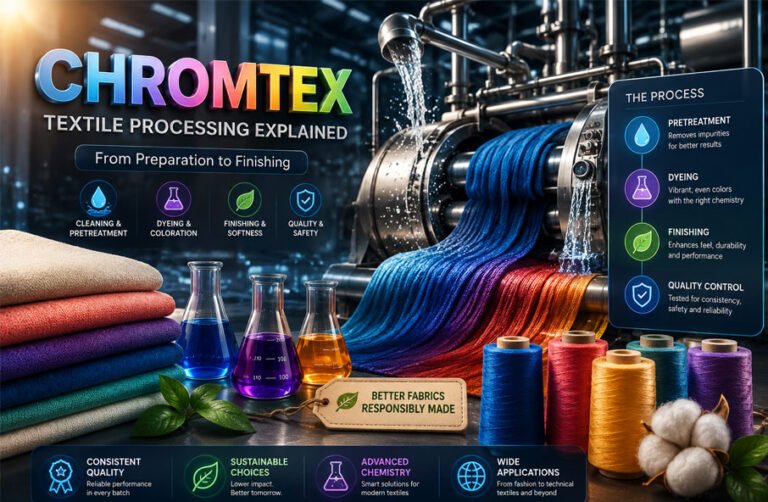
Chromtex is a term that appears online in discussions about textiles, color, fabric treatment, and textile chemicals. People often search for it to understand whether it is a chemical, a company, a fabric technology, or a type of textile-processing solution.
The name can be confusing because Chromtex is not a widely accepted technical term for one standard textile chemical or process. It is also easy to confuse it with similarly named companies and industry platforms.
This article explains what Chromtex appears to mean, how it differs from similar names, and how the real textile processes connected with the term work.
What Is Chromtex?
Chromtex is best understood as an ambiguous name connected with textile processing rather than the scientific name of one chemical.
Online descriptions sometimes present Chromtex as a textile treatment, chemical system, or group of products used for fabric preparation, coloring, and finishing. However, there is no widely established textile standard that defines Chromtex as one universal process.
The word itself may help explain the confusion. “Chrom” is often associated with color, while “tex” sounds connected with textiles. This makes the name seem like an established textile term even when the exact meaning depends on the source.
In practice, the processes commonly described under Chromtex are already known in the textile industry by specific names. These include dyeing, pretreatment, textile auxiliaries, washing, softening, fixing, and finishing.
This distinction is important. A wetting agent does not perform the same job as a dye, softener, enzyme, or fixing agent. Treating all of them as one Chromtex chemical would give readers an inaccurate picture of how textile processing works.
If a product is specifically sold under the Chromtex name, its manufacturer information, technical data sheet, and safety documents should be checked to understand what it actually contains and what it is intended to do.
Chromtex, Chromatex Chemicals, and ChromaTexChem
Several similar names appear online, but they should not be treated as the same thing.
Chromtex is the broad and unclear term discussed in this article. Public information under this exact spelling does not clearly establish it as one universal textile company, chemical, or technology.
Chromatex Chemicals Pvt. Ltd. is a separate and documented textile-chemical company in Pakistan. The spelling includes an extra “a.” The company states that it has served the textile industry since 1999 and produces auxiliary chemicals used in pretreatment, dyeing, and finishing.
Its product range includes categories such as wetting agents, detergents, enzymes, sequestering agents, peroxide stabilizers, leveling agents, fixing products, softeners, pH-control products, binders, and other textile-processing chemicals.
ChromaTexChem is different again. It is associated with an Indian industry exhibition and business platform covering colorants, textile chemicals, speciality chemicals, pigments, dyestuffs, equipment, testing, and related areas.
Because the names are similar, information from Chromatex Chemicals or ChromaTexChem sometimes appears in searches for Chromtex.
Readers should therefore check the exact spelling before accepting claims about a company’s history, products, certifications, offices, or achievements.
Generic statements that Chromtex was founded in a particular year, grew from a startup, operates globally, or has won industry awards should not be treated as confirmed unless a reliable source identifies the exact organization being discussed.
How Textile Processing Works
Textile processing covers the stages that turn fibers, yarn, or unfinished fabric into material ready for clothing, home textiles, or technical uses.
There is no single production method for every fabric. The process changes according to the fiber, fabric construction, desired color, machinery, and final use.
A textile may pass through preparation, washing, scouring, bleaching, dyeing, printing, rinsing, drying, and finishing before it is ready for use.
Chemical and mechanical treatments work together during these stages.
For example, preparation chemicals may clean the fabric before dyeing. Dyeing auxiliaries can help control the coloring process. Washing removes unwanted residues, while finishing treatments can change softness, appearance, moisture behavior, or other properties.
Good results also depend on accurate control of temperature, pH, water quality, treatment time, chemical concentration, and machinery.
This is why it is misleading to suggest that one chemical alone creates all the useful qualities of a finished textile. Fabric quality comes from the complete production system.
Fabric Preparation Before Dyeing
Fabric is not always ready to accept dye immediately after weaving or knitting.
Natural fibers may contain oils, waxes, dirt, and other materials. Manufacturing can also leave sizing agents, lubricants, and processing residues on the textile surface.
These materials can stop water and dye from reaching the fibers evenly. If they are not removed correctly, the final fabric may show patches, spots, uneven shades, or poor color penetration.
Pretreatment prepares the material for later stages.
For cotton and some other textiles, this may involve desizing, scouring, washing, and bleaching.
Desizing removes sizing materials that may have been applied to yarn during weaving. Scouring helps remove oils, waxes, dirt, and other impurities. Bleaching may be used when a cleaner or lighter base is needed before dyeing or printing.
The process must be controlled carefully. Treatment that is too weak may leave unwanted material behind. Treatment that is too harsh can damage fibers or reduce fabric performance.
Different fibers also require different preparation methods. Cotton, polyester, viscose, wool, and blended fabrics do not respond to chemicals, heat, water, and pH in exactly the same way.
Proper preparation gives manufacturers a more predictable surface and makes consistent coloration easier to achieve.
Textile Auxiliaries and What They Do
Textile auxiliaries are chemicals used to support specific operations during textile manufacturing.
Unlike fibers and dyes, they are mainly used to help a process work correctly. They can be used during preparation, dyeing, printing, washing, and finishing.
This is an established textile-industry term and is more accurate than describing every processing chemical as Chromtex.
A wetting agent helps water or processing liquid spread across and enter a textile more effectively.
A detergent can help remove oils, dirt, and other unwanted material.
Enzymes perform specific biological reactions. For example, some enzymes can help remove starch-based sizing materials, while others may be used for particular effects on cellulosic fabrics.
A sequestering agent helps control certain metal ions in processing water that could interfere with cleaning or coloration.
A leveling agent can help control how dye is taken up by the textile so that color develops more evenly.
A dispersing agent helps keep certain substances properly distributed in a processing bath.
Defoamers are used when unwanted foam interferes with production.
Fixing products may be used after dyeing to improve particular color-fastness properties in suitable systems.
Softeners are used during finishing to change the feel of fabric.
Other products may control pH, improve washing, protect fibers, stabilize processing chemicals, or support other specialized operations.
These chemicals cannot simply replace one another. Each one has a different purpose.
Manufacturers must consider fiber type, dye system, dosage, temperature, pH, machinery, water conditions, and chemical compatibility before selecting an auxiliary.
How Fabrics Are Dyed
Textile dyeing is more complex than placing fabric in colored water.
Different fibers have different chemical structures. A dye that works well on cotton may not be suitable for polyester, and a system designed for polyester may not be appropriate for wool or nylon.
Reactive dyes are widely used for cellulosic fibers such as cotton. Under the correct conditions, they can form strong chemical interactions with the fiber.
Disperse dyes are especially important for polyester. Polyester behaves differently from cotton and normally requires a different dyeing system and carefully controlled processing conditions.
Other fibers use other suitable classes of dyes and colorants.
Several factors can affect the final shade, including temperature, pH, treatment time, water quality, dye concentration, machinery, and the auxiliaries used in the process.
Auxiliaries help manufacturers control these conditions.
Wetting agents can help the processing liquid reach the textile evenly. Leveling agents may control the rate at which dye moves toward or enters the fiber. Dispersing agents help keep suitable dye particles distributed in the bath. Sequestering agents can reduce problems caused by unwanted metal ions in water.
Accurate control matters because a small variation can produce visible shade differences across a production batch.
For a factory producing hundreds or thousands of meters of the same fabric, even a minor color difference can become a quality problem.
Color Fastness and Fabric Quality
Color fastness describes how well a textile keeps its color when exposed to normal use and different conditions.
Depending on the product, manufacturers may test resistance to washing, rubbing, perspiration, light, or other forms of exposure.
Good color fastness begins with choosing a suitable dye for the fiber and applying it correctly.
After dyeing, washing and other after-treatment steps can remove excess or poorly attached color. In some dyeing systems, fixing products may also be used to improve certain fastness properties.
However, a fixing chemical cannot make every color permanent.
Long-term performance depends on the fiber, dye chemistry, processing conditions, after-washing, exposure to sunlight, garment use, and how the textile is cleaned and cared for.
Poor fastness can cause fading or color transfer. For manufacturers, this can result in rejected fabric, customer complaints, or the need for additional processing.
For this reason, color quality is not judged only by how bright or even a fabric looks when it leaves the dyeing machine. Manufacturers also need to consider how well that color performs during the expected life of the textile.
Textile Finishing and Fabric Performance
Dyeing gives fabric its color, but finishing helps control how the material feels, looks, and performs after production.
Finishing can affect softness, smoothness, flexibility, shape, moisture behavior, and surface appearance. Some finishes are also used for specific functions such as wrinkle resistance, reduced static, water repellency, or easier care.
Softeners are one common example. They can change the hand feel of fabric, which means how the material feels when touched or handled.
The result depends on the fiber, chemical used, dosage, application method, and final purpose of the textile. A finish that works well on bedding may not be suitable for sportswear or industrial fabric.
Mechanical finishing also plays an important role. Processes such as brushing, calendaring, compacting, and raising can change the surface, thickness, texture, or dimensions of a textile.
Not every finish is permanent. Some effects can become weaker after repeated washing or use. Manufacturers therefore need to test whether a finish performs for as long as the product requires.
Cotton, Polyester, and Blended Fabrics
Different fibers react differently to dyes, chemicals, temperature, and moisture. This is why textile processing must be matched to the material.
Cotton
Cotton is a natural cellulosic fiber. Before dyeing, it may need preparation to remove waxes, oils, sizing materials, and other impurities.
Reactive dyes are widely used for cotton and other cellulosic fibers. The exact recipe depends on the dye, equipment, shade, fabric construction, and required performance.
Cotton can also receive finishing treatments to change softness, appearance, shrinkage behavior, or other properties.
Polyester
Polyester is a synthetic fiber and behaves differently from cotton.
Disperse dyes are commonly used for polyester coloration. Temperature and process control are especially important because polyester does not absorb dyes in the same way as natural cellulosic fibers.
Suitable dispersing agents and other auxiliaries may also be needed depending on the dyeing method.
Blended Fabrics
Blended fabrics contain two or more fiber types. Cotton-polyester is a common example.
These materials can be harder to dye because each fiber may need different dyes and processing conditions. A manufacturer may need a carefully planned dyeing sequence or a compatible system that can color both components correctly.
This is another reason why one universal Chromtex process would not make technical sense for every fabric.
Quality Control in Textile Processing
Textile chemical processing depends on accurate control.
Small changes in temperature, pH, chemical concentration, treatment time, water quality, or machinery can affect the final fabric. Even when the same recipe is used, poor control can produce different results between batches.
Manufacturers may test fabric for shade, appearance, absorbency, strength, and color fastness.
Laboratory trials are also common before a full production batch is treated. A small sample can be used to check the color and processing conditions before larger quantities of fabric are exposed to the same treatment.
This can reduce the risk of wasting fabric, water, chemicals, energy, and labor.
Good chemicals alone cannot guarantee a good result. Correct storage, accurate measurement, trained workers, maintained machinery, and suitable processing conditions are also important.
Benefits of Proper Textile Processing
Proper textile processing can improve both production control and the final quality of fabric.
Good preparation can help fabric accept dye more evenly. Controlled dyeing can reduce shade differences. Appropriate finishing can improve softness, appearance, or a specific performance property.
Better control can also reduce the need for reprocessing.
When a fabric reaches the correct shade and quality on the first attempt, manufacturers may use less extra water, energy, labor, and chemicals.
Other possible benefits include better consistency between batches, improved color fastness, cleaner fabric, and more reliable finishing results.
These benefits come from the complete production process. They should not be described as guaranteed benefits of one product called Chromtex.
Limitations and Common Problems
Textile processing is useful, but it can also cause problems when chemicals or process conditions are not controlled correctly.
Incorrect chemical concentration can leave fabric under-treated or damage the material. Wrong pH or temperature can affect dye behavior and fiber strength.
Poor chemical compatibility may cause stains, deposits, uneven coloration, or unwanted reactions.
Processing for too long can also affect fabric quality, while stopping too early may leave the treatment incomplete.
Common results of poor processing include:
- uneven shades;
- poor color fastness;
- stains or patches;
- rough or unwanted texture;
- weak fabric performance;
- fiber damage;
- extra washing or recoloring.
Advanced textile processing can also be expensive. Laboratories, trained workers, automated dosing systems, wastewater treatment, testing, and quality-control systems all require investment.
Smaller manufacturers may find some of these systems harder to adopt.
Is Chromtex Safe?
Chromtex cannot be called safe or unsafe based on the name alone.
If Chromtex refers to a specific commercial chemical, its safety depends on the actual ingredients, concentration, intended use, exposure route, and handling instructions.
Manufacturers should check the Safety Data Sheet, technical product information, and supplier guidance before using any textile chemical.
Safe handling can include correct storage, worker training, suitable protective equipment, proper ventilation, controlled dosing, and responsible disposal.
Wastewater management is also important because chemicals used during washing, dyeing, or finishing may enter factory wastewater.
Finished textile safety is a separate issue. Brands and manufacturers may use restricted-substance rules and testing programs to control unwanted residues in products sold to consumers.
If a product is specifically sold as Chromtex, the safest approach is to verify the manufacturer and review its official safety documents before use.
Sustainability and Environmental Impact
Not all textile chemicals are environmentally friendly.
Their impact depends on the chemical composition, amount used, water consumption, processing temperature, energy needs, wastewater treatment, and waste management.
More sustainable textile production usually requires changes across the whole process.
Factories can reduce impact by improving chemical selection, lowering unnecessary water use, reducing failed batches, improving wastewater treatment, and using more efficient machinery.
Better process control can also help. If fabric reaches the correct result during the first treatment, there is less need for repeated washing, dyeing, or correction.
Enzymes can be useful in some textile processes because certain enzyme treatments can work under relatively mild conditions. However, the environmental value still depends on how the full process is designed and managed.
It would therefore be inaccurate to describe Chromtex, or any broad group of textile chemicals, as automatically eco-friendly.
Where Textile Processing Is Used
Textile processing affects many products used every day.
In clothing, it is used for T-shirts, jeans, dresses, uniforms, activewear, underwear, jackets, and many other garments.
Home textiles also depend on controlled preparation, dyeing, and finishing. Examples include bedsheets, towels, curtains, upholstery, carpets, and decorative fabrics.
Technical textiles are another important area. Processing may be used for automotive interiors, filtration products, protective materials, industrial fabrics, and some healthcare-related textiles.
Each application has different needs.
A soft finish may be important for bedding, while an industrial textile may need strength, stability, or resistance to particular conditions.
This is why textile manufacturers use different fibers, dyes, auxiliaries, and finishing methods for different products.
The Future of Textile Processing
Modern textile production is becoming more controlled and data-driven.
Automation can help factories manage chemical dosing, temperature, timing, and recipes more accurately. This can reduce mistakes caused by inconsistent manual measurements.
Sensors and production data can also help manufacturers identify changes in process conditions before they create larger quality problems.
Digital textile printing continues to develop as another method for applying color and designs to suitable fabrics. Its environmental impact still depends on the inks, pretreatments, equipment, energy use, and overall production method.
Research in textile science is also exploring lower-impact coloration, recycling, bio-based materials, enzyme technologies, functional coatings, and smart textiles.
Smart textiles are materials designed to sense or respond to certain conditions. They are part of a wider field of textile engineering and should not automatically be described as Chromtex.
The future of textile processing is likely to focus on better performance with less waste, lower resource use, and more precise process control.
Bottom Line
Chromtex is an unclear term that appears online in discussions about textile chemicals, color, dyeing, and fabric finishing.
It should not be treated as the scientific name of one universal textile chemical or one standard manufacturing system.
Some searches for Chromtex also lead to similarly named entities such as Chromatex Chemicals and ChromaTexChem, which are separate names and should not be mixed together.
The real textile processes connected with many Chromtex discussions are well established. They include pretreatment, dyeing, textile auxiliaries, washing, finishing, quality control, safety management, and wastewater control.
If a specific product is sold under the Chromtex name, buyers should confirm its manufacturer, technical data sheet, intended use, and Safety Data Sheet before making claims about what it does.
Frequently Asked Questions
What is Chromtex?
Chromtex is a term found online in connection with textiles, color, and fabric processing. It does not have one widely accepted technical definition that identifies it as a universal textile chemical or standard process.
Is Chromtex a textile chemical?
Not necessarily. Chromtex should not automatically be described as one chemical. Textile production uses many different products, including wetting agents, detergents, enzymes, dyes, dispersants, fixing agents, and softeners.
Is Chromtex the same as Chromatex Chemicals?
No automatic connection should be assumed. Chromatex Chemicals Pvt. Ltd. is a separate company name with different spelling. Information about that company should not be presented as information about Chromtex unless a reliable source clearly connects the two.
What are textile auxiliaries?
Textile auxiliaries are chemicals that support preparation, dyeing, printing, washing, and finishing.
They can help with wetting, cleaning, dispersion, leveling, foam control, fixation, softening, pH control, and other specific textile-processing needs.
How do textile chemicals help with dyeing?
Some chemicals help prepare fabric before dyeing. Others support wetting, dye distribution, pH control, dispersion, or after-treatment.
Their purpose depends on the fiber, dye class, machinery, water conditions, and desired result.
Does textile processing make fabric last longer?
Proper processing can help maintain textile quality, but it does not automatically make every fabric stronger or longer lasting.
Garment durability also depends on fiber quality, yarn, fabric construction, sewing, finishing, washing, drying, abrasion, and how the product is used.
Is Chromtex safe?
The name alone cannot show whether a product is safe. A specific chemical should be checked using its ingredients, technical data, Safety Data Sheet, intended use, and handling instructions.
Are textile chemicals environmentally friendly?
Some can support lower-impact production, but no broad group of textile chemicals should be considered automatically eco-friendly.
Environmental impact depends on chemical composition, water and energy use, wastewater treatment, process efficiency, and how the chemicals are managed.
More To Explore:
Smoothiepussit Reviews: Nutrition, Storage, Cleaning, and Safety
