

MataRecycler is a name connected with recycling, sustainability, waste management, and modern recycling technology. People searching for it may find very different explanations. Some websites describe MataRecycler as an environmental information platform, while others present it as an AI-powered smart recycling system.
The available evidence supports a more careful description. MataRecycler has a real online presence focused on recycling and sustainability information, but many claims about smart bins, artificial intelligence, automated sorting, and related products have not been independently confirmed.
This guide explains what MataRecycler is, what its website actually does, why smart-recycling technology is often linked to the name, and how the technologies described in those claims work in the wider recycling industry.
What Is MataRecycler?
MataRecycler is best understood as an online platform connected with recycling, waste management, reuse, sustainability, and environmental awareness. Its public material says it aims to make recycling information practical and easier to understand for individuals, businesses, and communities.
Its content covers subjects such as recycling methods, waste reduction, eco-friendly alternatives, responsible resource use, and environmental awareness.
The confusion begins when third-party websites use the same name differently. Some describe MataRecycler as a smart recycling system that uses artificial intelligence, sensors, automated sorting, and other advanced technology. Others use the name more broadly for modern approaches to resource recovery.
There is not enough reliable evidence to treat MataRecycler as one confirmed commercial machine, AI platform, or industry-standard technology. The name is also not known as a standardized technical term used throughout the recycling industry.
It is therefore useful to separate three ideas: the MataRecycler website, the wider idea of technology-assisted recycling, and real commercial recycling technologies developed by established companies.
MataRecycler Background and History
MataRecycler has a relatively recent documented online history. Public domain information records that MataRecycler.com was created on November 2, 2025. This gives a clear starting point for its web presence, but it does not prove that the project itself began on that exact date.
There is little reliable public information about MataRecycler before the domain appeared. No detailed company history, early project timeline, funding record, or documented launch announcement has been established.
The website refers to a team involved in researching and sharing information about recycling and sustainability. However, it does not clearly identify the people behind that team or provide biographies of founders or executives.
There is also a separate website using the MataRecycler.org domain. It presents itself more like a digital publication covering recycling, technology, and other topics. The existence of the two websites should not be taken as proof that they have the same owner or management. Available information does not establish that connection.
What Does MataRecycler Actually Do?
Its website says it researches and shares information about recycling, waste management, reuse, sustainability, and environmentally responsible choices. Its stated aim is to help readers understand these subjects and make better decisions about reducing waste and protecting resources.
The platform discusses topics such as recycling processes, responsible consumption, resource optimization, waste reduction, and eco-friendly alternatives. This makes it closer to an environmental information website than to a clearly documented waste-management company.
There is currently no reliable primary evidence showing that MataRecycler manufactures recycling machines, operates waste-processing facilities, collects household waste, runs municipal recycling services, or sells a verified smart-recycling device.
This distinction matters because a website can explain modern recycling technology without owning or developing that technology.
Why Is MataRecycler Often Described as Smart Recycling Technology?
A large part of the confusion comes from third-party articles.
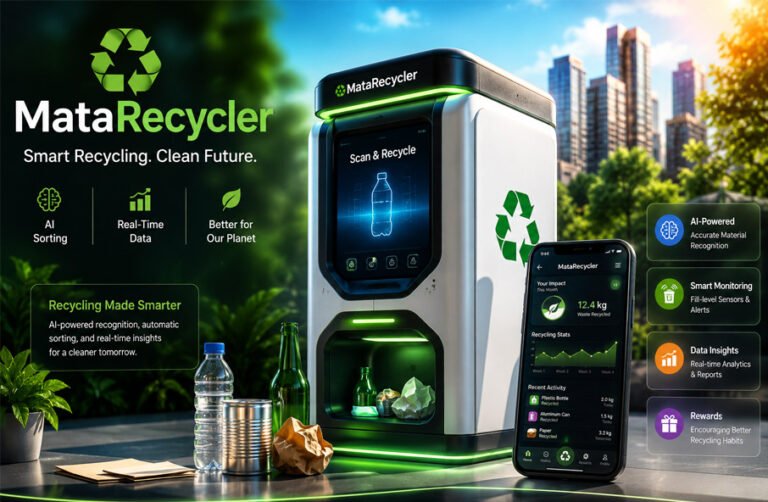
Some websites describe MataRecycler as an advanced recycling system that combines artificial intelligence, cameras, computer vision, sensors, smart bins, automated sorting, cloud software, and data analytics.
Other descriptions add features such as mobile apps, fill-level monitoring, collection alerts, recycling rewards, and route optimization.
These ideas are technically possible because similar technologies are already used in the wider waste and recycling industry. AI can help recognize materials, sensors can measure bin conditions, and software can analyze collection data.
However, the existence of these technologies in the industry does not prove that MataRecycler itself provides them.
The available primary information does not show a clearly identified MataRecycler hardware model, technical specification sheet, patent, verified app-store listing, named customer deployment, or independently tested recycling system.
Some sources also repeat precise performance claims about MataRecycler-style systems. Such figures should be treated carefully when they cannot be traced to independent testing, a named location, a manufacturer, or an original study.
Readers should therefore view AI, sensors, smart bins, and automated sorting as reported or commonly associated claims, rather than confirmed MataRecycler product features.
How Does a MataRecycler-Style Recycling System Work?
There is no verified technical specification showing exactly how a proprietary MataRecycler system operates.
However, the general process described in MataRecycler-related articles is similar to the way modern technology-assisted recycling can work.
Collection
Waste and recyclable materials first enter a collection system. This may involve household recycling containers, commercial waste collection, or material arriving at a recycling facility.
The purpose is to create a material stream that can be checked, separated, and processed.
Identification
The next step is identifying different materials.
Modern recycling facilities may use cameras, optical scanners, sensors, or other equipment to distinguish between plastics, metals, paper, cardboard, glass, and other material types.
Computer-vision and machine-learning systems can also support this process by analyzing images and recognizing objects or material categories.
Sorting
After identification, materials are separated into appropriate streams.
Sorting can involve manual workers, mechanical systems, air jets, magnets, optical equipment, or robotic systems depending on the facility and material.
Better sorting helps keep different materials apart and can reduce contamination.
Processing
Sorted materials normally require further preparation before they can be reused.
Depending on the material, this may involve cleaning, shredding, compacting, crushing, or other processing. The exact method depends on the recycling facility and what the recovered material will be used for.
Recovery
Useful materials are then recovered for possible reuse in new products or other applications.
The goal is to keep valuable materials in use instead of sending them unnecessarily to landfill or disposal.
Monitoring
Modern systems can also collect operational data. This may include the amount of material processed, contamination rates, collection volumes, or equipment performance.
The general sequence of collection, identification, sorting, processing, recovery, and monitoring is a useful way to understand modern recycling systems. It should not, however, be treated as a confirmed technical specification for MataRecycler itself.
Common Features Associated With Smart Recycling
Several technologies commonly appear in descriptions of MataRecycler and similar smart-recycling concepts. These are real technologies in the wider recycling sector, although they are not all verified MataRecycler features.
Material Identification
Material-identification systems help determine what type of waste is being processed. Cameras, optical sensors, and computer-vision software can support this task.
Accurate identification is important because different materials normally require different recycling processes.
Automated Waste Sorting
Automation can reduce the amount of repetitive manual sorting required at recycling facilities.
Machines may separate materials according to type, size, weight, magnetic properties, or visual characteristics. Automated systems can also work alongside human workers rather than replacing them completely.
Sensors and Monitoring
Sensors can collect information about containers, equipment, or waste streams.
For example, modern smart bins may use sensors to estimate how full they are. Waste operators can use this information to plan collection schedules more efficiently.
Data Analysis
Digital recycling systems can collect information about waste volumes, material types, contamination, and processing performance.
This information can help organizations understand where waste is being produced and where recycling operations may need improvement.
Recycling Education and Resource Recovery
Technology is only one part of effective recycling. Clear information can help people understand what should be recycled, how materials should be prepared, and what local programs accept.
The broader MataRecycler concept also places attention on recovering useful materials instead of treating everything as waste.
The Role of AI in Recycling
Artificial intelligence can support several parts of modern recycling.
Computer-vision systems can examine images of waste, while machine-learning models can help recognize objects or assign them to material categories. Automated equipment can then use this information during sorting.
AI may be especially useful where recycling facilities need to identify large numbers of mixed objects quickly and consistently.
However, AI does not perform the entire recycling process.
A working recycling system still needs collection vehicles, transportation, sorting equipment, processing facilities, quality control, trained staff, and buyers or manufacturers that can use recovered materials.
AI is therefore better understood as a supporting tool within recycling infrastructure rather than a replacement for the complete system.
What Is MataRecycler Used For?
The most clearly supported use of MataRecycler is providing recycling and sustainability information.
Individuals may use this type of content to better understand recycling rules, material separation, reuse, and responsible disposal. Businesses may use environmental information to think about how they organize waste and recyclable materials.
The broader MataRecycler concept can also be relevant to recycling facilities, communities, schools, and technology researchers. Possible areas include public recycling education, material recovery, waste-management planning, and research into sensors, automation, AI, and data-driven recycling.
The exact use depends on what someone means by “MataRecycler.” When referring to the website, its main role is informational. When referring to smart-recycling ideas described by third-party sources, the term may cover technologies used to identify, sort, monitor, and recover recyclable materials.
Benefits of Modern Smart Recycling
Modern recycling technology can improve how recyclable materials are collected, sorted, and tracked. These benefits apply to smart-recycling systems in general. They should not be treated as proven results from a specific MataRecycler product.
Better sorting is one of the main advantages. Sensors, cameras, computer vision, and automated equipment can help separate materials more accurately. Keeping paper, plastics, metals, glass, and other materials in the correct streams can make later processing easier.
Technology may also help reduce contamination. Contamination happens when food waste, non-recyclable objects, or the wrong materials enter a recycling stream. Better identification and clearer guidance can lower this risk, although no system can remove every contamination problem.
Automation can make some recycling operations more efficient. Facilities often process large amounts of mixed material, so machines can help with repetitive identification and sorting tasks.
Another benefit is better data. Digital systems can record how much material is collected, which materials appear most often, and where problems are happening. Operators can use this information to improve planning.
Better sorting can also support resource recovery. The goal is to keep useful materials in circulation instead of losing them through incorrect disposal.
Problems Smart Recycling Can Help Address
One common recycling problem is incorrect sorting. People may place items in the wrong container because packaging can be confusing and recycling rules differ between locations.
Another issue is contamination. Food residue, mixed materials, plastic bags, and other unsuitable items can reduce the quality of recyclable material.
Smart-recycling technology may also help facilities recover materials that might otherwise be lost. Automated identification can support workers and equipment when large quantities of waste need to be separated.
Data systems can improve visibility as well. Waste operators may be able to see collection volumes, container conditions, or material patterns instead of relying only on fixed schedules and manual checks.
Technology cannot solve every recycling problem, however. Local infrastructure, public behavior, collection systems, processing capacity, recycling rules, and demand for recovered materials all affect the final result.
MataRecycler vs Traditional Recycling
Traditional recycling usually depends on established collection services, sorting facilities, processing equipment, and manual work. Technology-assisted recycling adds digital tools and automation to some of these steps.
| Traditional Recycling | Technology-Assisted Recycling |
|---|---|
| More dependence on manual sorting | More opportunities for automated sorting |
| Basic identification methods | May use cameras, sensors, and computer vision |
| Limited real-time information | Can provide more operational data |
| Fixed collection schedules are common | Sensor data may support smarter collection planning |
| Public guidance may be separate | Digital tools can provide recycling information |
| Decisions rely mainly on standard procedures | Data can support operational decisions |
Smart technology does not necessarily replace traditional recycling. In most cases, it works with the same basic collection, sorting, transport, and processing infrastructure.
For MataRecycler specifically, this comparison should be understood as general industry context. There is no confirmed technical documentation showing that MataRecycler operates such a complete technology-assisted system.
Benefits and Limitations of MataRecycler-Style Systems
A MataRecycler-style smart recycling system could offer useful advantages if it included the technologies commonly described online. Better material recognition, automated sorting, monitoring, and data analysis could help organizations manage recyclable waste more effectively.
However, advanced recycling technology also has practical limits.
Specialized equipment can be expensive to purchase and install. Sensors, cameras, robotic systems, software, and network connections may also require ongoing maintenance.
Some products are difficult to recycle even with good technology. Packaging may contain several materials bonded together, and contamination can make recovery harder.
Automated systems also depend on good data and accurate identification. Poor sensor readings, unusual materials, damaged packaging, or changes in waste streams can affect results.
Local rules create another limitation. A material that is accepted in one city may not be accepted in another. Technology therefore cannot replace local recycling guidance.
Most importantly for MataRecycler, verification remains a major limitation. Specific claims about performance, accuracy, installations, or cost should not be accepted without technical documentation or independent evidence.
Pricing, Products, and Availability
There is no verified public pricing for a MataRecycler smart recycling product.
No reliable information has established hardware prices, installation costs, monthly subscriptions, enterprise plans, municipal contracts, or paid software tiers.
There is also no confirmed product catalogue showing MataRecycler-branded recycling machines or commercial smart bins.
The MataRecycler website itself is publicly accessible as an information resource. That does not mean an alleged MataRecycler technology platform should be described as free.
Geographic availability is also unclear. No verified evidence has established a commercial rollout of MataRecycler recycling equipment in specific countries, cities, or regions.
Readers should be cautious with any source that gives exact MataRecycler prices or claims widespread availability without linking to official product information.
Does MataRecycler Have an App?
Some third-party descriptions claim that MataRecycler includes a mobile application.
Reported functions include scanning waste items, checking whether something is recyclable, viewing recycling statistics, receiving reminders, and earning rewards.
These claims are not sufficiently verified.
No confirmed official iOS or Android app listing has been established in the information reviewed. There is also no verified app developer profile, version history, system requirement list, or official download page for a MataRecycler mobile application.
For that reason, a mobile app should be described as a reported feature, not a confirmed MataRecycler service.
Safety, Privacy, and Security
MataRecycler’s documented role is mainly informational, so the most practical safety issue is the accuracy of recycling advice.
Local recycling rules can differ greatly. Readers should check instructions from their local authority or waste provider before disposing of batteries, electronics, chemicals, medical waste, or other materials that may require special handling.
The MataRecycler contact information also advises users not to share unnecessary sensitive personal information when contacting the website.
For the alleged smart-recycling technology, there is not enough public documentation to evaluate technical security in detail. No verified information has established encryption methods, security certifications, cybersecurity audits, data-retention rules, or privacy controls for a MataRecycler smart-bin network.
There is also insufficient evidence to claim compliance with specific laws such as GDPR or CCPA.
Organizations considering any recycling technology should check how data is collected, stored, shared, and protected before using it.
Who Owns MataRecycler?
The founder and owner of MataRecycler are not publicly confirmed.
The website refers to a team responsible for researching and sharing recycling and sustainability information, but it does not provide a detailed leadership page identifying founders or executives.
Public domain-registration information confirms the existence and age of MataRecycler.com, but it does not establish a clear ownership history.
Other details such as headquarters, employee count, executive team, parent company, and formal corporate structure also remain unavailable in the reliable material reviewed.
For this reason, it is more accurate to call MataRecycler an online platform or website than to describe it as a confirmed recycling corporation.
Revenue and Net Worth
There is no reliable public information showing MataRecycler’s annual revenue or net worth.
No verified financial statements, company valuation, investment round, acquisition price, or funding announcement has been identified.
Website statistics should not be used to fill this gap. Estimated traffic, backlinks, domain authority, advertising value, or similar SEO measurements do not show what a business is actually worth.
Any exact revenue or net-worth figure for MataRecycler would therefore be speculative unless supporting financial evidence becomes available.
How to Check MataRecycler Claims
Readers can use a few simple checks when they find detailed claims about MataRecycler or another unfamiliar technology.
First, look for a clearly identified organization behind the product. A real commercial system should normally have information about its manufacturer, team, contact details, or legal business identity.
Next, check for technical documentation. Product specifications, manuals, patents, app listings, independent tests, and official case studies can provide stronger evidence than repeated blog descriptions.
Real-world deployments are also useful. Search for named cities, recycling facilities, businesses, schools, or government programs that have actually used the technology.
Statistics deserve special attention. If an article says a system improved recycling by a specific percentage, look for the original study or named project behind the figure. A precise number repeated across several websites is not automatically verified evidence.
For a major purchase or public project, buyers should also ask for customer references, past deployments, business-registration information, and independent testing before signing a contract.
How to Recycle More Effectively
Good recycling does not depend only on advanced technology.
The first step is to learn what your local recycling program accepts. An item can be technically recyclable but still not be accepted by the facility serving your area.
Keep recyclable items reasonably clean when local instructions require it. Food and liquid can contaminate some recycling streams.
Separate materials when necessary. For example, some products combine plastic, paper, metal, or glass in ways that need different handling.
Avoid placing unknown objects in recycling bins just because they appear recyclable. This practice can cause contamination or create problems for sorting equipment.
Reuse and repair are also useful when practical. A product that can still serve a purpose does not always need to enter the recycling stream immediately.
Following local collection instructions remains one of the simplest ways to improve recycling results.
Bottom Line
MataRecycler is best understood from the available evidence as an online platform connected with recycling, sustainability, reuse, waste management, and environmental awareness.
Its documented web presence is relatively recent, with MataRecycler.com registered in November 2025. Several important details remain unknown, including its founder, legal owner, headquarters, revenue, and corporate structure.
Many third-party websites describe MataRecycler as an AI-powered recycling system using smart bins, sensors, automated sorting, computer vision, and data analytics. These technologies are real within the wider recycling industry, but there is not enough reliable evidence to confirm them as features of a proprietary MataRecycler product.
The safest approach is to distinguish between MataRecycler’s documented informational role, general smart-recycling technology, and unverified claims about a specific MataRecycler system.
Frequently Asked Questions
What is MataRecycler?
MataRecycler is an online platform associated with recycling, sustainability, waste management, reuse, and environmental awareness. Some websites also use the name when discussing smart-recycling technology, but these broader descriptions are not consistently verified.
Is MataRecycler a real company?
The MataRecycler website is real, but there is not enough reliable public information to establish it as a formally documented recycling technology company with known founders, executives, customers, and commercial products.
Its legal business structure and ownership remain unconfirmed.
Is MataRecycler an AI-powered recycling system?
Some third-party sources describe MataRecycler as an AI recycling system using sensors, cameras, smart bins, and automated sorting.
However, no sufficiently verified technical documentation, hardware model, app listing, or named customer deployment has been established. The AI-system description should therefore be treated as unconfirmed.
How does MataRecycler work?
There is no confirmed proprietary MataRecycler technical process.
Modern smart recycling generally involves collecting waste, identifying materials, sorting them into suitable streams, processing those materials, recovering useful resources, and monitoring operations with data. Some systems use AI, cameras, sensors, and automation during these stages.
Does MataRecycler have a mobile app?
Some websites claim that MataRecycler has an app for recycling guidance, scanning items, tracking activity, or earning rewards.
No verified official iOS or Android application has been established, so these features should not be presented as confirmed.
Is MataRecycler free?
The informational website can be accessed publicly.
There is no reliable pricing information for a commercial MataRecycler smart recycling product, software subscription, hardware system, or enterprise service. It would therefore be inaccurate to describe such a product as either free or paid.
Who owns MataRecycler?
MataRecycler’s owner and founder are not publicly confirmed. The website mentions a team, but reliable public information does not currently identify its leadership or detailed ownership structure.
Is MataRecycler safe to use?
Reading the website is different from using a physical recycling technology.
For recycling advice, users should confirm important disposal instructions with their local waste authority because accepted materials differ by location. For any alleged MataRecycler commercial technology, organizations should verify the vendor, technical specifications, privacy practices, security measures, and real-world deployments before relying on it.
More To Explore:
