

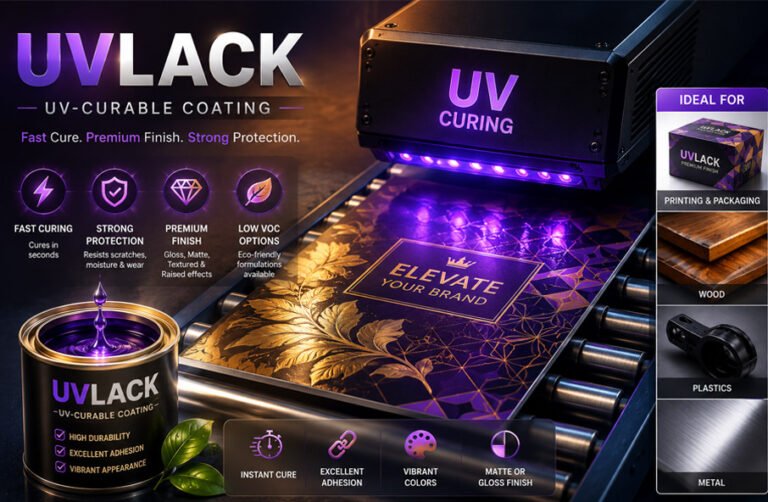
UVLack is a UV-curable varnish or surface coating. It starts as a liquid and becomes a hard film when exposed to the correct ultraviolet light.
People often search for UVLack to understand what it is, how UV curing works, and where this type of coating is used. It is especially common in printing and packaging, while similar UV-curable coatings are also used on wood, plastic, metal, and other manufactured products.
This guide explains how UVLack works, the different finishes available, UV lamps and LED curing, common applications, benefits, limitations, safety, and other practical details.
What Is UVLack?
UVLack is a coating that cures when ultraviolet light starts a chemical reaction inside it. Unlike many traditional varnishes that need time to air-dry or lose solvent or water, a UV-curable coating can become solid very quickly when the correct curing conditions are used.
The term is closely connected with UV-Lack. In German, Lack can mean lacquer, varnish, or coating. This makes UV-Lack a practical term for a lacquer or varnish that cures with ultraviolet radiation.
UVLack is also used as a commercial product name. Pluma lists UVLACK Varnish and UVLACK Spot Varnish in its UV coating range for print finishing.
The wider UV-curing technology is not new. UV-curable coatings have been used for many years in printing and manufacturing. The exact formula depends on what is being coated and what result is required.
A UV varnish made for printed paper, for example, may be very different from an industrial coating designed for plastic or wood.
How Does UVLack Work?
UVLack begins as a liquid coating. It is spread over a surface in a controlled layer and then exposed to a suitable UV light source.
The liquid normally contains reactive resins or oligomers, monomers or reactive diluents, additives, and light-sensitive chemicals called photoinitiators.
The photoinitiator is important because it absorbs UV energy. Once activated, it starts the chemical reaction that causes the coating molecules to join together.
This reaction is commonly called polymerization or crosslinking.
The process can be understood in five basic steps:
- The surface is prepared and cleaned.
- UVLack is applied in the required thickness.
- The coating passes under a suitable UV lamp or LED unit.
- The photoinitiator reacts to the UV energy.
- The liquid coating becomes a solid film.
Technical print material describes the same process: UV light activates the photoinitiators, which starts crosslinking in the resin and turns the wet varnish into a hard layer very quickly.
This is why UV curing can be much faster than ordinary drying. A printed sheet may be able to move toward cutting, folding, binding, or packing soon after the coating stage instead of waiting for a long drying period.
What Affects UVLack Curing?
UVLack does not cure correctly simply because it is placed under any UV light. The coating and curing system have to work together.
Several factors can affect the final cure.
Lamp power is important because the coating needs enough UV energy to complete the reaction. A weak or aging lamp may not provide enough output.
Wavelength also matters. Photoinitiators react to certain parts of the UV spectrum. If the lamp produces the wrong wavelength range, the coating may remain partly uncured.
Coating thickness affects how deeply UV light needs to travel. A very thick layer may require more energy than a thin one.
Production speed is another factor. If a coated product passes under the lamp too quickly, it may not receive enough UV exposure.
The coating formula, substrate, lamp distance, pigments, and other machine settings can also change the result. The supplied material similarly notes that lamp power, coating thickness, surface type, machine setup, and formulation all influence curing.
Color can matter as well. Clear coatings normally allow UV light to pass through more easily. Strong or dark pigments may absorb or block part of the radiation, so some pigmented products can require different curing settings.
Good process control is therefore necessary even though UV curing itself is fast.
UV Lamps vs UV LED Curing
UVLack can be cured using different types of equipment. Two important systems are traditional UV lamps and UV LED units.
Traditional UV Lamps
Many older and established curing lines use mercury-based UV lamps. These lamps produce UV energy across a wider range of wavelengths.
Their broad output makes them compatible with many traditional UV coating formulas.
However, they can also create significant heat. Depending on the equipment, they may require warm-up time, cooling systems, ventilation, and regular lamp maintenance.
The lamps also lose output over time, which means curing performance should be checked rather than assuming an older lamp still works at its original power.
UV LED Curing
UV LED systems work differently. LEDs can switch on and off quickly and normally produce light within a narrower wavelength range.
They can place less heat on some products, which can be useful when working with thin films, plastics, or other heat-sensitive materials.
LED curing can also avoid some of the warm-up requirements associated with traditional mercury lamps.
However, an important limitation is that not every UVLack product will cure under every UV LED unit.
The photoinitiator in the coating must respond to the wavelength produced by the LED system. A varnish developed for a broad-spectrum mercury lamp may need a different formulation before it works correctly with an LED source.
The lamp and coating should therefore be checked for compatibility before production begins.
Types of UVLack Finishes
UVLack is not limited to one appearance. Different formulations and application methods can produce different surface effects.
The supplied material describes UV-curable finishes as glossy, matte, textured, or raised depending on the coating and process.
Gloss
Gloss UVLack creates a shiny surface that reflects more light. In printing, it can make photographs, colors, and graphics look stronger and more vivid.
It is often used when visual impact is important.
Matte
Matte UV coating creates a softer surface with less visible reflection.
It can be useful when a design needs a calmer appearance or when strong glare would reduce readability.
Textured Finishes
Some UV-curable coatings are designed to change how a surface feels as well as how it looks.
The exact texture depends on the formulation, coating weight, and application method.
Raised or Relief UV
Thicker UV varnish can be used to produce raised effects. This is often applied selectively to logos, letters, patterns, or other design elements.
The added height gives the printed area a more noticeable feel. Technical print information also describes relief varnish as a way to emphasize text and design elements in three dimensions.
Not every UVLack product is available in every finish. The actual options depend on the manufacturer and intended use.
Full-Surface UV vs Spot UV Varnish
UVLack can be applied across an entire printed surface or only to selected areas.
Full-Surface UV Coating
A full-surface coating covers most or all of the printed face.
It can create an even gloss or matte appearance while also adding a protective layer over the print.
This method is commonly used when the goal is consistent finishing across a brochure, cover, label, package, or similar item.
Spot UV Varnish
Spot UV, also called partial UV varnish, is applied only to selected areas.
A printer may use it on a:
- Logo
- Product name
- Photograph
- Title
- Pattern
- Graphic element
The contrast between coated and uncoated areas can make selected parts of the design more noticeable.
For example, a package may have a matte background with a glossy UV-coated logo. The difference in reflection and texture helps separate the logo from the rest of the design.
The supplied material confirms that Pluma lists UVLACK Spot Varnish as a separate product and explains that spot varnish can be applied to selected design elements.
Spot UV also requires accurate registration. If the coating does not line up correctly with the printed artwork, the final result can look uneven.
Common Uses of UVLack
UVLack is strongly associated with commercial printing, but UV-curable coating technology has wider industrial uses.
Printing
UV varnish can be used on many printed products, including business cards, brochures, flyers, folders, postcards, magazine covers, posters, and similar materials.
Gloss finishes can increase shine and color impact, while matte or raised coatings can be used for a different visual or tactile result.
Packaging
Packaging is another important use.
Boxes, labels, sleeves, and other printed packaging can use full UV coating for broad finishing or spot UV to highlight specific design elements.
A coating may also help the printed surface handle rubbing, moisture, and repeated contact during transport, display, and normal handling.
The supplied research notes that packaging can use UV coating both for visual presentation and surface protection.
Wood
UV-curable coatings are also used in some wood-finishing systems.
Fast curing is useful in factory production because coated panels or components can move quickly to the next stage after the finish has cured.
The exact product must still be suitable for the type of wood, preparation method, required appearance, and expected wear.
Plastic
UV-curable coatings can be applied to certain plastics when the coating and surface are compatible.
Plastics can be more difficult than paper because some materials naturally have poor adhesion. Surface cleaning, primers, or other preparation may be needed depending on the plastic.
Metal
UV coatings are also used in some metal-finishing applications.
As with plastic and wood, the product must be formulated for the actual substrate and environment.
Industrial UV coatings may be designed for different levels of abrasion, chemical, moisture, or weather resistance.
Benefits of UVLack
The main benefits of UVLack come from its fast curing process and the properties that can be built into the finished coating.
Fast Curing
Speed is one of the biggest advantages.
A suitable UV coating can cure in a very short time after exposure to the correct radiation. This reduces the waiting period between coating and later production stages.
For printers, that may mean sheets can move sooner toward cutting, folding, binding, or packing. Technical sources describe UV curing as a way to reduce drying delays during print production.
Faster Production
Short curing times can help manufacturers maintain continuous production lines.
Less waiting between stages can reduce bottlenecks and allow products to move through the factory more efficiently.
This benefit is especially useful in high-volume operations.
Surface Protection
A properly cured UV coating creates a hard film over the material underneath it.
Depending on the specific formulation, this can help provide resistance to scratches, rubbing, moisture, stains, chemicals, or normal handling.
The amount of protection varies by product. A decorative print varnish should not automatically be expected to provide the same protection as a heavy industrial coating.
The supplied material also notes that UV-cured coatings can improve resistance to scratching, moisture, abrasion, chemicals, and repeated use depending on the formulation.
Decorative Effects
UVLack can change both the appearance and feel of a surface.
Gloss can create strong shine. Matte can reduce reflections. Spot UV can draw attention to selected details, while raised coating can add noticeable texture.
This makes UV varnish useful when both protection and design matter.
Lower Solvent Use in Some Systems
Many UV-curable coatings use high-solids formulations and can reduce the need for conventional organic solvents.
This can lower VOC emissions compared with some traditional solvent-based coating systems.
However, UV coating should not automatically be described as VOC-free. Formulations differ, and environmental performance also depends on the equipment, energy use, waste, and complete production process.
Limitations and Drawbacks
UVLack has useful advantages, but it is not the right coating for every job.
One limitation is equipment cost. UV curing needs suitable lamps or LED units, shielding, controls, and sometimes cooling or ventilation. This can make setup more expensive than a simple air-dried coating process.
Shape can also be a problem. UV light must reach the wet coating. Hidden corners, deep recesses, and complex parts may not cure evenly if the light cannot reach them properly.
Thick coatings can also be harder to cure. UV energy may not travel deeply enough through the full layer, especially when the coating contains strong pigments.
Some materials may also have poor adhesion. A coating that works well on coated paper may not bond well to a certain plastic, metal, or untreated wood surface.
UVLack can also cost more than some conventional coatings. The total cost depends on the coating, equipment, production speed, energy use, and number of rejected items.
The best choice depends on the surface, shape, required finish, production method, and budget.
Common UVLack Problems and Troubleshooting
UVLack problems usually come from curing, adhesion, contamination, or poor setup.
Incomplete Curing
A coating may look dry on the surface but remain soft underneath.
This can happen when the coating is too thick, the lamp is too weak, the wavelength is wrong, or the production line moves too fast.
The first step is to check the coating manufacturer’s curing instructions. Lamp output, coating weight, exposure time, and line speed should all match the product.
Sticky or Tacky Surface
A sticky surface can be a sign of under-curing.
In some UV systems, oxygen can also interfere with the curing reaction at the surface. This is called oxygen inhibition.
Possible solutions may include stronger or more suitable UV exposure, a different photoinitiator system, a changed formulation, or specialized inert-gas curing in industrial setups.
The correct solution depends on the coating chemistry.
Poor Adhesion
Poor adhesion often starts before curing.
Dust, oil, grease, moisture, release agents, or other contamination can stop the coating from bonding properly.
Some smooth plastics are also difficult to coat.
Cleaning the surface and using the correct primer or surface treatment can improve adhesion. A small test should be done before full production.
Weak or Uneven Finish
An uneven finish can result from incorrect coating thickness, poor application, wrong machine settings, or an unsuitable substrate.
The coating should be applied evenly and checked for gloss, texture, adhesion, and cure before a large run begins.
Surface Preparation and Application
Good surface preparation is important because UV curing cannot fix a dirty or incompatible surface.
The material should be clean, dry, and free from dust, oil, grease, and other contamination.
Different substrates may need different preparation.
Wood may need sanding, sealing, or priming. Plastics may need a suitable primer or special surface treatment. Metal may need cleaning and preparation that matches the coating system.
Printed paper and packaging also need compatible ink, coating, and curing conditions.
Before full production, a small test panel or sample run is useful. It can show whether the coating bonds correctly, cures fully, and gives the expected finish.
For spot UV work, registration should also be checked so the coating lands exactly where the design requires.
UVLack vs Normal Varnish and Other Finishes
UVLack is mainly different from normal varnish because it hardens through UV curing instead of relying mainly on air drying, solvent evaporation, oxidation, or heat.
This gives UVLack a major speed advantage.
Aqueous coatings are another common option, especially in printing. They use water-based systems and can provide broad protection with simpler equipment in some applications.
Oil-based varnishes are slower but may still be useful where UV equipment is not available.
Two-part coatings can provide strong performance on some industrial surfaces and may work better on large or complex objects.
Film lamination is different because it adds a separate plastic film over the printed surface. It can give stronger physical protection than a thin varnish, but it also changes the feel, cost, and recycling considerations of the finished product.
UVLack is often chosen when fast curing and visual effects such as gloss, matte contrast, spot finishing, or raised details are important.
No single finish is best for every job.
Environmental Considerations
UV-curable coatings can reduce the need for conventional solvents in many applications.
This can lower volatile organic compound emissions compared with some solvent-based coatings.
However, it is not correct to say that every UVLack product is VOC-free.
Formulations vary, and some products may still release small amounts of volatile material during curing or contain ingredients that require careful handling.
Energy use also matters. UV lamps and LED systems need electricity. Traditional mercury lamps may also require cooling and ventilation.
A proper environmental comparison should consider the coating formula, energy use, production speed, waste, rejected products, and equipment.
Fast curing alone does not automatically make a coating environmentally better.
Waterborne UV Coatings
Not every UV-curable coating is a completely water-free, 100-percent-solids system.
Waterborne UV coatings also exist.
In these systems, water helps the coating spread and form a smooth film. Much of the water leaves before the UV curing stage.
The remaining reactive materials are then hardened by ultraviolet light.
This combines some benefits of water-based coating with UV curing.
It is therefore too broad to say that every UV coating contains no water or that every UV coating is made from 100 percent solids.
UVLack Safety and Proper Handling
UVLack should be treated carefully before it is fully cured.
Wet resins, monomers, additives, and photoinitiators may irritate the skin or eyes. Some ingredients may also cause stronger reactions depending on the formulation.
Workers should always follow the Safety Data Sheet for the exact product being used.
Suitable gloves, eye protection, protective clothing, and ventilation may be required.
UV curing equipment also needs proper safety controls.
Direct exposure to strong UV radiation can damage the eyes and skin. Lamps should be shielded, and guards and interlocks should remain in good working order.
Workers should not look directly at an active UV lamp or place bare skin near an open curing unit.
Some lamp systems can also produce ozone, so ventilation may be needed depending on the equipment.
A properly cured film is different from the uncured liquid. Even so, the coating should be checked to confirm full curing before the item is packed, handled, or used.
Can UVLack Be Used for Food Packaging?
UVLack can be used in packaging, but UV curing alone does not make a coating safe for direct food contact.
Food packaging can require special low-migration or specially approved formulations.
Manufacturers may need to consider whether coating ingredients can move from the packaging into the food.
The correct product depends on the type of packaging, where the coating is placed, and the regulations that apply in that market.
A coating described as low migration is not automatically approved for every direct food-contact use.
For food packaging, the safest approach is to check the manufacturer’s technical documents and applicable legal requirements before use.
How to Choose the Right UVLack
The first step is to identify the base material.
Paper, cardboard, wood, plastic, and metal can all need different UV coating formulas.
Next, decide what result is required. This may include gloss, matte, texture, raised detail, stain resistance, scratch resistance, or chemical protection.
The curing system must also match the coating.
Check the lamp type, wavelength, power, distance, and production speed.
It is also useful to consider what happens after coating. Cutting, folding, gluing, printing, packing, or outdoor use can all affect the choice.
Before buying or using a UVLack product, ask for the technical data sheet, Safety Data Sheet, and curing instructions.
A small production test can prevent larger problems.
Price per liter should not be the only factor. A cheaper coating may require more material, more curing energy, or more rework.
A more expensive product may give a lower total production cost if it works better with the surface and equipment.
Care and Maintenance
A cured UV coating can be durable, but it is not impossible to damage.
Sharp tools, abrasive dirt, strong impacts, and harsh chemicals may mark the surface.
Use a soft cloth and a cleaner that is suitable for the coated item.
Avoid aggressive cleaning products unless the coating manufacturer says they are safe.
Deep scratches or damage may need refinishing rather than normal cleaning.
Care requirements can differ between printed packaging, wood furniture, plastic parts, and industrial products.
Future of UV-Curable Coatings
UV coating technology continues to develop.
UV LED curing is becoming more important because it can offer instant switching, lower heat on some materials, and improved energy control.
Manufacturers are also working on lower-odor coatings, safer raw materials, and formulas that work better on difficult surfaces.
Waterborne UV coatings are another area of development.
Future systems may also improve curing on complex shapes and reduce waste during production.
The main challenge remains the same: the coating chemistry, substrate, and curing equipment must work together.
Bottom Line
UVLack is a UV-curable varnish or coating used mainly in printing, packaging, and industrial surface finishing.
Its biggest strengths are fast curing, good production speed, decorative effects, and useful surface protection.
It also has limits. UVLack needs suitable curing equipment, good surface preparation, correct coating thickness, and proper lamp settings.
Some surfaces and shapes are harder to coat than others, and safety rules must be followed when handling wet coating and UV equipment.
The best results come from matching the coating, substrate, preparation method, and curing system.
Frequently Asked Questions
What is UVLack used for?
UVLack is used for printing, packaging, wood, plastic, metal, and other industrial surfaces. It can improve appearance and add surface protection.
How quickly does UVLack cure?
UVLack can cure very quickly, sometimes within seconds. The exact time depends on the formula, coating thickness, lamp power, wavelength, and line speed.
Is UVLack better than normal varnish?
UVLack is faster than many normal varnishes and can work well in high-speed production. However, it is not always better. Conventional coatings may suit some surfaces, shapes, or budgets more effectively.
Can UVLack cure under a UV LED lamp?
Only if the coating is designed for the wavelength produced by the LED unit. A coating made for a traditional mercury lamp may not cure correctly under UV LED.
Why does UVLack sometimes stay sticky?
A sticky surface can result from weak curing, thick coating, incorrect wavelength, fast line speed, oxygen inhibition, or an unsuitable formula.
Is UVLack safe?
It can be used safely when the product instructions, Safety Data Sheet, protective equipment, ventilation, and UV shielding requirements are followed. Uncured coating and direct UV exposure can create health risks.
Is UVLack environmentally friendly?
Some UV coatings can reduce solvent use and VOC emissions compared with traditional solvent-based systems. However, not every UVLack product is VOC-free, and equipment energy use should also be considered.
Is UVLack safe for food packaging?
Only certain coatings are suitable for specific food-packaging uses. UV curing alone does not prove food safety. The exact formulation and regulatory requirements must be checked.
More To Explore:
