


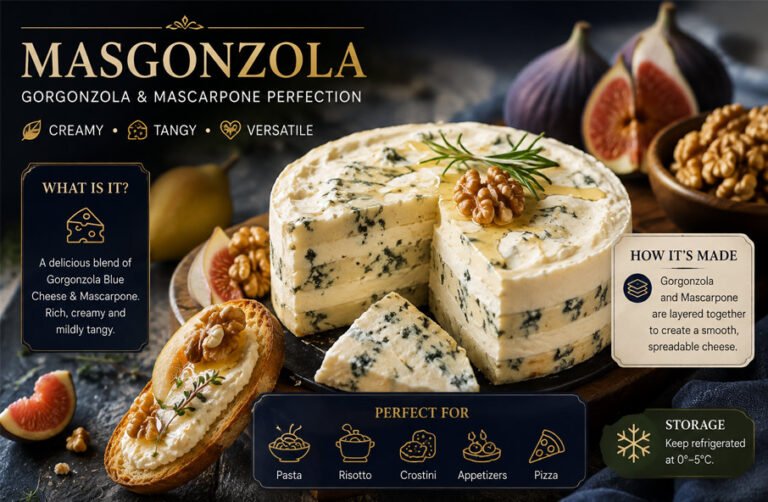
Masgonzola is a creamy cheese specialty made by combining Gorgonzola with mascarpone. The name appears in recipes and commercial cheese products, but online descriptions sometimes make it sound like a completely separate type of cheese.
This guide explains what Masgonzola actually is, what it contains, how it is prepared, what it tastes like, and how it differs from traditional Gorgonzola. It also clears up common confusion about its origin and status.
What Is Masgonzola?
Masgonzola is best understood as a combination of Gorgonzola and mascarpone. Gorgonzola provides the blue-cheese flavor, while mascarpone adds a mild, creamy, and rich texture.
The name itself appears to combine parts of the words mascarpone and Gorgonzola. Established recipe sources have used Masgonzola as a short name for a mascarpone-Gorgonzola product.
Masgonzola does not always look exactly the same. Some products blend the two cheeses more closely. Others are made with visible alternating layers of white mascarpone and blue-veined Gorgonzola.
Several documented commercial products use approximately equal amounts of the two cheeses. A 50% Gorgonzola and 50% mascarpone combination is therefore a useful example, but it should not be treated as a universal recipe.
Masgonzola may also be sold without the word “Masgonzola” on the package. Similar products can appear under names such as Gorgonzola and Mascarpone, Gorgonzola e Mascarpone, or Gorgonzola with Mascarpone.
The main idea remains the same: strong or tangy blue-cheese characteristics are softened by the richness of mascarpone.
Is Masgonzola a Real Cheese?
Masgonzola is a real food product and culinary name, but it should not be confused with a separately protected traditional cheese variety.
This distinction matters because Gorgonzola is an officially protected Italian PDO cheese. Its production follows defined rules covering ingredients, production areas, maturation, and other characteristics. Masgonzola does not appear to have its own separate Protected Designation of Origin or comparable standardized specification.
For this reason, it is more accurate to describe Masgonzola as a Gorgonzola-mascarpone cheese specialty rather than an independent type of historic blue cheese.
Some recent online articles describe Masgonzola as a newly emerging cheese concept. Others describe it as an old European cheese with its own traditional production methods. Reliable evidence does not clearly support either description.
The term was already being used commercially well before the recent online interest around it. However, there is no reliable evidence identifying one inventor, one original producer, or an exact date when Masgonzola was first created.
There is also no verified standard defining separate “young,” “aged,” or other official Masgonzola varieties. Such claims should be treated carefully unless they refer to a specific manufacturer’s product.
What Is Masgonzola Made Of?
Traditional Masgonzola-style products have two main components: Gorgonzola and mascarpone.
Gorgonzola is an Italian blue cheese made from cow’s milk. It gives Masgonzola its blue veins, tanginess, saltiness, and characteristic blue-cheese flavor.
Mascarpone is a very rich and mild dairy product made mainly from cream. Its role is different. It adds softness, fat, moisture, and a buttery dairy flavor.
When the two are combined, mascarpone reduces some of Gorgonzola’s intensity. This creates a cheese product that can be easier to spread and milder than eating straight Gorgonzola.
Commercial examples show that a 50/50 mixture is common. One documented product uses 50% full-fat Gorgonzola and 50% double-cream mascarpone.
That does not mean every Masgonzola must use equal amounts. Because there is no universal Masgonzola production standard, manufacturers can use different proportions.
A version containing more mascarpone will normally be creamier and milder. A product with a greater amount of Gorgonzola will usually have a stronger blue-cheese character.
How Is Masgonzola Made?
Masgonzola generally does not begin as a completely separate cheese made from raw ingredients through its own unique fermentation and aging process.
Instead, the basic method involves bringing Gorgonzola and mascarpone together.
One common approach is to arrange the cheeses in alternating layers. The finished product may show pale or white mascarpone between sections of creamy Gorgonzola with visible blue-green veins. Italian producers have made Gorgonzola-and-mascarpone specialties using this layered method.
Other versions may be more closely blended. This explains why one Masgonzola product may look like a striped or layered block while another may have a smoother and more uniform appearance.
The exact ratio also affects the result. More mascarpone produces a softer and richer texture. More Gorgonzola gives the mixture a stronger aroma and sharper flavor.
There is no reliable evidence of one universal Masgonzola aging period. Claims that all Masgonzola must mature for a specific number of weeks are misleading.
The aging process mainly belongs to the Gorgonzola component. Genuine Gorgonzola PDO has regulated production and maturation requirements before it is combined with mascarpone.
This is another important difference between Masgonzola and a stand-alone traditional cheese. Masgonzola is better understood as a finished cheese specialty created from two established dairy products.
What Does Masgonzola Taste Like?
Masgonzola combines two very different flavor profiles.
Gorgonzola contributes tangy, salty, earthy, and slightly sharp blue-cheese notes. Mascarpone is much milder. It tastes creamy, buttery, milky, and slightly sweet.
Together, the two usually create a softer and rounder flavor than plain Gorgonzola. The mascarpone reduces the intensity without completely hiding the blue-cheese character.
This can make Masgonzola easier to enjoy for someone who finds strong blue cheese too intense.
The exact taste depends on the product. A 50/50 version can taste very creamy with a noticeable but controlled blue-cheese flavor. A version containing more Gorgonzola will naturally taste stronger.
Temperature can also affect how the cheese tastes. When slightly softened, its creamy texture becomes more noticeable and the flavors are easier to experience together.
Masgonzola Texture and Appearance
Texture is one of the main qualities that separates Masgonzola from ordinary Gorgonzola.
Mascarpone adds considerable softness and moisture. The finished product is normally creamy and can be easy to spread, especially after it has softened slightly.
When refrigerated, Masgonzola becomes firmer. As it warms, the mascarpone component becomes softer and smoother.
Layered products can have a distinctive appearance. White or pale mascarpone may sit between sections of Gorgonzola containing blue or blue-green veins. Other versions may look more blended and less clearly divided.
These differences do not necessarily mean one product is more authentic than another. There is no single legally defined Masgonzola appearance or production method.
The creamy structure also helps Masgonzola melt smoothly. This makes it useful in dishes where both cheese flavor and a rich texture are wanted.
Masgonzola vs. Gorgonzola
Masgonzola and Gorgonzola are closely related, but they are not the same product.
Gorgonzola is a traditional Italian blue cheese with PDO protection. Masgonzola combines Gorgonzola with mascarpone to create a softer and generally milder cheese specialty.
| Feature | Masgonzola | Gorgonzola |
|---|---|---|
| What it is | Gorgonzola combined with mascarpone | Italian blue cheese |
| Main ingredients | Gorgonzola and mascarpone | Mainly pasteurized whole cow’s milk, cultures, salt, rennet, and mold |
| PDO protection | No separate Masgonzola PDO verified | Yes |
| Texture | Very creamy, soft, often spreadable | Creamy to firmer depending on type and age |
| Flavor | Mild, buttery, tangy, and gently blue | More clearly blue, tangy, and sometimes sharp |
| Appearance | May be blended or layered | Blue-veined cheese |
| Common use | Sauces, spreads, pasta, risotto, and appetizers | Cheese boards, pasta, sauces, cooking, or eating on its own |
Straight Gorgonzola makes more sense when a dish needs a clear and stronger blue-cheese flavor.
Masgonzola can be more useful when creaminess is equally important. The mascarpone helps soften the taste and gives sauces, spreads, and other dishes a richer texture.
For people who are new to blue cheese, Masgonzola can also provide a gentler way to experience Gorgonzola’s characteristic flavor without using the cheese at full strength.
Masgonzola Nutrition
Masgonzola does not have one fixed nutrition profile. The values depend on the amount of Gorgonzola and mascarpone used, as well as the producer.
Commercial products show that Masgonzola-style cheese is generally high in calories and fat. This is mainly because mascarpone is a rich cream-based dairy product.
One documented 50/50 Gorgonzola and mascarpone product provides about 369 calories per 100 grams, with 35 grams of fat, 23 grams of saturated fat, 12 grams of protein, and 0.7 grams of salt. These figures are only an example and should not be treated as standard values for every product.
Compared with plain Gorgonzola, adding mascarpone can increase total fat and calories while reducing the amount of protein and salt per 100 grams.
Masgonzola may also provide calcium and other minerals from its dairy ingredients. The exact amount depends on the product, so the nutrition label is the best source for specific figures.
Because many versions contain a large amount of saturated fat, portion size can be useful to consider. Masgonzola can be enjoyed as part of a balanced diet, but it is better described as a rich cheese rather than as a special health food.
Allergies and Dietary Considerations
Traditional Masgonzola contains dairy. Both Gorgonzola and mascarpone are made from milk, so the product is not suitable for people with a milk-protein allergy.
It is also not vegan.
Authentic Gorgonzola PDO is reported to contain very little lactose. However, this does not mean Masgonzola is automatically lactose-free. Mascarpone is added to the product and can change its lactose content. Anyone who needs to avoid lactose should check the label of the specific product.
Some individual Gorgonzola-mascarpone products may be labeled gluten-free. This should not be assumed for every brand. Ingredients and manufacturing conditions can differ.
People with specific dietary needs should check the allergen statement, ingredient list, and nutrition information before eating the product.
Best Ways to Use Masgonzola
Masgonzola works well in recipes because it combines the flavor of blue cheese with the soft texture of mascarpone.
It can be used cold, softened, or melted.
Pasta and Creamy Sauces
Masgonzola melts easily into hot pasta. The mascarpone helps create a smooth sauce while the Gorgonzola adds flavor.
It can work with short pasta, ravioli, gnocchi, pappardelle, and other pasta shapes. A small amount of pasta water can help loosen the cheese into a smoother sauce.
Established recipes also use Gorgonzola-mascarpone combinations in pasta dishes, showing that this is one of the most practical uses for the product.
Risotto
Masgonzola can be stirred into risotto near the end of cooking.
The mascarpone adds creaminess, while the Gorgonzola gives the rice a stronger savory flavor. Betty Bossi has specifically suggested Masgonzola as a replacement for using Gorgonzola and mascarpone separately in a risotto recipe.
Crostini, Bread, and Crackers
Its soft texture makes Masgonzola easy to spread over toasted bread, crostini, crackers, or similar foods.
It works especially well when paired with something sweet or fresh to balance the richness of the cheese.
Pizza and Baked Dishes
Small pieces of Masgonzola can be added to pizza, flatbread, vegetable bakes, and other oven dishes.
The cheese softens as it heats and adds both creaminess and blue-cheese flavor.
Documented recipes also use Gorgonzola-mascarpone mixtures in baked pumpkin dishes.
Appetizers and Cheese Boards
Masgonzola can be served as part of a cheese board or used in small appetizers.
One documented recipe uses it as a filling for dates with walnuts and rocket. The sweetness of the dates helps balance the salty and tangy cheese.
It can also be served with bread, crackers, fruit, nuts, or vegetables.
When using Masgonzola for the first time, it can help to start with a small amount. More can be added depending on how strong a blue-cheese flavor is wanted.
What Goes Well With Masgonzola?
Masgonzola pairs well with ingredients that balance its rich, creamy, and tangy character.
Sweet fruits are a common choice. Pears, figs, apples, grapes, and dates can provide contrast to the salty flavor of Gorgonzola.
Nuts also work well. Walnuts, hazelnuts, almonds, and pistachios add texture and mild sweetness.
Vegetables can provide a more savory balance. Pumpkin, beetroot, radicchio, celery, roasted vegetables, and rocket or arugula can all work with a creamy blue-cheese mixture.
Herbs such as thyme and rosemary can be used in cooked dishes where their flavor suits the other ingredients.
Honey is another common pairing with blue cheese. A small amount can soften the salty and tangy character of Masgonzola without hiding its flavor.
Bread, crackers, pasta, and similar neutral foods also work well because they reduce some of the richness and allow the cheese to remain the main flavor.
Documented Masgonzola recipes and serving suggestions include combinations with pear, walnuts, dates, pumpkin, beetroot, hazelnuts, and greens.
How to Store Masgonzola
Masgonzola is a fresh refrigerated dairy product and should be kept cold.
One commercial Gorgonzola-mascarpone product recommends storage at no more than 5°C. Other products may have different instructions, so the package label should always take priority.
After opening, keep the cheese well covered. This helps protect it from drying out and from absorbing odors from other foods in the refrigerator.
There is no universal shelf life for Masgonzola. How long it keeps depends on the producer, packaging, ingredients, storage temperature, and whether it has been opened.
The use-by or best-before date printed on the product should be followed.
If Masgonzola is being served as a spread, a small portion can be allowed to soften slightly before eating. The rest should remain refrigerated rather than being left at room temperature for a long period.
How to Buy Masgonzola
The word “Masgonzola” may not appear on every package.
When shopping, similar products may be labeled:
- Gorgonzola and Mascarpone
- Gorgonzola e Mascarpone
- Gorgonzola-Mascarpone
- Gorgonzola with Mascarpone
These names can describe essentially the same type of cheese combination.
Check the ingredient ratio if it is listed. A product with equal amounts of Gorgonzola and mascarpone will usually be very creamy and relatively mild.
A version with more Gorgonzola may have a stronger blue-cheese taste.
Also check whether the product is layered or blended. This changes the appearance and texture, although both formats can be sold as Gorgonzola-mascarpone specialties.
The ingredient list, allergen information, nutrition label, storage instructions, and use-by date are also useful when comparing products.
Common Misconceptions About Masgonzola
Masgonzola is sometimes described incorrectly online because the term is less familiar than Gorgonzola.
One common claim is that Masgonzola is simply another spelling of Gorgonzola. This is not correct. Gorgonzola is the protected Italian blue cheese, while Masgonzola is commonly used for a product combining Gorgonzola and mascarpone.
Another claim describes Masgonzola as an ancient Italian cheese with its own traditional aging process and varieties. Reliable evidence for a separate historic Masgonzola cheese has not been found.
Some recent articles describe it as a completely new food trend created in 2025 or 2026. That is also misleading. The Masgonzola name was already in commercial use years before these recent articles appeared.
There is no verified universal Masgonzola aging period, production area, official recipe, or PDO standard.
Claims that Masgonzola is rapidly spreading through restaurants or social media should also be treated carefully. Such statements may appear in recent food articles, but reliable market data supporting them is limited.
The simplest and best-supported definition remains a Gorgonzola and mascarpone cheese specialty.
Bottom Line
Masgonzola is a creamy combination of Gorgonzola and mascarpone.
Gorgonzola provides the tangy, salty, and blue-cheese flavor. Mascarpone adds softness, richness, and a milder dairy taste.
Some commercial versions use equal amounts of the two cheeses, while others may use different proportions or preparation methods. Products can be blended or arranged in visible layers.
Masgonzola is not the same as Gorgonzola PDO and does not have its own verified protected cheese status.
Its soft texture makes it useful for pasta, risotto, sauces, bread, appetizers, pizza, and baked dishes. Because recipes and products differ, readers should check the individual label for nutrition, allergens, storage, and ingredient ratios.
Frequently Asked Questions
What is Masgonzola?
Masgonzola generally refers to a cheese specialty made by combining Gorgonzola with mascarpone. It is usually softer, creamier, and milder than plain Gorgonzola.
Is Masgonzola the same as Gorgonzola?
Gorgonzola is a protected Italian PDO blue cheese. Masgonzola combines Gorgonzola with mascarpone and does not have a separate verified PDO status.
What is Masgonzola made from?
The main ingredients are Gorgonzola and mascarpone. Some documented commercial versions use 50% of each, although there is no required universal ratio.
How is Masgonzola made?
It is usually made by combining prepared Gorgonzola and mascarpone. The cheeses may be blended or arranged in alternating layers. There is no single legally defined Masgonzola production method.
What does Masgonzola taste like?
Masgonzola has the tangy and earthy character of Gorgonzola with the mild, buttery richness of mascarpone. It is generally creamier and less intense than plain blue cheese.
Can you melt Masgonzola?
Its soft texture allows it to melt well in pasta sauces, risotto, baked dishes, and other cooked recipes.
What can I use instead of Masgonzola?
The closest replacement is a combination of Gorgonzola and mascarpone.
If you want a much milder option without the blue-cheese flavor, mascarpone or plain cream cheese can work in some recipes. The final taste will be different.
Where can you buy Masgonzola?
Look in the refrigerated cheese section. The product may be sold as “Gorgonzola and Mascarpone,” “Gorgonzola e Mascarpone,” or “Gorgonzola with Mascarpone” rather than under the Masgonzola name.
More To Explore:
