


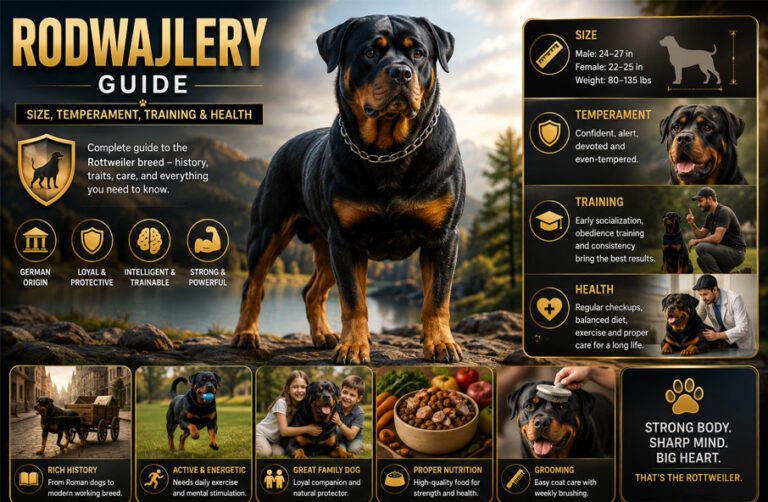
Rodwajlery is a term that appears in online searches related to the Rottweiler, a large German working dog. It is not the official name of a separate dog breed. Major breed organizations recognize the dog as the Rottweiler.
People may search for Rodwajlery after seeing the word online or because it sounds similar to the way Rottweiler is pronounced in some languages. This guide explains what the term means and covers the Rottweiler’s history, size, appearance, temperament, family life, training, exercise, health, grooming, and everyday care.
What Does Rodwajlery Mean?
Rodwajlery is best understood as a nonstandard online term connected with the Rottweiler. It is not listed as an independent breed by major canine organizations.
The Fédération Cynologique Internationale, or FCI, recognizes the Rottweiler under Standard No. 147 and lists Germany as the breed’s country of origin. The American Kennel Club also recognizes the Rottweiler as an established working breed.
Some websites describe Rodwajlery as a phonetic, regional, or internet spelling of Rottweiler. However, its exact linguistic origin has not been officially established by major breed organizations.
The word should therefore not be used to describe a rare or newly developed dog breed. There is also no reliable evidence that Rodwajlery refers to a special Rottweiler bloodline, size, color, or type.
When readers search for Rodwajlery in relation to dogs, official Rottweiler information provides the most reliable explanation.
Rottweiler History and Origin
The history of the Rottweiler goes back many centuries. Its ancestors are believed to include mastiff-type dogs that traveled with Roman legions. These dogs helped soldiers move and guard livestock as Roman forces crossed different parts of Europe.
Over time, strong working dogs became established around the German town of Rottweil. The area was an important livestock and trading center.
Local butchers and cattle dealers used these dogs to drive cattle, protect property, and pull carts. The dogs became known as the Rottweiler Metzgerhund, which means the Butcher’s Dog of Rottweil.
Their strength, endurance, and protective nature made them useful working animals.
The need for cattle-driving dogs later decreased as railway transportation and industrialization changed the way livestock and goods were moved. Rottweiler numbers declined, but dedicated breeders continued to preserve and develop the breed.
The Rottweiler later found new roles in police work, guarding, service work, organized dog activities, and family companionship. The American Kennel Club admitted the Rottweiler to its Stud Book in 1931.
Today, the breed remains known for both physical strength and its ability to work closely with people.
Rodwajlery Size and Weight
A Rodwajlery, when the term is used for a Rottweiler, is a large and strongly built dog.
Adult males generally stand about 24 to 27 inches at the shoulder. Adult females are usually around 22 to 25 inches tall.
A general Rottweiler weight range is approximately 80 to 135 pounds. Males are normally larger and heavier than females.
Weight can vary according to sex, age, body frame, muscle condition, diet, activity level, and overall health. A large Rottweiler should still be balanced and physically fit.
Bigger is not automatically better. An excessively heavy dog may place additional strain on its joints and may lose some of the agility expected from a working breed.
Official breed standards focus on strength, balance, endurance, and correct proportions rather than simply producing the heaviest possible dog.
Appearance and Coat
Rottweilers have a compact and muscular appearance. Their bodies are built for strength and practical work rather than extreme size.
The breed normally has a broad head, strong neck, deep chest, substantial bone, and powerful legs. Despite this heavy build, a healthy Rottweiler should still move with balance and control.
The coat is short, dense, and relatively easy to maintain.
Black is the main coat color. Clearly defined markings appear in shades ranging from rust to mahogany. These markings are commonly seen around the muzzle, cheeks, eyebrows, chest, legs, and beneath the tail.
The breed’s appearance should remain functional. Excessive heaviness, exaggerated body proportions, or other extreme physical traits do not improve the dog’s health or working ability.
Temperament and Personality
Rottweilers are often recognized for their confident and watchful nature.
The FCI breed standard describes the Rottweiler as good-natured, devoted, obedient, eager to work, self-assured, steady, alert, and even-tempered.
They can form very close relationships with their families. Many Rottweilers like being involved in everyday household life and enjoy regular interaction with their owners.
The breed also has natural protective instincts. A Rottweiler may be cautious around unfamiliar people and may pay close attention to changes in its environment.
This does not mean that every Rottweiler is aggressive. Aggression, extreme nervousness, or uncontrolled behavior is not the desired breed temperament.
Temperament can be influenced by several factors, including genetics, breeding practices, early experiences, socialization, training, health, and the dog’s living environment.
Individual dogs can therefore behave differently even when they belong to the same breed.
Responsible breeding and proper training are especially important because an adult Rottweiler is physically strong. Good temperament combined with good control makes everyday handling much easier.
Are Rodwajlery Good Family Dogs?
Rottweilers can become good family dogs when they are responsibly bred, properly socialized, trained, and cared for.
They are often closely attached to their household and may enjoy spending time near family members. Their protective nature can also make them attentive to what happens around the home.
Families with children need to consider the dog’s size and strength. Even a friendly Rottweiler can accidentally knock over a small child during play.
Young children should therefore be supervised around large dogs. Children should also be taught not to disturb a dog while it is eating, sleeping, or trying to move away.
Rottweilers can also live with other animals, but compatibility depends on the individual dog, its socialization, and previous experiences.
Early positive exposure to different people, dogs, environments, and normal household situations can help a puppy develop into a more confident adult.
A Rottweiler should not be chosen simply because someone wants an intimidating guard dog. The breed needs companionship, training, exercise, and regular involvement with its family.
Training a Rodwajlery
Training should begin when a Rottweiler is young.
Puppies can start learning simple household rules, their name, recall, leash manners, and basic commands from an early age. The goal is to develop habits before the dog becomes large and physically powerful.
The collected breed guidance stresses the importance of early and consistent training.
Basic commands such as sit, stay, come, leave it, and heel can make everyday life easier and safer. Calm behavior around visitors and other dogs is also useful.
Rottweilers are intelligent and often learn quickly. However, some can also be independent or strong-minded.
Training works best when rules are clear and consistent. Reward-based methods using food, toys, praise, and play can help the dog understand which behaviors are wanted.
Harsh punishment can create fear, confusion, or defensive behavior and is not necessary for teaching basic control.
Leash training is particularly important. An adult Rottweiler can be difficult to control if it has learned to pull from puppyhood.
Owners should also work on polite greetings so the dog does not jump on visitors or become overexcited around unfamiliar people.
Training should continue throughout adulthood. Regular practice helps maintain good manners and also provides useful mental stimulation.
Early Socialization
Socialization means helping a dog learn how to behave calmly and appropriately around normal parts of everyday life.
For a Rottweiler puppy, this can include safe exposure to different people, friendly dogs, household sounds, vehicles, surfaces, buildings, outdoor environments, and normal public situations.
Experiences should be positive and controlled.
Socialization does not mean forcing a frightened puppy to interact with something it wants to avoid. The goal is to introduce new experiences gradually so the puppy can build confidence.
This is especially useful for Rottweilers because they can naturally be watchful and protective.
A poorly socialized dog may find unfamiliar people or situations more difficult to handle. A well-socialized dog is usually better prepared to respond calmly when something new happens.
Socialization should not stop after puppyhood. Owners should continue giving their dog appropriate experiences throughout its life.
Good socialization does not remove a Rottweiler’s natural personality or protective instincts. It helps the dog learn when a situation is normal and when there is no reason to react.
Exercise and Mental Stimulation
Rottweilers are working dogs and need regular physical activity.
Many healthy adult Rottweilers can benefit from around two hours or more of daily exercise, although the right amount depends on the dog’s age, health, fitness, and individual energy level.
Exercise can include walking, structured play, training, swimming, controlled running, and dog sports.
Rottweilers can also take part in activities such as obedience, tracking, rally, herding, and other organized sports.
Mental activity is just as important as physical exercise.
Training sessions, scent games, food puzzles, searching activities, and learning new commands can help keep the dog’s mind active. Giving a Rottweiler structured tasks can also provide an outlet for the intelligence and working ability for which the breed was developed.
Puppies should not be given the same exercise routine as fully grown adults. Their joints and bones are still developing, so exercise should be appropriate for their age.
Senior dogs may also need shorter or gentler activity depending on mobility and health.
Regular activity can support healthy body weight, muscle condition, behavior, and general well-being. A Rottweiler that receives little exercise or mental stimulation may become bored and can develop unwanted behaviors.
Living Space and Lifestyle
Rottweilers are large dogs, so they need enough space to move comfortably. A secure garden can be useful, but outdoor space does not replace daily exercise, training, or time with the family.
A Rodwajlery, when the term refers to a Rottweiler, should not be treated as a dog that simply stays outside and guards property. The breed usually does best when it is included in normal family life.
Owners need time for walks, training, feeding, grooming, veterinary care, and regular interaction. Because Rottweilers are active and intelligent, they may become bored when they receive too little exercise or attention.
Secure fencing is also important. A strong adult dog should not be able to leave the property easily. Owners should use a suitable lead and maintain good control in public places.
This breed may not suit someone who wants a very low-energy dog with little daily responsibility.
Health Problems and Recommended Tests
Rottweilers can be healthy dogs, but like other large breeds, they can be affected by inherited health problems.
Health testing is especially important when choosing a puppy. Responsible breeders should be able to show real test results rather than simply saying that their dogs are healthy.
Recommended Rottweiler health screening can include hip and elbow evaluations, heart checks, eye examinations, and DNA testing for juvenile laryngeal paralysis and polyneuropathy, usually called JLPP.
Hip and elbow problems can affect movement and comfort. These conditions are important in a large, heavy breed because extra body weight can place more stress on the joints.
Heart and eye screening can help identify some inherited or developing health problems before dogs are used for breeding.
JLPP is an inherited neurological disease. It can affect the nerves that control breathing and movement. DNA testing can help breeders avoid producing affected puppies.
Different breed organizations may recommend additional tests. Owners should check current guidance from recognized Rottweiler clubs and discuss health concerns with a veterinarian.
No breeder can honestly guarantee that a puppy will never develop a health problem. Health testing lowers some risks but does not remove every possible illness.
Lifespan
Rottweiler lifespan estimates vary between reliable sources.
A practical general estimate is around a decade, although some dogs live longer and others may have shorter lives.
Lifespan can be affected by genetics, breeding quality, diet, body weight, exercise, veterinary care, accidents, and disease.
Keeping a Rottweiler at a healthy weight is especially important. Excess body fat can increase pressure on the joints and may contribute to other health problems.
Regular veterinary checks can also help find some conditions earlier.
Grooming and Coat Care
The Rottweiler has a short coat that is fairly easy to maintain.
Weekly brushing is usually enough for normal coat care. It helps remove loose hair and keeps the coat clean. Rottweilers can shed throughout the year and may shed more during seasonal changes.
Bathing should be done when needed. Dogs that spend a lot of time outdoors may need more frequent cleaning than dogs that stay mostly indoors.
Nails should be trimmed regularly if they do not wear down naturally. Overgrown nails can affect comfort and movement.
Dental care is also important. Regular tooth brushing and veterinary dental checks can help reduce plaque and gum problems.
Owners should also check the ears, skin, paws, and coat regularly. Grooming is a useful time to notice lumps, sore areas, skin changes, or injuries.
Feeding and Weight Management
Rottweilers need a balanced diet that matches their age, size, activity level, and health.
Puppies have different nutritional needs from adult and senior dogs. Large-breed puppies should grow at a controlled rate rather than becoming heavy too quickly.
Adult dogs should be fed enough to maintain a healthy body condition without gaining unnecessary weight.
Treats can be useful during training, but they still add calories. Owners should count treats as part of the dog’s total daily food intake.
Fresh water should always be available.
There is no special official Rodwajlery diet. Food choices should be based on the individual dog’s needs rather than unusual online claims.
Dogs with allergies, digestive problems, weight issues, or medical conditions may need advice from a veterinarian.
Working Roles and Dog Sports
Rottweilers were developed as working dogs.
Historically, they helped move livestock, guard property, and pull carts. Their strength and trainability later made them useful in police and other structured working roles.
Modern Rottweilers can take part in many organized activities.
These may include obedience, tracking, rally, herding, agility, conformation, and Barn Hunt.
Some individual Rottweilers may also work in service, therapy, rescue, or other specialist roles. However, not every dog is suitable for these jobs.
Success depends on temperament, health, training, confidence, and the specific demands of the role.
Dog sports can be useful even for family pets because they provide both physical exercise and mental work.
Common Rottweiler Behavior Problems
Pulling on the Lead
A Rottweiler can become very difficult to control if it learns to pull.
Lead training should start early. Reward the dog for walking near the handler and change direction when pulling begins.
Short, regular practice is often more useful than waiting until the dog is fully grown.
Jumping on People
Young Rottweilers may jump when excited.
Because adult dogs are large and heavy, this behavior should be corrected early.
Owners can reward calm greetings and ask visitors not to encourage jumping.
Overprotective Behavior
Some Rottweilers can become too protective if they are poorly socialized or allowed to make their own decisions about strangers.
Training should teach the dog to look to the owner for guidance.
Controlled exposure to visitors and normal public situations can also help.
Boredom and Destructive Behavior
A Rottweiler that receives too little exercise or mental activity may chew, dig, bark, or damage household items.
The practical solution is to increase suitable exercise, training, play, and mental work.
Problems Around Other Dogs
Some dogs may react strongly to unfamiliar dogs.
Early socialization can reduce this risk, but owners should still manage interactions carefully.
A qualified trainer or behavior professional may be useful if the dog shows repeated aggression, fear, or loss of control.
Sudden behavior changes can also sometimes be linked to pain or illness. A veterinary check is sensible when a dog’s behavior changes without a clear reason.
Who Should Own a Rodwajlery?
A Rottweiler is best suited to someone who understands the responsibility of owning a large, strong working dog.
The owner should be prepared to provide daily exercise, regular training, and continued socialization.
Confidence and consistency are useful, but harsh handling is not necessary.
The breed can suit families that have enough time to include the dog in normal daily life and provide clear rules.
First-time dog owners can own a Rottweiler, but they should research the breed carefully and consider working with an experienced trainer.
A Rottweiler should not be chosen mainly because it looks intimidating.
The best owner is someone who values stable temperament, good behavior, health, and responsible control.
Choosing a Rottweiler Puppy or Rescue Dog
When buying a puppy, choose the breeder carefully.
A responsible breeder should be willing to discuss the health and temperament of the parents and provide proof of recommended health tests.
Buyers should ask about hip and elbow evaluations, heart and eye checks, and relevant DNA screening.
Where possible, meeting the puppy’s mother can help buyers observe temperament and living conditions.
Be cautious of breeders who focus mainly on very large size, unusual colors, aggressive behavior, or claims that their dogs are rare.
Terms such as “giant Rodwajlery” or “rare Rodwajlery breed” do not represent a separate officially recognized breed.
Adoption is another option.
For an adult rescue Rottweiler, ask about previous behavior, health, training, reactions to children, and compatibility with other animals.
Rescue organizations may not always know the dog’s complete history, so potential owners should be prepared for a careful introduction period.
Temperament and health should matter more than appearance.
Legal, Housing, and Insurance Considerations
Rottweiler ownership laws differ by location.
There is no single worldwide rule that applies to every Rodwajlery or Rottweiler.
Some countries, cities, housing communities, landlords, or insurance companies may have breed-specific rules or restrictions.
Even where Rottweilers are not specifically restricted, general dangerous-dog laws can still apply.
Owners are responsible for keeping their dog under control and preventing harm.
Before buying or adopting a Rottweiler, check current local laws, rental rules, and insurance terms.
This is especially important for people living in apartments or rented homes.
Rodwajlery Price and Ownership Costs
There is no single worldwide price for a Rottweiler.
Puppy prices can vary according to country, breeder reputation, pedigree, health testing, working or show lines, and veterinary preparation.
A higher price does not automatically mean a better dog. Buyers should focus on health testing, temperament, responsible breeding, and good living conditions.
The purchase price is only one part of the cost.
Owners also need to plan for food, veterinary care, vaccinations, training, insurance where required, grooming supplies, bedding, collars, leads, crates, toys, and secure fencing.
Large dogs often cost more to feed than smaller breeds.
Veterinary treatment can also become expensive if a dog develops a serious health problem.
Choosing a very cheap puppy without proper health testing can sometimes lead to much higher costs later.
Rodwajlery vs. Rottweiler
Rodwajlery and Rottweiler should not be treated as two separate recognized breeds.
Rottweiler is the official breed name used by major canine organizations.
Rodwajlery is an unofficial term that appears online in connection with the breed.
There is no recognized difference in size, temperament, health, or appearance between a Rodwajlery and a Rottweiler because Rodwajlery does not have its own official breed standard.
Readers should be careful with websites that describe Rodwajlery as a rare new breed, luxury variety, or special bloodline without reliable registration evidence.
For accurate information, Rottweiler breed standards from recognized organizations are the better reference.
Bottom Line
Rodwajlery is best understood as a nonstandard online term linked to the Rottweiler.
The Rottweiler is a large German working breed with a long history of livestock work, guarding, cart pulling, police work, companionship, and dog sports.
The breed is intelligent, strong, confident, and often closely attached to its family.
Those qualities also bring responsibility.
A Rottweiler needs early socialization, consistent training, regular exercise, good nutrition, proper health care, and responsible handling throughout its life.
Anyone researching Rodwajlery should use official Rottweiler information rather than unsupported claims about a separate breed.
Frequently Asked Questions
What is Rodwajlery?
Rodwajlery is a nonstandard online term commonly connected with the Rottweiler.
Major canine organizations do not recognize Rodwajlery as a separate dog breed. The official breed name is Rottweiler.
Is Rodwajlery different from a Rottweiler?
No recognized breed difference has been established.
When Rodwajlery is used to describe a dog, it generally refers to the Rottweiler.
How big does a Rodwajlery get?
Using Rottweiler breed information, adult males are usually around 24 to 27 inches tall at the shoulder.
Females are generally around 22 to 25 inches.
A typical general weight range is about 80 to 135 pounds, depending on sex, frame, health, and condition.
Are Rodwajlery good family dogs?
Rottweilers can be good family dogs when they are responsibly bred, trained, socialized, and cared for.
They can become devoted household companions, but their size and strength mean young children should be supervised around them.
Are Rodwajlery aggressive?
Aggression is not the desired Rottweiler temperament.
The breed can be protective and watchful, but behavior depends on genetics, socialization, training, environment, and the individual dog.
Responsible management is especially important because of the breed’s strength.
How much exercise does a Rottweiler need?
Healthy adult Rottweilers usually need substantial daily exercise.
Around two hours or more may suit many adults, but the exact amount depends on age, fitness, health, and individual energy level.
Mental activities such as training, scent work, and problem-solving are also useful.
What health problems should Rottweiler owners watch for?
Important concerns include hip and elbow problems, heart conditions, eye problems, and inherited disorders such as JLPP.
Health testing of breeding dogs can help reduce some inherited risks.
How long do Rodwajlery live?
A reasonable general estimate for a Rottweiler is around a decade.
Some dogs may live longer or shorter lives depending on genetics, body weight, diet, exercise, veterinary care, disease, and other factors.
More To Explore:
