


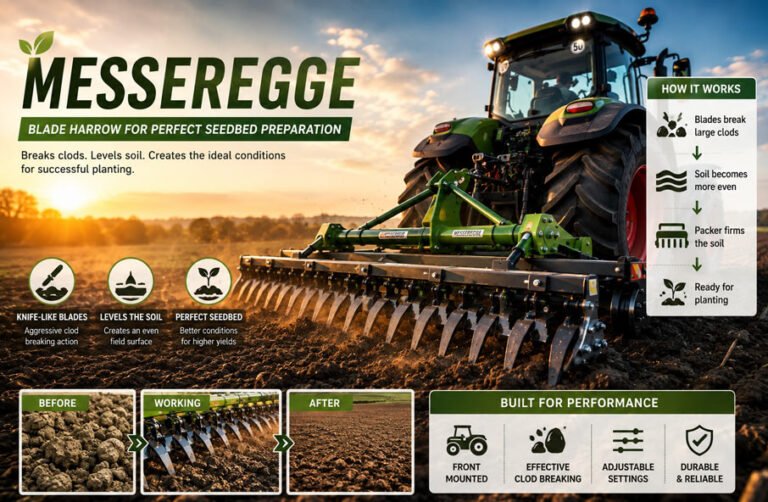
A Messeregge is an agricultural tool used to prepare the upper layer of soil. The name comes from German farming language and is linked with a harrow that uses knife-like or blade-style working parts.
Farmers mainly use it to break large soil clods, level rough ground, and prepare a more even seedbed. It is often mounted at the front of a tractor or fitted ahead of a front packer.
People also search for Messeregge because the word has been given several unrelated meanings online. Agricultural dictionaries, machinery manuals, and equipment listings give the strongest support to the farming meaning.
This guide explains what a Messeregge is, how it works, what it is used for, and why it is often combined with other soil-preparation equipment.
What Is a Messeregge?
A Messeregge is a type of agricultural harrow that uses knife-like or blade-style parts to work the soil surface. It is mainly designed for shallow soil preparation rather than deep cultivation.
The German name helps explain the tool. Messer means knife or blade, while Egge means harrow. Langenscheidt lists Messeregge as an agricultural word and gives scarifier as an English translation. In farming equipment discussions, knife harrow or blade harrow can describe the design more clearly.
The tool usually has a strong frame with rows of steel blades. These blades work across the soil surface and attack larger clods before another machine completes the final preparation.
Some machinery listings also use the related term Messervoregge. This usually refers to a blade harrow positioned ahead of a packer or another implement. The exact name and design can vary between manufacturers.
A Messeregge should not be confused with a plough or deep cultivator. Its main job is to improve conditions near the surface. It can be one part of a larger seedbed-preparation system.
How Does a Messeregge Work?
A Messeregge works as the tractor moves forward across the field. Its blades come into contact with rough soil and larger clods in the upper layer.
The blades strike, cut, press, or plane the soil depending on the design. This can break large lumps into smaller pieces and reduce ridges left by earlier cultivation.
The tool can also move loose soil into small low areas. This helps create a flatter surface before a roller, packer, cultivator, or seed drill passes over the same ground.
A typical Messeregge can include a carrying frame, mounting points, steel knives, and controls for changing the working height, depth, or blade angle. Exact construction differs between manufacturers and models.
Some machines use rigid blade rows. Others may use spring-supported working elements that can move when they meet stones or hard ground. The correct system depends on the machine and the conditions where it will be used.
Several factors affect how well the tool works.
Soil moisture is especially important. Very wet soil may smear or stick instead of breaking into useful crumbs. Very dry soil can form hard clods that are difficult to break.
Working depth also matters. A deeper setting is not always better. If the blades work too aggressively, they may move too much soil, collect residue, or increase the load on the tractor.
Blade angle and tractor speed can also change the result. The aim is usually to create a level surface with smaller soil crumbs without turning the top layer into fine dust.
What Is a Messeregge Used For?
The main purpose of a Messeregge is to prepare rough soil before the next field operation.
One of its clearest uses is breaking large soil clods. After ploughing, especially on heavy ground, the surface can contain large and hard lumps. A roller may press some of these clods into the ground without fully breaking them.
The Messeregge attacks these larger pieces first. This makes the soil easier for the following implement to manage.
It is also used for leveling the field. Ridges and uneven areas can affect the way a seed drill follows the ground. High and low spots may lead to changes in planting depth. Blade rows can reduce these differences before the final seedbed tool passes.
Another important use is supporting seedbed preparation. A good seedbed normally needs a reasonably level surface, smaller soil crumbs near the top, and firmer soil below the seed placement area.
The Messeregge can help create the first part of this condition by reducing larger clods. A following roller or packer can then firm and reconsolidate the soil.
In some machinery combinations, the tool may also work surface crop residue. However, residue handling depends on blade spacing, frame design, working depth, and field conditions. It should not be assumed that every Messeregge is designed for heavy residue.
The tool can also prepare the ground for a rear cultivator, power harrow, roller, or seed drill. Because some roughness has already been reduced, the rear implement may not need to work as aggressively in suitable conditions.
A Messeregge is therefore usually a supporting soil-preparation tool. It does not replace every other cultivator or harrow.
Why Is a Messeregge Often Mounted at the Front?
Many Messeregge systems are designed for the front of a tractor.
Front mounting allows the blades to work the soil before the tractor’s rear implement reaches the same area. Large clods and rough sections can therefore be reduced earlier in the cultivation process.
This arrangement also allows more than one field job to happen during a single tractor pass.
For example, a front-mounted Messeregge may break and level clods while a rear cultivator prepares the seedbed. In another setup, a rear seed drill may plant while the front equipment prepares the surface ahead of it.
This can reduce the need for a separate clod-breaking pass in some situations. However, fewer passes are not guaranteed. The result depends on soil conditions, field size, tractor power, machine width, wheel slip, and how well the front and rear implements work together.
Front equipment can also help balance a tractor carrying a heavy rear implement. This must be calculated correctly because front-mounted machinery changes axle loading, steering, lifting requirements, and transport dimensions.
The tractor must have enough lifting capacity and suitable front linkage for the full combination.
Messeregge and Front Packer
The Messeregge and front packer combination is one of the best-documented uses of this tool.
The Messeregge works first. Its blades attack larger clods and reduce uneven areas.
The front packer or roller follows behind. It presses the soil, crushes smaller lumps, and reconsolidates the prepared surface.
This creates a simple working sequence:
break the clods → level the surface → firm the soil
Kerner documents the Messeregge as a leading tool that can be fitted to its front-packer systems. The company also offers a spring-tine harrow as a separate alternative, showing that the two tools have different working actions.
The Messeregge can therefore do the cutting and leveling work while the packer handles pressing and reconsolidation.
This combination can be useful after ploughing when the field contains large clods and needs both breaking and firming before planting.
Working widths vary by model. There is no single standard Messeregge size. Some commercial examples are around 2.5 to 3 meters wide, while larger front-packer systems can use wider configurations.
The correct size depends on the tractor, front packer, rear implement, field conditions, and transport requirements.
Adjustment is also important. The frame should normally work evenly across its full width. Unequal settings can cause one side to cut more deeply than the other. On documented Kerner equipment, adjustment spindles are used to help maintain even working depth.
Which Soil Conditions Suit a Messeregge?
A Messeregge can work in different soil types, but it is often most useful where larger clods form after ploughing or other cultivation.
Medium and heavy soils can benefit because they are more likely to leave rough lumps on the surface. Clay-rich soil can form especially hard clods when it dries. A blade harrow can help break these before the next implement works the field.
Loam soil may also benefit when the surface is uneven or contains larger pieces that need to be reduced.
Light sandy soil usually forms fewer hard clods. In these conditions, aggressive blade action may not always be needed. A lighter harrow or roller may be enough.
Soil moisture is just as important as soil type. Wet soil may smear or stick to the blades, while very dry soil can increase wear and make clods harder to break.
Operators should always check the actual field result and adjust the machine to the conditions.
Messeregge vs. Other Harrows and Soil Tools
A Messeregge has a different working action from many other soil tools.
A spring-tine harrow uses flexible tines that scratch, vibrate, and move through the upper soil layer. It is often better suited to lighter leveling and combing action.
A disc harrow uses rotating angled discs. These can cut and mix soil and crop residue more aggressively than a blade-style Messeregge.
A power harrow uses PTO-driven moving parts. It usually creates a more intensive seedbed and often needs more tractor power.
A roller or front packer mainly presses and firms the soil. It does not lead with blade-style cutting action.
The Messeregge sits between these tools in purpose. Its main strength is breaking and leveling surface clods before another implement finishes the job.
No single tool is always better. The right choice depends on the soil, crop residue, working depth, tractor capacity, and the result the farmer needs.
Benefits of Using a Messeregge
A Messeregge can offer several practical benefits when the field and machine are well matched.
It can reduce large clods before they reach a rear implement. This helps create a more even surface and may make seedbed preparation more consistent.
It can also support better use of front and rear tractor equipment. A front-mounted blade harrow can work at the same time as a rear cultivator, roller, or drill.
This may reduce the need for a separate field pass in suitable conditions. Fewer passes can also reduce tractor travel and working time, although the real savings depend on field size, fuel use, machinery width, and soil conditions.
Another benefit is that the rear implement receives soil that has already been partly broken and leveled. In some fields, this may allow the rear machine to work less aggressively.
These benefits are not guaranteed. Correct setup and suitable soil conditions are still necessary.
Limitations and When Another Tool May Be Better
A Messeregge is not suitable for every field.
Very wet soil can stick to the blades and packer. Instead of breaking into useful crumbs, the soil may smear or become compacted.
Very dry ground can create the opposite problem. Hard clods may resist the blades and increase wear on the working parts.
Stony fields can also be difficult. Stones may bend or damage rigid blades. Some spring-supported designs can provide more protection, but regular inspection is still important.
Heavy crop residue may collect in the frame on some machines, especially if the blade spacing or design is not suited to the amount of material.
The Messeregge mainly works near the surface. It cannot replace a subsoiler, plough, or deep cultivator when the field has deep compaction or needs strong soil inversion.
In these cases, another tool may be more suitable.
How to Choose the Right Messeregge
Choosing the right Messeregge depends on the tractor, field, and the other implements used in the system.
The working width should usually match the rear implement. A narrow front tool may leave untreated strips, while a much wider unit can create balance and transport problems.
Tractor compatibility is also important. The tractor must have a suitable front linkage and enough lifting capacity for the full machine.
The operator should check total weight, front axle load, steering, tyre capacity, hydraulic needs, and transport width before buying.
Blade design also matters. Rigid blades can provide a direct cutting action. Spring-supported blades may offer more protection when stones or hard ground are common.
Adjustment should be simple and practical. Height, depth, and blade angle can change how strongly the tool works the soil.
Replacement parts should also be considered. Easy access to knives, bolts, frames, and wear parts can make long-term maintenance easier.
The lowest purchase price is not always the best choice. Compatibility, adjustment, wear parts, and dealer support can be more important over time.
Setup and Operating Tips
Always follow the manual for the exact machine.
The implement should be mounted securely and set level across the working width. Uneven adjustment can cause one side to work more deeply than the other.
Start with a shallow or conservative setting. Make a short test pass and inspect the soil before making further changes.
The surface should look level and broken into useful crumbs. It should not look polished, smeared, or turned into fine dust.
Working depth and blade angle should be adjusted when soil conditions change. Low areas, shaded sections, and headlands may hold more moisture than the rest of the field.
Drive at a steady speed. Excessive speed can cause bouncing, soil throwing, or an uneven finish.
The rear implement should also be checked. The full front-and-rear combination should work as one system.
Maintenance and Safety
Regular maintenance helps keep the Messeregge working evenly.
Inspect the blades for wear, bending, cracks, and uneven length. Worn blades can change the working depth across the machine.
Check bolts, frame parts, mounting points, and adjustment mechanisms. Lubricate grease points and moving parts according to the manufacturer’s instructions.
Packed soil and residue should be removed after use. This makes it easier to find cracks, loose parts, and damaged blades.
If the Messeregge is used with a roller or front packer, bearings, packer rings, and related components should also be checked.
Safety is important because the machine includes sharp blades, heavy frames, hydraulics, and sometimes folding sections.
Before inspection or maintenance, lower and secure the implement, stop the tractor, and follow the shutdown procedure in the machine manual.
Warning equipment, lights, and transport requirements should also be checked before road travel.
Why Is There Confusion About Messeregge Online?
Messeregge is not a common English word, so many readers first meet it through search engines.
This has created confusion because different websites use the word for very different things.
Some pages describe it as a digital platform, business idea, exhibition concept, food, or travel destination. These meanings do not have the same level of support as the agricultural definition.
One reason for the confusion may be the similarity between the German words Messer and Messe.
Messer means knife or blade.
Messe can mean a trade fair or exhibition in the right context.
Mixing these words can lead to explanations that sound possible but do not match the documented agricultural term.
The agricultural meaning is supported by dictionaries, machinery manuals, product listings, parts documents, and equipment photographs.
The safest approach is to treat agriculture as the established meaning and describe other uses as unconfirmed or website-specific unless stronger evidence exists.
Is a Messeregge Worth Using?
A Messeregge can be useful for farms that often deal with rough, clod-filled soil after ploughing.
Its main advantage is that it can break and level the surface before another machine completes the next step. When used with a front packer or rear cultivator, this can combine several jobs in one pass.
It may be especially useful on medium or heavy soils where larger clods are common.
It is less useful when the soil already needs only light preparation. Wet, very dry, or stony conditions can also reduce its value.
The decision should be based on soil type, crop system, tractor capacity, working width, other machinery, blade wear, and maintenance needs.
A Messeregge is most useful when it fits naturally into the full cultivation system rather than being added as a separate tool without a clear purpose.
Bottom Line
A Messeregge is a German blade harrow used for shallow soil preparation. Its knife-like working parts break larger clods, level rough ground, and prepare the surface for a roller, front packer, cultivator, or seed drill.
It is often used at the front of a tractor so several field operations can be combined during one pass.
The tool works best when the machine, tractor, soil, and following implement are properly matched. Correct adjustment and regular maintenance are also important.
Although the word has been given several unrelated meanings online, agricultural sources provide the strongest evidence for Messeregge as a real soil-working implement.
Frequently Asked Questions
What is a Messeregge?
A Messeregge is a German agricultural tool that uses knife-like or blade-style working parts to break soil clods and prepare the upper soil layer.
What does Messeregge mean in English?
The word combines Messer, meaning knife or blade, with Egge, meaning harrow. English descriptions include scarifier, knife harrow, and blade harrow.
What is a Messeregge used for?
It is mainly used for breaking large surface clods, leveling rough soil, and supporting seedbed preparation before another implement works the field.
Is a Messeregge the same as a disc harrow?
No. A disc harrow uses rotating discs, while a Messeregge uses knife-like or blade-style working elements.
What is the difference between a Messeregge and a spring-tine harrow?
A Messeregge uses blade-style elements for a firmer cutting and leveling action. A spring-tine harrow uses flexible tines that scratch, vibrate, and comb through the soil.
Can a Messeregge fit any tractor?
No. Compatibility depends on working width, mounting system, lifting capacity, front axle load, weight, hydraulics, and the other machinery used with it.
What soil is best for a Messeregge?
It is often most useful on medium and heavy soils where large clods form after cultivation. Soil moisture is also important. Very wet or very dry conditions can reduce performance.
Is Messeregge also a digital platform or exhibition term?
Some websites use the word in those ways, but these meanings are not supported as strongly as the agricultural definition. The farming meaning has clearer support from dictionaries and machinery documentation.
More To Explore:
